
Bill of Lading Template and Annotated Ocean B/L Sample
A filled-out ocean B/L with every box annotated — what belongs in it, who fills it, and what it costs when it is wrong. Blank straight, house and master templates in PDF and Word. Nothing is gated.
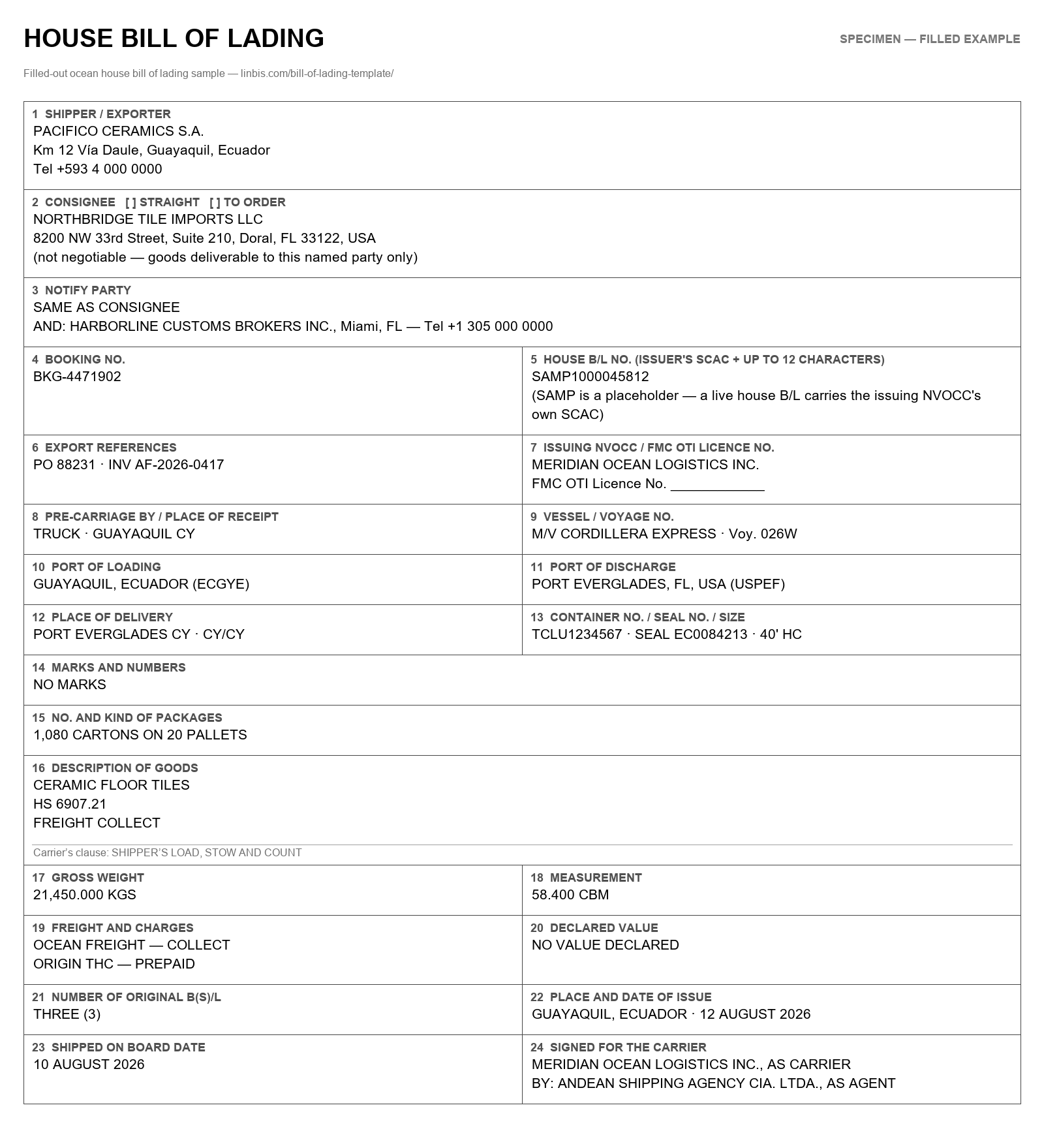
A bill of lading is the carrier's receipt for the cargo, the contract of carriage, and — when it is made out to order — a document of title that must be surrendered before the goods are released. A complete ocean B/L names the shipper, consignee and notify party; identifies the vessel, voyage, port of loading and port of discharge; describes the packages, gross weight and measurement; states whether freight is prepaid or collect; and carries a place and date of issue, an on-board date and the carrier's signature.
On this page The specimen — a filled-out ocean house B/L Box by box: what goes in it, who fills it, what it costs Blank templates — straight, house and master Three documents that look alike: straight, order and sea waybill Master versus house What goes wrong
Below is a filled-out specimen ocean house B/L with every box annotated — what belongs in it, who fills it, what it costs when it is wrong — followed by blank straight, house and master templates in PDF and Word. Nothing here is gated.
The specimen — a filled-out ocean house B/L
Ocean carriers do not share a common box-numbering scheme the way IATA numbers the air waybill. The numbers below are our annotation convention, applied to the field set that appears on essentially every ocean B/L form. Every party, vessel, container, reference and date in the specimen is fictitious.
| 1 · Shipper / Exporter | PACIFICO CERAMICS S.A. Km 12 Vía Daule, Guayaquil, Ecuador Tel +593 4 000 0000 |
||
|---|---|---|---|
| 2 · Consignee | NORTHBRIDGE TILE IMPORTS LLC 8200 NW 33rd Street, Suite 210, Doral, FL 33122, USA (not negotiable — goods deliverable to this named party only) |
||
| 3 · Notify Party | SAME AS CONSIGNEE AND: HARBORLINE CUSTOMS BROKERS INC., Miami, FL — Tel +1 305 000 0000 |
||
| 4 · Booking No. | BKG-4471902 | 5 · Bill of Lading No. | SAMP1000045812 (SAMP is a placeholder — a live house B/L carries the issuing NVOCC's own SCAC) |
| 6 · Export References | PO 88231 · INV AF-2026-0417 | 7 · Forwarding Agent / FMC No. | MERIDIAN OCEAN LOGISTICS INC. FMC OTI Licence No. ____________ |
| 8 · Pre-carriage by / Place of Receipt | TRUCK · GUAYAQUIL CY | 9 · Vessel / Voyage No. | M/V CORDILLERA EXPRESS · Voy. 026W |
| 10 · Port of Loading | GUAYAQUIL, ECUADOR (ECGYE) | 11 · Port of Discharge | PORT EVERGLADES, FL, USA (USPEF) |
| 12 · Place of Delivery | PORT EVERGLADES CY · CY/CY | 13 · Container No. / Seal No. / Size | TCLU1234567 · SEAL EC0084213 · 40' HC |
| 14 · Marks and Numbers | NO MARKS | ||
| 15 · No. and Kind of Packages | 1,080 CARTONS ON 20 PALLETS | ||
| 16 · Description of Goods | CERAMIC FLOOR TILES HS 6907.21 FREIGHT COLLECT Carrier’s clause: SHIPPER'S LOAD, STOW AND COUNT |
||
| 17 · Gross Weight | 21,450.000 KGS | 18 · Measurement | 58.400 CBM |
| 19 · Freight and Charges | OCEAN FREIGHT — COLLECT ORIGIN THC — PREPAID |
20 · Declared Value | NO VALUE DECLARED |
| 21 · Number of Original B(s)/L | THREE (3) | 22 · Place and Date of Issue | GUAYAQUIL, ECUADOR · 12 AUGUST 2026 |
| 23 · Shipped on Board Date | 10 AUGUST 2026 | 24 · Signed for the Carrier | MERIDIAN OCEAN LOGISTICS INC., AS CARRIER BY: ANDEAN SHIPPING AGENCY CIA. LTDA., AS AGENT |
Box by box: what goes in it, who fills it, what it costs
| Box | What goes in it | Who fills it | If it is wrong |
|---|---|---|---|
| 1 · Shipper | Full legal name and address of the party contracting with the carrier — not the factory, unless the factory is the contracting party. | Shipper, via the booking; forwarder transcribes | An AMS shipper name that does not match the ISF seller draws a mismatch and, on a US import, can hold the container at the terminal. |
| 2 · Consignee | Either a named party (straight, non-negotiable) or "TO ORDER" / "TO ORDER OF [bank]" (negotiable). This single box decides the legal character of the document. | Shipper instructs; carrier or NVOCC types it | Naming a consignee when the sale is on a letter of credit destroys the bank's security and the credit will not be paid. |
| 3 · Notify Party | Who the carrier telephones on arrival. On a US import, this is almost always the customs broker as well as the buyer. | Shipper / consignee instruction | A blank or stale notify party means nobody files entry, and free time expires while the box sits. |
| 4 · Booking No. | The carrier's or NVOCC's booking reference the shipment was accepted under. | Carrier / NVOCC | A booking number that does not match the manifest breaks the link between the B/L and the vessel's cargo declaration. |
| 5 · Bill of Lading No. | The unique document number. For US vessel manifest filing the number is built from the issuer's SCAC as the first four characters, followed by up to twelve more alphanumeric characters. | Issuing carrier or NVOCC | A number that is not SCAC-prefixed and unique will not transmit to CBP, and a duplicate number across two shipments causes an in-bond or entry to be filed against the wrong cargo. |
| 6 · Export References | Purchase order, commercial invoice number, letter-of-credit number, internal file number. | Shipper | Not fatal to the carriage, but a missing PO number is the single most common reason an accounts-payable department will not pay the freight invoice. |
| 7 · Forwarding Agent / FMC No. | The forwarder or NVOCC and, for a US-regulated intermediary, its Federal Maritime Commission ocean transportation intermediary licence number. | Forwarder | Acting as an NVOCC on a US trade without a licence and a published tariff is an FMC compliance exposure, not a paperwork slip. |
| 8 · Pre-carriage / Place of Receipt | The inland leg and the point where the carrier took custody — the point at which carrier liability begins. | Forwarder / carrier | Leaving it blank on a door move pushes the liability start point to the terminal gate and leaves the inland leg uncovered. |
| 9 · Vessel / Voyage No. | The vessel actually loaded and its voyage number, not the vessel booked. | Carrier, after loading | A stale vessel name is the classic letter-of-credit discrepancy; banks check it against the on-board notation. |
| 10 · Port of Loading | The port where the goods went on board. Use the UN/LOCODE alongside the name. | Carrier | If it differs from the port named in the credit, the bank requires an on-board notation restating the credit's port of loading, the vessel and the shipment date. |
| 11 · Port of Discharge | Where the cargo comes off the vessel — the customs port of unlading, which is not always the delivery city. | Carrier | Filing entry at the wrong port means the entry is rejected and free time keeps running. |
| 12 · Place of Delivery | The final contractual delivery point and the service mode: CY/CY, CY/Door, CFS/CFS. | Forwarder | A CY/Door B/L billed as CY/CY is how forwarders lose the drayage margin on a whole contract. |
| 13 · Container / Seal / Size | Container number with its check digit, the seal number affixed at stuffing, and the equipment type. | Shipper at stuffing; forwarder verifies | A seal number that does not match the one on the box at destination is a discrepancy the carrier and CBP will both record, and it can trigger an examination. |
| 14 · Marks and Numbers | The shipping marks stencilled on the packages, or "NO MARKS". | Shipper | Marks that disagree with the packing list are a documentary-credit discrepancy. |
| 15 · No. and Kind of Packages | The outer package count and type — cartons, pallets, drums, bundles. Not the number of pieces inside. | Shipper | Under US COGSA the carrier's default liability is capped per package, so how the count is stated is a direct financial term, not a description. |
| 16 · Description of Goods | A plain commercial description sufficient for customs, plus the HS heading. "SHIPPER'S LOAD, STOW AND COUNT" is a liability-qualifying carrier’s clause: put it on its own line alongside the description, never in place of one. Do not write "SAID TO CONTAIN" into the description field — 19 CFR 4.7a lists "STC" alongside "FAK" and "general cargo" as unacceptable manifest descriptions. | Shipper | A vague description ("GENERAL CARGO", "FAK", "STC") is not an acceptable cargo description under 19 CFR 4.7a and draws a rejection under the 24-hour rule; the container will not be loaded. |
| 17 · Gross Weight | The gross weight of the cargo including packing. For the container itself the shipper must separately verify and submit a verified gross mass before it can be loaded. | Shipper | No verified gross mass, no loading — the container is rolled and the shipper carries the cost. |
| 18 · Measurement | Volume in cubic metres, to three decimals. LCL freight is normally rated on the greater of weight or measurement. | Shipper / forwarder | Understated CBM on an LCL booking produces a corrected invoice from the co-loader and a margin hole on the file. |
| 19 · Freight and Charges | Which charges are prepaid and which are collect, line by line. "Prepay and add" belongs here explicitly. | Forwarder, from the quotation | A "freight prepaid" B/L released before the shipper has paid is an unsecured loan to the shipper. |
| 20 · Declared Value | Normally left as "NO VALUE DECLARED". Declaring a value raises the carrier's liability ceiling above the statutory package limitation, at an ad valorem freight cost. | Shipper, with a decision | Leaving it blank on high-value cargo means recovery is capped at the package limitation, however large the loss. |
| 21 · Number of Original B(s)/L | How many originals were issued — conventionally three, stated in words and figures. On a negotiable bill each original is a document against which delivery can be demanded. Straight bills are routinely issued in a set of three as well; the set is simply not negotiable. | Issuing carrier / NVOCC | Once one original is surrendered against delivery, the rest are void. An uncontrolled fourth original is a fraud vector. |
| 22 · Place and Date of Issue | Where and when the document was issued. This is not the shipment date. | Issuing carrier / NVOCC | Banks read the on-board date, not this one. Confusing the two is a routine cause of a late-shipment discrepancy. |
| 23 · Shipped on Board Date | The date the goods physically went on board the named vessel, either pre-printed or as a dated on-board notation. | Carrier, after loading | Missing or undated, the document is a "received for shipment" B/L. Under a credit calling for an on-board B/L, it will be refused. |
| 24 · Signature | Signed by the carrier or by a named agent expressly signing "as agent for the carrier". | Carrier or its agent | An agent who signs without stating the capacity risks being held as the contracting carrier. |
Blank templates — straight, house and master
- Straight (non-negotiable) bill of lading — PDF, fillable · Word
- House bill of lading (NVOCC) — PDF, fillable · Word
- Master bill of lading — PDF, fillable · Word
No sign-up, no email. These are blank forms for drafting and training. A B/L that will actually move cargo must be issued on the contracting carrier's or NVOCC's own form, under its own terms and — for a US-regulated intermediary — its published tariff.
Three documents that look alike: straight, order and sea waybill
The consignee box decides which one you are holding.
| Straight B/L (non-negotiable) | Order B/L (negotiable) | Sea waybill | |
|---|---|---|---|
| Consignee box reads | A named party | "TO ORDER" or "TO ORDER OF [bank]" | A named party |
| Document of title | Yes — but non-negotiable | Yes | No |
| Transferable by endorsement | No — endorsement gives the transferee no additional rights | Yes, by endorsement and delivery | No |
| Original needed to collect the cargo | Carrier practice varies; the named consignee is the only party entitled to delivery | Yes — one endorsed original, surrendered | No — consignee identifies itself |
| Use it when | The buyer has paid, or is a related party, but you still want a bill of lading rather than a waybill | Payment is by letter of credit or documentary collection, or the cargo may be sold in transit | Trusted counterparty, prepaid or open account, and you want release without couriering paper |
The wording matters and it is regularly got wrong. A straight bill is a non-negotiable document of title, not a non-document-of-title: the Uniform Commercial Code defines “document of title” to include a bill of lading without qualifying it by negotiability, and then provides that a document of title which is not negotiable is nonnegotiable. What the federal statute requires on the face of a straight bill is the words “nonnegotiable” or “not negotiable” — nothing more. Do not print “not a document of title” on one.
One scoping point US operators get wrong: the federal statute governing straight and order bills applies to bills issued for carriage between US places or from a US place to a foreign country. A bill issued in Guayaquil for an import into Florida is not covered by it; the carrier's own terms and its chosen law govern instead.
Master versus house
On a consolidation there are two B/Ls covering the same physical box. The vessel-operating carrier issues the master to the NVOCC, which is the shipper in that relationship. The NVOCC issues a house B/L to each underlying shipper on its own form. One master, many houses.
The consequences are practical. The master moves the container; the house moves the commercial relationship, and it is the house B/L number that carries the security filing data at the lowest bill of lading level. The master usually shows the NVOCC as shipper and its destination agent as consignee — never the ultimate buyer. If the buyer's name appears on the master, the NVOCC has just disclosed its client to the ocean carrier. The same master-and-house logic runs through air freight, where the equivalent pair is the house and master air waybill.
What goes wrong
- The consignee box was filled from the last file. A named consignee on a letter-of-credit shipment cannot be fixed after the vessel sails without the carrier's amendment and, usually, a fee.
- The on-board date was taken from the issue date. They differ whenever the document is typed after loading, which is most of the time.
- "Freight prepaid" was printed before the funds arrived. Once the original is out, the leverage is gone.
- No verified gross mass, or a weight that disagrees with it. SOLAS VI/2 makes the VGM a condition of loading: without one the box does not load. A disagreement between the B/L weight, the VGM and the packing list will at minimum draw a query from the line, and outside the carrier’s tolerance it will roll the container.
- Originals went out by courier and the vessel arrived first. On a short trade lane a three-day transit beats a courier, and the cargo sits accruing charges — the reason demurrage and detention exposure is a documentation problem before it is a terminal problem.
- The description was "GENERAL CARGO". 19 CFR 4.7a names it, with "FAK" and "STC", as an unacceptable manifest description. It will not clear the 24-hour rule.
- An agent signed without stating capacity. Write "as agent for the carrier" every time.
How software handles it
Filling a B/L from a template is transcription, and transcription is where the errors come from. The same shipper, consignee, container, weight, measurement and freight terms are keyed into the booking, the B/L, the manifest transmission and the invoice — each retype a chance to diverge.
A freight system holds those values once, on the shipment, and renders the house and master B/L from them, so a change in one place is a change everywhere. Linbis generates ocean bills of lading as part of ocean export documentation, alongside the shipment, container and charge records; for the concept rather than the form, start with what a bill of lading is.
Frequently asked questions
What is the difference between a straight and an order bill of lading?
A straight bill names the consignee and is non-negotiable: endorsing it transfers no additional rights, and only the named party is entitled to the goods. An order bill is consigned "to order" or "to order of" a bank, is negotiable, and transfers title by endorsement and delivery. Use a straight bill when the buyer has already paid; use an order bill when a bank or the possibility of sale in transit requires control over the cargo.
Can I use a Word or PDF bill of lading template for a real ocean export?
Use one for drafting, quoting, training and internal review. Do not use a generic form to actually contract carriage. The B/L is the contract, and the terms that govern it are the issuing carrier's or NVOCC's own terms printed on or incorporated by reference into its form. A blank template carries no terms at all.
Who signs the bill of lading — the shipper or the carrier?
The carrier, or a named agent signing expressly for the carrier. The shipper's signature does not appear on an ocean B/L as the issuing signature; the shipper's declarations are the content of the boxes it supplied, which is why "shipper's load, stow and count" exists.
What is the difference between a house and a master bill of lading?
The master is issued by the vessel-operating carrier to the NVOCC. The house is issued by the NVOCC to the underlying shipper. One consolidated container carries one master and as many houses as there are shipments inside it, and the house number is the level at which the shipment is identified for security filing.
How many original bills of lading are issued?
Conventionally three, stated on the face of the document in words and figures. They exist so that the carrier, the shipper and the consignee can each hold one. Once one original has been surrendered against delivery, the remaining originals are void. Issuing more than the set stated on the face, or issuing a replacement without a letter of indemnity, is how B/L fraud starts.
We already fill our B/Ls in Word. Why change?
Because the Word file is downstream of nothing. The vessel changes, the on-board date changes, a container is swapped, and the document that goes to the bank is whichever copy someone remembered to open. The cost of a template is not the template — it is the correction fee, the amended manifest and the discrepancy on the credit. If your volume is low enough that this never happens, keep the template; it is on this page, free. If it happens more than once a quarter, the document should be generated from the shipment record instead. Linbis starts at $150 per month including one user, and the trial does not ask for a card.
Explore the platform
- freight forwarding software
- ocean freight software
- air freight software
- warehouse management for forwarders
- freight quoting
Explore Ocean Export — see how the house and master B/L are produced from the shipment record.