
Linbis › Compare › Magaya vs CargoWise vs Linbis
Compare · Multi-branch forwarders
Magaya vs CargoWise vs Linbis for Multi-Branch Forwarders (2026)
Three platforms that get shortlisted together by forwarders and NVOCCs running more than one office. Compared on the things a multi-branch operation actually lives with: one record across offices, consolidation, warehouse, customs filing, the ledger, and who publishes a price.
Short answer. CargoWise is the platform for a group of separate legal entities filing customs in many countries and consolidating books across them — and since December 2025 its cost is usage-based and unpublished. Magaya positions itself on forwarding plus warehouse with a long US–Latin America presence; pricing is not published. Linbis is for the forwarder, NVOCC or 3PL — one office or several, one user or many — that wants every office on one record, consolidation engineered at scale, a warehouse module with offline scanning and snapshot billing, ISF and AMS filed to CBP from the file, a double-entry ledger with a QuickBooks sync that runs both ways for payments, seven interface languages, and the price on the website before the demo: $150 a month including one user, $299 including three, free trial without a card.
If your branches are separate legal entities that need consolidated multi-entity books and customs entries filed in several countries, read the CargoWise section first. If they are offices of one company — in one country or several, working in several languages and currencies — read the Linbis one.
The comparison table
Linbis: $150 / month (1 user) · $299 / month (3 users) — published. CargoWise and Magaya: no figure at their public pricing URLs on the date above.
Alphabetical. The price row records what each vendor’s public pricing URL returned. Capability rows for CargoWise and Magaya are kept to their public positioning; we have not operated either product, and we say so. The Linbis column describes the shipped platform.
| CargoWise (WiseTech Global) | Linbis | Magaya | |
|---|---|---|---|
| Built for | Global networks; groups of separate legal entities with dedicated IT | Freight forwarders, NVOCCs, customs brokers and 3PLs — from one user on the Startup plan to multi-office operations with overseas agents. What scales is the configuration surface, not a consulting contract: 24 shipment workflow flows, per-customer contract pricing, a 79-permission role grid (plus a per-person switch that hides costs, buy rates and margin), a screen designer, a document designer, seven interface languages | Mid-market forwarders that also run a warehouse; strong US–Latin America presence (public positioning) |
| Multi-branch model | Multi-entity, multi-country, multi-currency on one database; the deepest option for cross-border groups | Every office works the same record on one login. A division tag on users, shipments and quotes maps into QuickBooks Departments; record scope and roles decide who in Houston may edit a Miami consolidation, re-derived on every query; each desk gets its morning brief at its own local time; multicurrency runs through the charge line, invoice, bill and ledger. Honest limit: divisions are a reporting tag — no separate per-branch ledger or numbering series | Multi-location operations with warehouse locations tied to forwarding files (public positioning) |
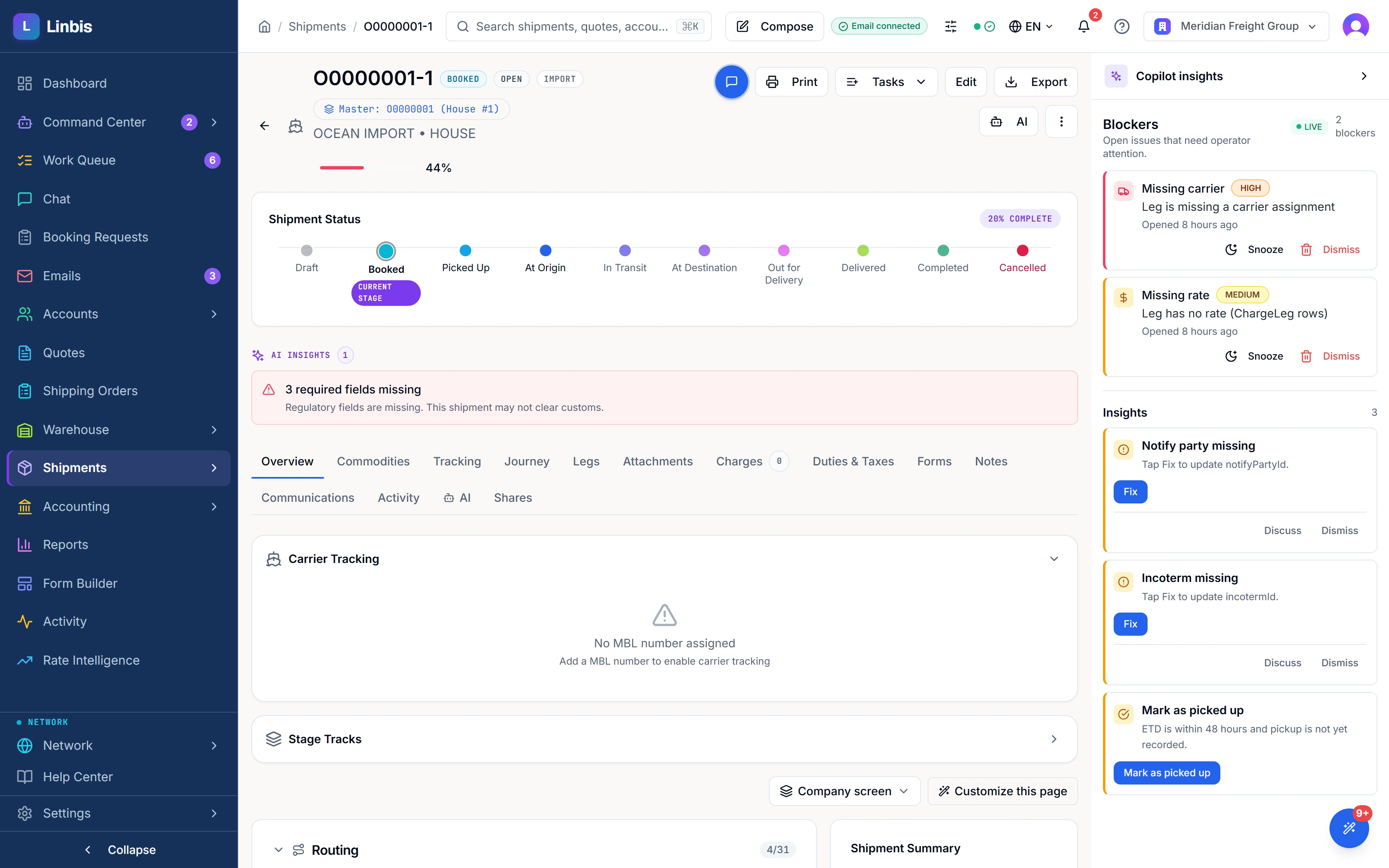
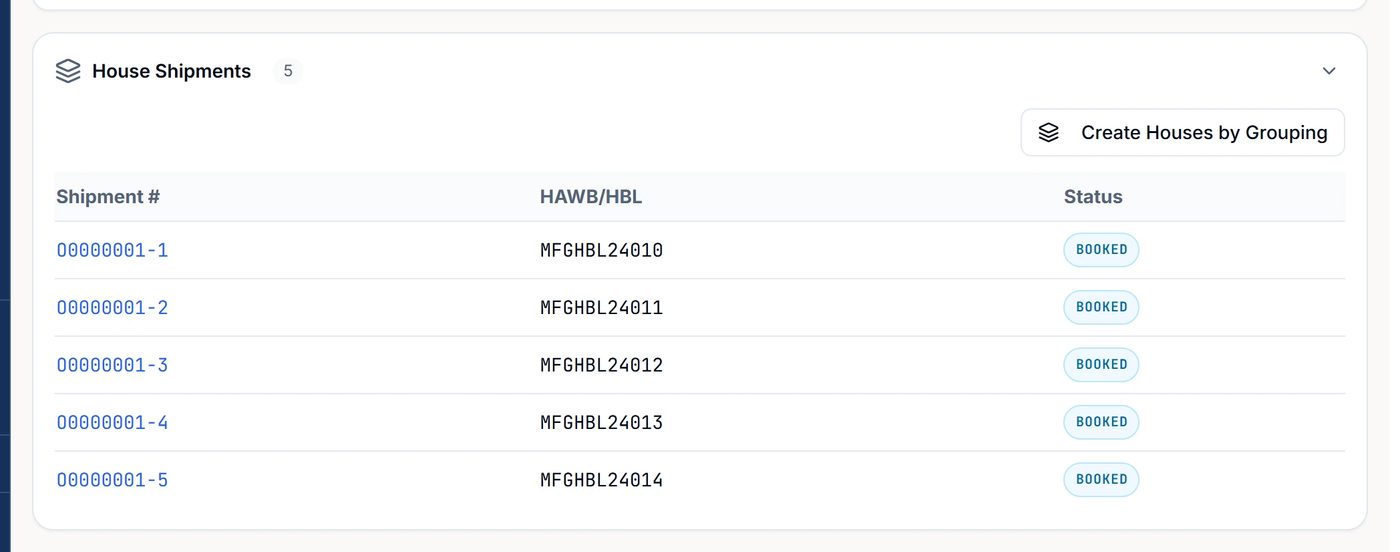
| Consolidation (master / house) | Full consolidation planning tied to cut-offs and execution constraints | Up to 500 shipping orders imported from a spreadsheet become house shipments under one master in one action (batches of 50), each with its own file number, leg plan, copied charges and bill-to; 19 fields propagate master → house; an edit to the master’s carrier, vessel, voyage, flight, ETD or ETA writes onto every house | Forwarding consolidation with warehouse receiving linked to the file (public positioning) |
| Warehouse | WMS module inside the platform | Included on Premium: receipts and releases with proof of delivery, zones and bins, piece/pallet/container nesting, an installable barcode scan app for receive, pick, pack, load and deliver that keeps working when the Wi-Fi drops (scans queue and replay in order, no double counting), manifest import with per-line arrival reconciliation, storage billing that freezes a per-piece snapshot per run, releases that cannot be self-approved — and a Magaya-style warehouse receipt (modelled on Magaya’s receipt, restyled in Linbis’s document design) as the default receipt form, with a WMS layout as the alternative | Warehouse management is the core strength — forwarding and WMS in one system (public positioning) |
| Customs | Broadest multi-jurisdiction coverage of the three | ISF 10+2 prepared from the shipment’s parties and commodities, completeness-scored against the deadline, previewed as the exact X12, and transmitted to CBP — standalone or as an ISF-5 riding the AMS manifest bill; Linbis is a CBP-approved software provider and you file under your own SCAC and bond, with an attestation on every transmission. EEI/AES data validated; denied-party screening against US, EU, UK and UN lists; layered duty and landed cost. Limit: electronic filing is US CBP; entry filing (ABI) is a broker path | US customs compliance tooling (AMS, ISF) positioned for US forwarders (public positioning) |
| Accounting | Multi-entity accounting inside the platform | A double-entry ledger built for forwarding: 91-account freight chart of accounts on day one, AR and AP subledgers, periods that close, per-file P&L, income and expense in different currencies on one charge line, an agent netting statement — and a choice of Linbis GL, QuickBooks only, or both through a QuickBooks Online sync across 13 entity types (payments both ways) | Accounting module inside the suite (public positioning) |
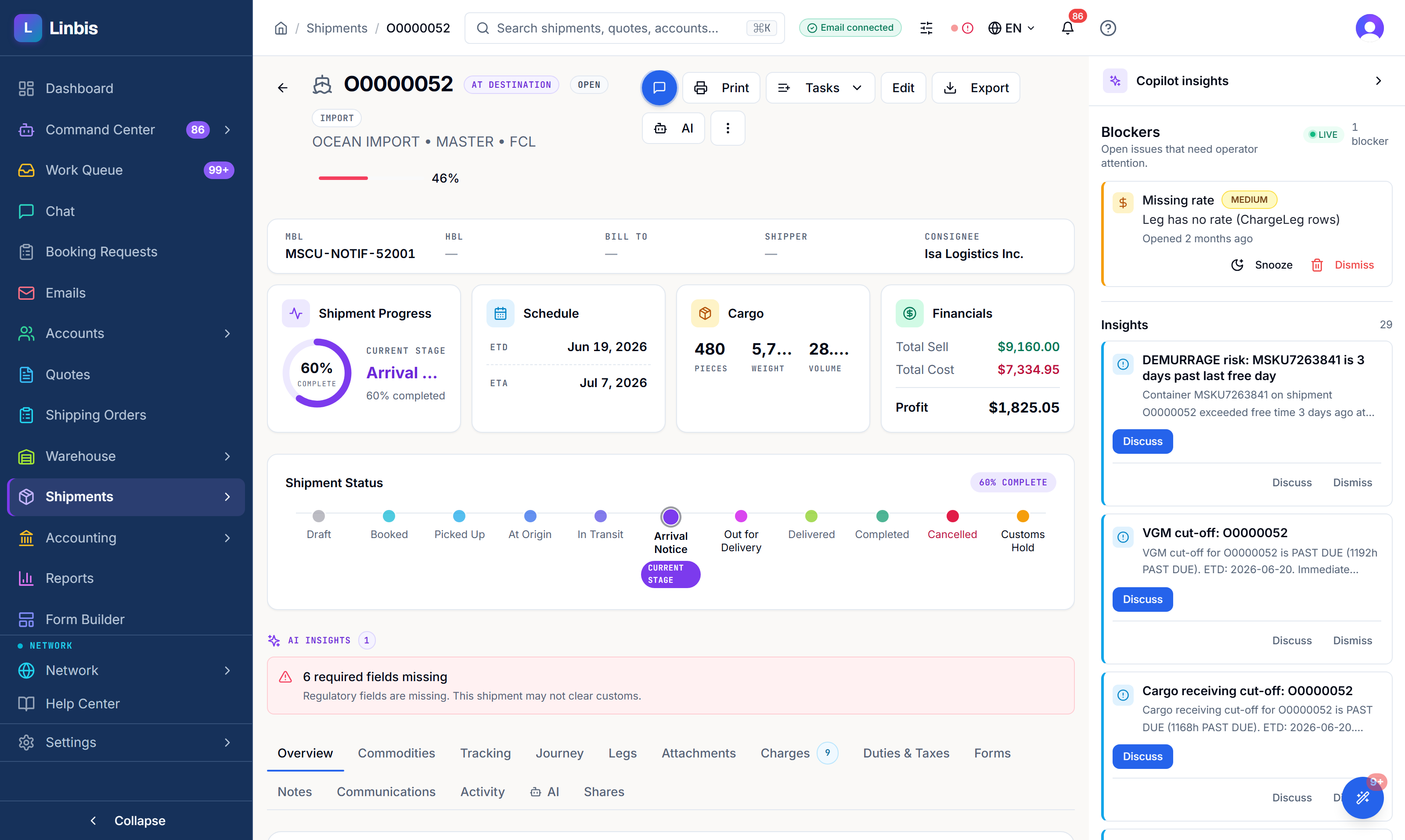
| Tracking | Carrier connectivity across the WiseTech network | Container milestones from Maersk and CMA CGM over DCSA, pulled on request with your own carrier credentials; flights on 50 major cargo and passenger airlines followed by live aircraft position every five minutes once OpenSky Tracking is switched on, with departure and arrival recorded on the file; each container milestone polled on the master is copied onto every house; four cost clocks per container — demurrage, detention, terminal storage, chassis per-diem — each with its own free time and daily rate | Tracking portals for customers (public positioning) |
| Customer visibility | Customer portal (public positioning) | A branded portal with 18 screens — booking and quote requests that land already assigned, document approvals, warehouse inventory, delivery scheduling, a message thread with internal notes structurally invisible — in eight languages, plus no-login tracking links | Customer-facing tracking portals (public positioning) |
| AI | Automation features across the suite; partner-configured | Out of the box the AI proposes and a person approves: 24 email classifications (23 freight types plus unknown) with confidence shown on each, extraction from PDF and image attachments with evidence, one Approve creating the record and firing its workflow, a 90-tool copilot on every screen with audit log and undo. Then you set the rope: four autonomy levels across 35 action categories inside an envelope you define, financial and high-risk actions human-only, and a replay of any policy change against your own history first | Automation features across the suite (public positioning) |
| Published price (public pricing URL) | Not published — cargowise.com/pricing returns 404; usage-based since 1 Dec 2025 |
Published. $150 / month incl. 1 user · $299 / month incl. 3 users · Enterprise by quote. linbis.com/pricing | Not published — magaya.com/pricing returns 404 |
| Getting live | Partner-led implementation; a project measured in months (public positioning) | Free trial, no card. Self-serve sign-up creates a working workspace — a 91-account chart of accounts, more than 90 branded document templates and a permissive workflow from the first login; import wizards with dry-run preview for shipments, shipping orders, accounts and warehouse receipts; on Premium and Enterprise, Linbis runs a phased migration for you if you are moving off the old Linbis Logistics platform | Sales-led implementation (public positioning) |
| Honest weakness | Cost and complexity below enterprise scale; unpublished, volume-linked pricing | Electronic customs filing is US CBP only; divisions are a reporting tag, not separate entity ledgers; ocean milestones refresh on demand from the tracking panel rather than on a schedule; a smaller company with a small, dated public review base | Pricing and onboarding are sales-led; forwarders without a warehouse pay for depth they will not use (public positioning) |
We are not reprinting third-party star ratings here. They change monthly and belong to the sites that collect them — check G2 and Capterra directly and note the review counts and dates.
What “multi-branch” really tests
Every vendor on this page will say it supports multiple branches. The word hides four different questions, and they separate the platforms far better than any feature list.
- Is it one record or several? When Miami books an export and Houston handles the trucking leg, is that one shipment both offices can open, or two files that someone reconciles at month-end? On Linbis it is one record: Miami’s export and Houston’s trucking leg are the same shipment with a division tag, and the file’s legs, containers and charges are on it whichever office opens it. On CargoWise the same is true at enterprise scale, across entities and countries. On Magaya, warehouse locations and forwarding files are linked, which is the right shape if the branches are warehouses.
- Do branches share customers and consolidations? A consolidation built in one office should be visible — and editable, with permissions — in another. Ask to see a master bill created in branch A and a house bill added to it from branch B.
- What does the accounting look like? Per-entity ledgers consolidated, or one ledger with departmental reporting? For a group with separate legal entities, CargoWise’s multi-entity accounting is the reference. For branches inside one legal entity, Linbis runs one double-entry ledger with a 91-account freight chart, per-file P&L on every shipment, and division tags that map to QuickBooks Departments for departmental reporting — simpler to run and to audit.
- What does a new branch cost to open? On a cloud platform, a branch is configuration, not a project. On a per-transaction model, a branch that adds volume adds cost on every shipment. On a flat monthly plan, it adds seats. Get this in writing before you sign, because it is the number that changes when you grow.
Per-branch questions, three vendors
| Question a multi-office forwarder asks | CargoWise | Linbis | Magaya |
|---|---|---|---|
| Can Houston open and edit a Miami consolidation? | Yes, across entities (public positioning) | Yes — one record; who may edit is decided by record scope and role, re-derived on every query | Within a multi-location setup (public positioning) |
| Can we see margin by branch? | Multi-entity reporting | Per-file P&L on every shipment; branch margin through the division tag in QuickBooks Departments | Reporting inside the suite (public positioning) |
| Do branches in other countries work in their own language and currency? | Yes (public positioning) | Seven interface languages; multicurrency on the charge line, invoice, bill and ledger; desks briefed at their own local time | English and Spanish positioning for the Americas (public positioning) |
| Do we need separate legal-entity books? | Yes — its home ground | No — divisions are a tag; a group of separate entities keeps consolidated books elsewhere | Not stated publicly |
| What does the next branch cost? | More transactions on the value pack | More seats on a flat plan; the price is published | Ask sales |
CargoWise
WiseTech Global’s CargoWise is the category’s reference platform and the one large global forwarders standardise on. Its strengths for a multi-branch group are structural: one database across entities, countries and currencies; the broadest customs coverage available; and the fact that many of your agents and large shippers already run it, which smooths data exchange. Its weaknesses for anyone below that scale are the mirror image: implementation is partner-led and measured in months, the learning curve is real, and — since the December 2025 move to usage-based value packs — the bill tracks transactions rather than seats and is not published. For a twelve-country network of separate entities with an IT team, none of that argues for leaving. For a three-office forwarder in one company, all of it does.
Magaya
If you are looking for a Magaya alternative, or weighing Magaya against the other two, its distinguishing public positioning is the pairing of forwarding with warehouse operations in a single system, and a long presence on US–Latin America trade lanes. If your branches include a bonded or general warehouse, it deserves a look. Pricing is not published (the pricing URL returns 404) and implementation is sales-led. Two things to weigh against that: Linbis pairs forwarding and warehouse on the same record too — with offline scanning, manifest reconciliation and snapshot storage billing — and its default warehouse receipt is a Magaya-style form, modelled on Magaya’s receipt and restyled in Linbis’s document design. The full alternatives page is at Magaya alternatives.
Linbis
Linbis runs the whole operation on one record — quote, shipment, master and house consolidation, warehouse, documents, customs filing, invoice, vendor bill and ledger — and publishes the price. For a multi-office team that means every office on one login, division tags that flow into QuickBooks Departments, role-scoped access re-derived on every query, morning briefs in each desk’s own time zone, and multicurrency on the charge line itself. Four things to test on a live file during the free trial: documents rendered from the record (a library of more than 90 templates), with your own layouts built in Forms Studio, a browser designer where you start from one of 22 ready-made templates or a blank page; up to 500 imported shipping orders converted to house shipments under one master in one action, with edits to the master’s carrier, vessel, voyage, flight, ETD or ETA cascading to every house; ISF and AMS filed to CBP from the shipment under your own SCAC and bond; and an AI that proposes by default and does more only inside the envelope you set.
It runs in seven interface languages — English, Spanish, Portuguese, French, German, Italian and Chinese — with the customer portal in eight, from Miami. The honest weaknesses: electronic customs filing is US CBP; divisions are a reporting tag rather than separate ledgers; ocean milestones refresh on demand today; Linbis is a smaller company than the other two, and its public review base is small and dated.
Magaya vs Linbis, head to head
Strip CargoWise out and the comparison narrows to one question: where does the warehouse sit in your business? Magaya’s public positioning is warehouse-first with forwarding attached, and for a bonded operation whose profit centre is storage and handling that is a coherent choice — test it. Linbis puts the warehouse on the shipment’s own record: cargo received against the manifest you imported, matched, short, over or unmatched per line; a scan app that keeps receiving when the Wi-Fi drops; storage billing that freezes a per-piece snapshot so a disputed invoice is reconstructed line by line; and a release that cannot be self-approved. What Linbis does not have today: cycle counting and an inventory-adjustment screen — a 3PL that lives on counts should check that first. On everything outside the warehouse — the double-entry ledger with a QuickBooks choice, ISF and AMS from the file, seven languages, 24 configurable shipment workflow flows, a governed AI — the comparison is between a shipped mechanism and a public positioning statement, and the price is published on one side only.
For an NVOCC specifically
An NVOCC’s software question is narrower than a forwarder’s: consolidation volume, house-bill issuance, container control, AMS and ISF, and — since December 2025 — what a container costs to process in the system. The December repricing hit mid-sized NVOCCs hardest because usage-based pricing scales with the boxes moved. Against that, a flat monthly plan is the alternative shape: on Linbis, a three-person desk on the $299 plan pays the same in a forty-container month as in a four-hundred-container month. Linbis models CFS import as a workflow — stripping, cargo and marks holds, arrival notices — on the same record as the house bills, and files the ISF-5 riding the AMS manifest bill; an NVOCC running its own CFS should test that against Magaya’s warehouse-first positioning on one live consolidation. CargoWise remains the deeper platform for an NVOCC operating in many customs jurisdictions.
Pricing, and the December 2025 change
On 1 December 2025 WiseTech Global moved CargoWise customers onto usage-based value packs; in its own release there are “no longer any CargoWise Cloud standard hosting costs or seat fees”. The full explanation, and why we do not repeat the competitor-sourced rate figures as fact, is in what changed in December 2025 on the CargoWise alternatives page. The simplest way to compare the three: convert every offer into dollars per year for your team at your volume. Linbis publishes the inputs; for CargoWise and Magaya, ask for them in writing early — the willingness to put a number in an email is itself a data point.
Where each one wins
CargoWise wins on breadth of customs jurisdictions, on multi-entity accounting across countries, on the size of its partner ecosystem, and on network effects — the agents and shippers already on it. Magaya’s public positioning is warehouse-first with a long US–Latin America history; Linbis’s default warehouse receipt is a Magaya-style form, modelled on Magaya’s receipt and restyled in Linbis’s document design. Linbis wins when you want one record from quote to ledger with the price published; consolidation at volume; a warehouse with offline scanning and reconstructable storage billing; ISF and AMS filed from the file; seven languages and dual-currency charge lines for overseas agents; and configuration — 24 shipment workflow flows (plus receipt, release, quote, shipping-order and opportunity flows), per-customer pricing, screen and document designers — without a consulting project.
Reporting across branches — the question nobody demos
A demo shows one branch’s dashboard. The number a multi-branch owner needs is the one nobody volunteers: margin by branch, by customer, by lane, this month, without a spreadsheet. Ask each vendor for it on your own data during the trial, and note three things about the answer.
- Where the number comes from. If charges accrue on the shipment record as it moves — the way Linbis handles them, with income and expense on the same line — file margin is live and per-file P&L is on every shipment; branch margin comes through the division tag in QuickBooks Departments. If charges are posted to accounting at month-end, the report is a month old the day it is right.
- Whether a shared shipment is counted twice. When Miami books and Houston delivers, the revenue belongs to one file. Systems that keep two files count it twice or not at all. One record, one count.
- Whether the customer sees the same truth. The status your portal shows the customer should be the status your branches see. On Linbis it is the same record; on any platform, make the vendor prove it rather than say it.
CargoWise’s multi-entity reporting is the deepest of the three for a group of separate legal entities; that depth is part of what its implementation buys. For branches inside one entity, a single ledger with departmental reporting — the Linbis shape — is simpler to run and to audit.
What switching actually involves
Whichever way you move, the migration is the part vendors under-describe, and on a multi-branch team it is the part that decides whether the change takes a month or a year.
- Open files by branch. Each office has shipments in flight. The safe sequence is one live shipment per branch on the new system beside the old one, then a lane, then a desk — never a single cutover date for every office at once. A vendor that only offers a full cutover is asking you to carry the risk.
- Master data once, not per branch. Customers, vendors, agents and rates should be imported once and shared. Linbis ships import wizards — column mapping, party and port resolution, a dry-run preview with duplicates flagged that writes nothing until you confirm — for shipments, shipping orders, accounts and warehouse receipts, and on Premium and Enterprise runs a phased migration for you if you are moving off the old Linbis Logistics platform; make every vendor demonstrate the same on a file of your own data before you sign.
- Documents that carry your brand. House bill, arrival notice and invoice formats are what your customers recognise. Find out whether they are templates to rebuild per branch or live views of the record configured once — and whether you can edit them yourself in a browser designer.
- Permissions across branches. Who in Houston may edit a Miami consolidation? Decide it before the import, because the answer is a configuration on one platform and a customisation project on another.
- The price in an email. Plan, seats or transactions included, and what a new branch adds. If the vendor cannot write the number down, you have learned something about the next three years.
Questions forwarders ask
CargoWise vs GoFreight vs Magaya for multi-branch operations — where does GoFreight fit?
GoFreight is a credible modern platform for US-based forwarders and NVOCCs with several domestic branches, with accounting in the product. Its pricing page carries no figures, so the number arrives through sales. It sits between Magaya and Linbis in this comparison: more interface polish than Magaya, less published pricing than Linbis. The head-to-head is at GoFreight vs Linbis.
Which is best for a forwarder with a warehouse in one branch and sales desks in two others?
Test both on one live receipt. Linbis includes the warehouse on Premium — receipts, releases, offline barcode scanning, manifest reconciliation and storage billing that freezes a per-piece snapshot per run — on the same record as the shipments. What it does not have today: cycle counting and an inventory-adjustment screen; a bonded 3PL that lives on counts should check that first.
Can Linbis handle multiple branches in different countries?
Yes: seven interface languages, multicurrency through the charge line, invoice, bill and ledger, overseas-agent accounting (agent bill-to, netting statement, commission tiers), and desks briefed in their own time zones. The honest limits: electronic customs filing is US CBP, and divisions are a tag rather than separate legal-entity ledgers.
Does switching mean re-keying our open shipments?
It should not. Linbis ships import wizards with a dry-run preview for shipments, shipping orders, accounts and warehouse receipts, and runs a phased migration on Premium and Enterprise for customers moving off the old Linbis Logistics platform. Make every vendor prove the same on your data before you sign.
Is Magaya cheaper than CargoWise?
Neither publishes a price, so nobody outside your two quotes can say. What can be said is structural: since December 2025 CargoWise’s cost is volume-linked; Magaya’s is quote-based; Linbis’s is a flat monthly plan published on its site.
See the price before the demo.
Plans are published. The trial is free and does not ask for a card. Start with one live shipment beside your current system.
- WiseTech Global, “WiseTech Global launches CargoWise Value Packs”, 1 December 2025.
- Vendor pricing URLs requested 5 September 2026: cargowise.com/pricing (404), magaya.com/pricing (404), linbis.com/pricing (200, figures published).
- Linbis plan figures and plan inclusions from linbis.com/pricing on the same date; Linbis capability counts from the Linbis product inventory of the shipped platform (August 2026).
- Got a vendor wrong? Write to Linbis with the correction and we will fix it and note the date.