
Linbis › Blog › AI logistics assistant
Guide · AI logistics assistant
AI Logistics Assistant: The Smart Way to Scale Operations
An AI logistics assistant is an intelligent virtual tool that automates communication, shipment tracking, quoting, documentation, and decision support across logistics operations. These assistants use natural language processing (NLP), predictive algorithms, and logistics APIs to interact with customers, carriers, and teams.
Read the transcript — “AI You Can Govern” (0:59)
0:03 Letting software act on your freight shouldn’t come down to one switch.
0:07 In Linbis, it’s a dial.
0:09 It ships at level zero — observe only. Nothing moves until you decide it should.
0:14 Four levels, set separately for thirty-five kinds of action
0:18 trusted with one kind of work, still asking about the next.
0:22 Some things never leave human hands.
0:24 High-risk actions need a person at every level,
0:27 and sanctions approval can’t be switched off at all.
0:31 Before you give it more rope, replay it against your own history —
0:35 your team’s real decisions — and see, category by category, how often it would have agreed.
0:41 And it can’t grade its own homework.
0:44 That’s AI you can govern —
0:46 Linbis, freight forwarding software for forwarders, NVOCCs, customs brokers and 3PLs.
0:52 Start free at linbis.com.
Short answer. An AI logistics operations assistant takes routine reading, re-keying and chasing off a logistics team: it sorts inbound email and documents, answers status questions from live records, drafts quotes, replies and bookings, and flags exceptions. Some talk to customers (website chatbots, voice agents); others work inside the team’s operating platform. It is also sold as a freight AI assistant, an AI shipping assistant or an AI copilot.
The useful ones work inside your system of record and let you decide, task by task, what they may do without asking.
Core Functions of an AI Logistics Assistant
On a forwarding desk, as with AI assistants for supply chain operations generally, every function raises the same question: who decides?
| Function | What It Does | Who should decide |
|---|---|---|
| Email triage | Reads each incoming email and attachment, sorts it by type with a confidence score, and lifts the fields out of the PDF | Nobody: sorting is low risk |
| Shipment updates | Drafts tracking, ETA, and milestone notifications from the record | You, per stage: a draft for approval, or sent automatically at the stages you choose |
| Quote generation | Drafts a quote based on cargo, mode, and lane, ready to price from your own rates or a carrier’s reply | A person sends it |
| Customer support | Answers FAQs, service status, and document requests from live records, so your customer service team replies faster | A person sends the reply, unless you turn on automatic replies |
| Scheduling assistant | Drafts the pickup or delivery booking and the trucker’s instructions | A person confirms |
| Document automation | Autofills B/L, packing lists, invoices, and customs docs from the shipment record | A person prints or sends them, or a stage email you set to send automatically |
| Internal help desk | Supports staff with shipment data and workflow steps, citing the record it read | Nobody: it only reads |
| Exception watch | Flags free time running out, cut-offs, duplicate MBL or MAWB numbers and overdue invoices | Your team, from the alert; the assistant only raises it |
How Much Should an AI Logistics Assistant Do on Its Own?
Every row above has two settings: whether the assistant does the task, and whether it asks first. Set the second by risk. Sorting email alone is useful on day one; approving bills alone is a liability until your own files show it gets them right.
| Kind of action | Examples | Risk | What we recommend |
|---|---|---|---|
| Read and sort | Classify an email, extract shipment data, send a routine status notification | Low | Runs on its own once you trust it |
| Prepare operational work | Create charges from a rate, book a carrier on a standard lane, build a consolidation | Medium | Suggests and waits; later, acts and tells you |
| Commit money or the law | Send a customer invoice, prepare a customs filing, create a shipment from an email, record a payment | High | Proposes; a person approves |
| Compliance | Sanctions screening, a credit release, a dangerous-goods declaration | Critical | A person approves, always |
The examples and their risk bands are Linbis’s defaults. The last column is our advice for any product; ask each vendor where it draws the lines. In Linbis today, medium-risk actions by the background agents wait for approval at every level, apart from the few routine updates noted below.
A sensible order for any product: let it read and sort first; have it propose the medium-risk work and watch how often your team accepts a proposal unchanged; raise one kind of action at a time; and keep anything that commits money or the law behind a person until your own records say otherwise.
In Linbis: a dial, not a switch
Four levels, from L0 Observe Only to L3 Bounded ODD Autonomy, set separately for each of 35 kinds of action under a company-wide cap.
- It ships at L0, with the background agents off. With no autonomy policy saved, everything it proposes is blocked or waits for a person, and automatic approval, replies and stage emails start switched off. Once an admin turns the background agents on, a few routine updates they make (shipment status and carrier references, tracking, operator assignment, generated documents) apply without approval, even at L0.
- Risk bands limit the dial. The default bands are 11 low, 10 medium, 10 high and 4 critical; under the level-by-risk rules, high- and critical-risk kinds stop at suggest-and-approve at every level.
- Actions that start from an email pass a separate gate, where the level you grant decides, not the band; anything that writes money also needs a known amount within a value cap you set (5,000 until you change it). Grant vendor bills L2, the company cap permitting, and a bill that matches its shipment and fits the cap is entered and approved without a click unless the lines that exceed a cost already on the file come to more than 5% over; a line with no matching cost on the file is not checked. Those bills, and bills that match no shipment, wait for a person. A booking never qualifies: it arrives without a price. Cancellations, customs holds, replies it reads as a counter-offer and sanctions hits always go to a person.
The page on Linbis’s AI logistics software describes the settings, including why its own runs cannot raise its trust score.
Worked Example: AI Assistant in Action on a Booking Email
One booking email, traced through Linbis, which we make. Steps 1 to 4 can be checked in a trial with your own mail.
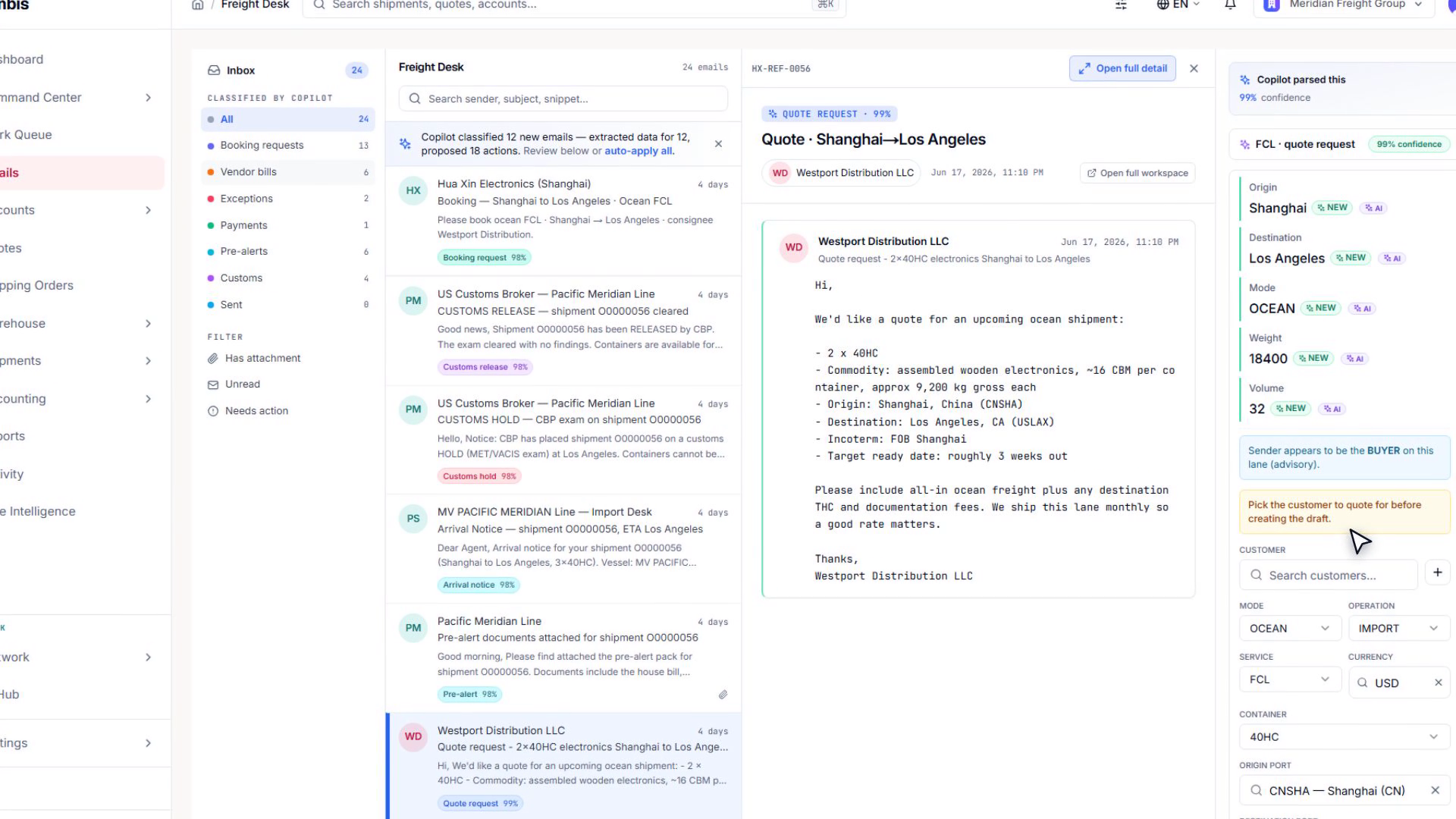
- The email arrives. A shipper asks for an ocean FCL booking, Shanghai to Los Angeles (top of the list in the first screen below). Linbis sorts it into one of 24 email classifications (23 freight types plus an UNKNOWN bucket it never processes automatically), and every result carries a confidence score you can see: anything UNKNOWN or under 60% goes to a person’s triage queue instead of a workflow. With email role routing switched on, each type must also clear its own bar before it is routed: 0.85 for a booking request, 0.98 for a vendor bill.
- The fields are lifted. Ports, parties, Incoterm and declared value come out of the email and any attached PDF, each marked with its source, and a counter shows which required fields are still missing.
- It proposes; it does not create. The proposal waits in the Freight Desk, and no autonomy level changes that for a booking: the email gate will not let an action that writes money run before its amount is known, and a booking has no price yet.
- One click makes the file. Approve creates the shipment and starts the same workflow a manual create starts, so your configured automations fire as if someone had keyed it in.
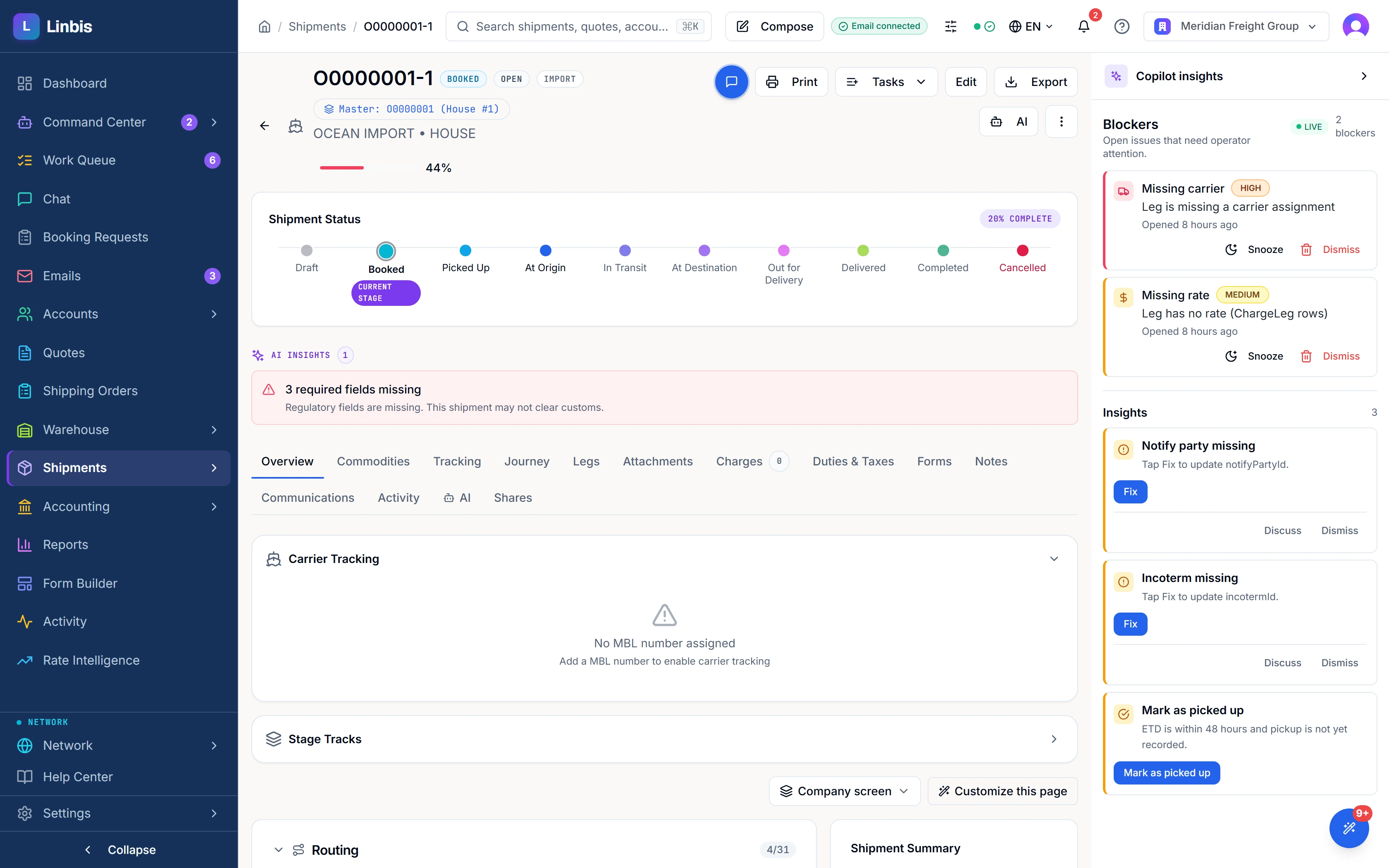
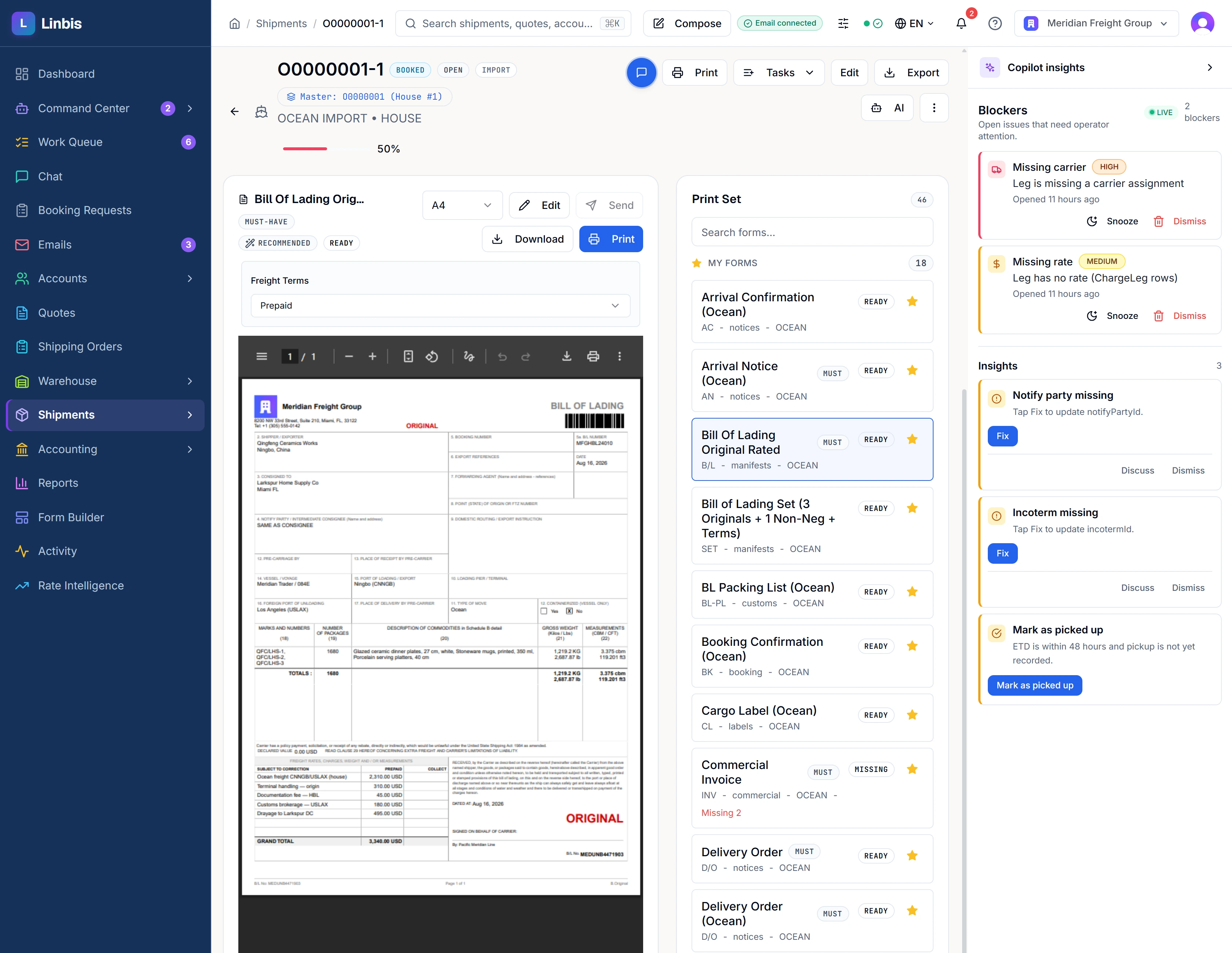
- Then it can watch. Once background checks are turned on for your company, they look for cut-offs, demurrage and detention, missing documents and duplicate MBL or MAWB numbers; and documents render from the record, so a corrected weight corrects every form printed after the fix.
We quote no accuracy, speed or conversion figure.
Benefits of Using an AI Logistics Assistant
Each benefit is real, and each has a condition.
| Benefit | Impact on Operations | True only if |
|---|---|---|
| Time savings | Reduces manual input and response times | It writes into your system of record, not beside it |
| Consistent service | Standardizes replies and processes on every shift | Its answers come from your records, with the source shown |
| Fewer missed deadlines | Free time and cut-offs surface before they cost money | Every alert has an owner |
| Reduced costs | Fewer touches per shipment, so the same team handles more files | You measure it on your own files |
| Data-driven actions | Every proposal and decision is logged | It records what your people decided, not only what it did |
Tools That Offer AI Logistics Assistants: Which Kind Do You Need?
“Assistant” covers six different products, and AI logistics platforms can offer several at once. We describe kinds, not product names, which change faster than this page.
| Kind | What it handles | Who it talks to | What to ask |
|---|---|---|---|
| Website chatbot | Tracking lookups and FAQs on your site | Your customers | What it may promise, and how it hands over to a person |
| Copilot in your operating platform | Questions, drafts and record changes | Your staff | Does every change wait for approval, and can it be undone? |
| Inbox assistant | Sorting mail, reading attachments, drafting replies | Your staff | Does it create the record, or leave you to re-key it? |
| Background agents | Watching files, preparing work, raising exceptions | Your staff, through alerts | What may each one do without asking? |
| AI voice agent (voice assistant) | Phone calls: status questions, check calls | Callers | How it is priced (often per minute), and what happens off-script |
| Answering service or virtual assistant | Calls, email and admin handled by people | Callers and your team | How do they reach your data? |
How to choose. Start from where the work arrives. If most of it is phone calls, a voice agent or an answering service takes the load. If it is email, attachments and re-keying, an inbox assistant or a copilot that writes into your system of record saves the most time. If files slip because nobody is watching them, background agents matter most. If you need more than one kind, ask how they hand work to each other.
Linbis is the second, third and fourth kind. It does not answer phone calls, and it is not an answering service.
How to Evaluate an AI Logistics Assistant
Ask every vendor the same questions, in writing. The answers are ours, checked against Linbis’s code on the date above.
| Question | Our answer |
|---|---|
| 1. Does it write into your system of record? | Yes. Approving a booking request creates the shipment; quote requests and vendor bills become draft quotes and AP bills on the file |
| 2. What does it do on day one? | It reads, sorts and flags. It starts at L0 with the background agents off, so nothing it proposes runs without a person until an admin changes a setting |
| 3. What can never run unattended? | Sanctions hits, since sanctions approval cannot be switched off; and cancellations, customs holds and replies it reads as a counter-offer, when they arrive by email |
| 4. Where do its answers come from? | @Linbis in team chat prints the facts its tools read, cites the rows, and drops any summary sentence with a number the tools did not return |
| 5. Will it email customers on its own? | Only if an admin turns it on: automatic replies and automatic stage emails are off by default |
| 6. Can a mistake be undone? | Copilot edits to a shipment’s fields can be undone for five minutes, unless someone has changed them since; other approved actions are reversed by hand. Every approval is logged |
What’s Next for AI Logistics Assistants?
Where the category is heading, and where Linbis stands, so nothing here reads as a promise.
- Conversational AI across platforms (chat, email, WhatsApp, voice). AI voice agents already take logistics calls as a separate product. In Linbis, voice notes in team chat are stored but not transcribed; WhatsApp carries your team’s alerts and, once you connect a verified WhatsApp Business account, customer messages that land on the file for a person to answer; and no AI answers the phone.
- Smart task routing to departments or carriers. Linbis email rules already assign, tag, notify, create tasks and file mail into team folders.
- Autonomy granted task by task on the evidence, and taken back when the evidence turns.
AI logistics assistants will act more on your behalf. Ask of each one who decided how much.
Where Linbis Fits, and What It Does Not Do
Linbis is freight forwarding software for forwarders, NVOCCs, customs brokers and 3PLs, with quoting, shipments, warehouse, customs, documents and accounting on one record. Its AI is the copilot, inbox and background-agent kind: a Copilot on every screen with 90 tools whose edits to your shipments, charges, quotes and accounts wait for your approval, 24 email classifications, and 18 kinds of background check. More on the Linbis AI page.
What it does not do.
- It does not answer phone calls or work as an answering service.
- The AI does not chat with your customers. @Linbis refuses to answer in any conversation that includes someone outside your company; customers use the portal or no-login tracking links.
- It does not transcribe voice notes, and it syncs one mail folder per connected mailbox.
- It prices quotes from the rates you hold, not from a spot market.
Conclusion: Choosing an AI Logistics Assistant for Freight Operations
An AI logistics assistant is worth having when it takes the reading, re-keying and chasing off your logistics operations team and leaves the decisions with them until you choose otherwise. That is what scaling operations should mean. Judge any product on three questions: does it work inside your system of record, can you set what it may do task by task, and can you see how its proposals fared with your own team before you let it act? Then try it on your own mail.
AI Logistics Assistant FAQ
What is an AI logistics operations assistant?
An AI tool that works alongside a logistics operations team: it reads incoming email and documents, answers questions from shipment records, drafts the follow-up work and watches files for exceptions, ideally inside your system of record.
What is the difference between a general AI assistant and a freight AI assistant?
A freight AI assistant also knows the documents and the record: a booking request from an arrival notice, an MBL from an HBL, free time from a cut-off. It reads your live shipments rather than the internet, within your team’s permissions.
Can an AI logistics assistant answer phone calls?
Some can. AI voice assistants for logistics and AI-assisted answering services take status calls and hand over to a person, often priced by the minute. Linbis does not answer phone calls.
Can an AI logistics assistant give 24/7 customer support?
Website chatbots, AI voice agents and answering services can take customer questions around the clock and hand over to a person. An assistant inside your operating platform works for your team instead: in Linbis it drafts the replies, and automatic replies stay off unless an admin turns them on.
What does an AI logistics assistant cost?
It follows the kind: voice agents often bill by the minute, operating platforms by plan or seat. Linbis publishes its plans: $150 a month including one user, $299 including three.
Try an AI logistics assistant on your own mail. The trial is free and does not ask for a card.