
Bill of Lading Sample: How to Fill Out Every Box
A filled bill of lading, box by box — what goes in each one, in the order you would fill them in. Every box called out on a real print, the handful that decide who collects the cargo marked out from the ones that are only routing detail, and a three-and-a-half-minute walkthrough of the same sheet.
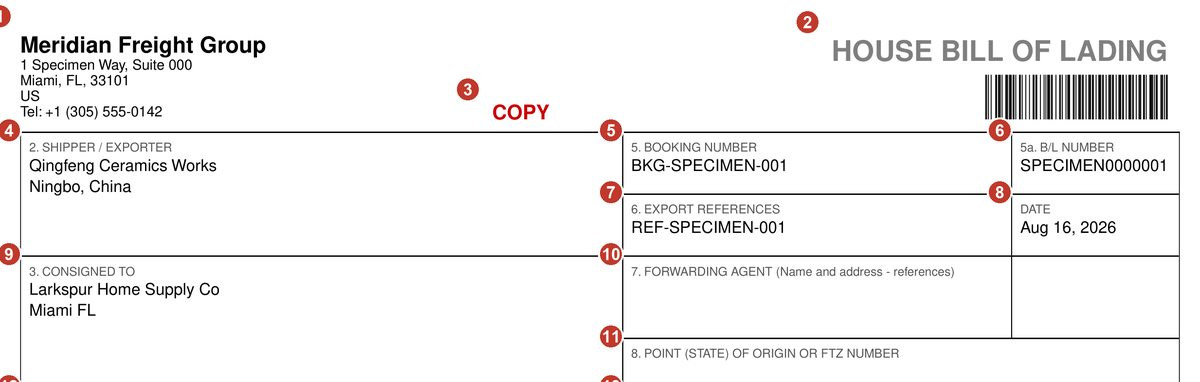
A bill of lading is a single sheet of boxes. The top holds the parties — who is shipping, who is receiving, who to notify, and the forwarding agent. The middle holds the routing — pre-carriage, place of receipt, vessel and voyage, port of loading, port of discharge, place of delivery. The bottom holds the cargo — marks and numbers, number of packages, description of goods, gross weight, measurement — and then the charges block, and the place, date and signature of issue. It does three jobs at once: it is the carrier’s receipt for the goods, it is evidence of the contract of carriage, and when the consignee box is made out to order it is the document the parties use to control delivery at the other end. Below is a filled one, box by box.
Read the transcript — “Bill of Lading Sample: How to Read Every Box” (3:31)
0:00 A filled bill of lading, box by box. A real print from an ocean bill-of-lading template. Invented parties, nothing retouched.
0:12 Three bands: parties, routing, cargo. The form prints its own box numbers. They skip 1 and use 12 twice. The red callouts are ours.
0:22 The title tells you which document you hold. HOUSE BILL OF LADING, or BILL OF LADING for the master. COPY says this print is a record copy.
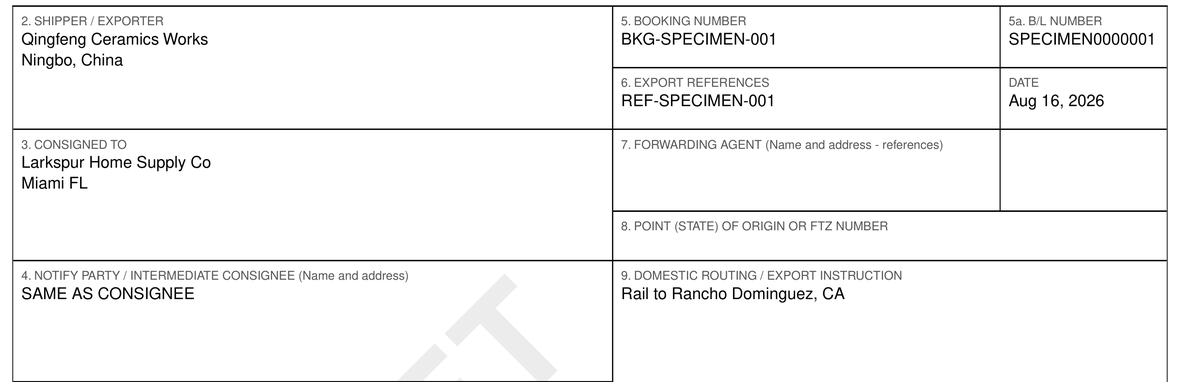
0:32 Box 2 — Shipper / Exporter. The party contracting with the carrier. On a house bill that is the real exporter.
0:42 Box 3 — the box that decides negotiability. A named company is straight. TO ORDER, or TO ORDER OF a named bank, makes it negotiable.
0:53 Box 4 — Notify party. Who the carrier calls on arrival. To order with no notify party is a standard rejection.
1:03 Box 5a — the B/L number, and where it repeats. It prints again bottom-right and in the footer. On a master print, 5a carries the house number.
1:14 Boxes 12 and 13 — where the carriage starts. Place of receipt is not the port of loading. That difference is what a claim gets argued over.
1:24 Boxes 14, 15 and 16 — vessel, load, discharge. The ship and the voyage number. Often TBN until the booking is firm. Check the country as well as the city.
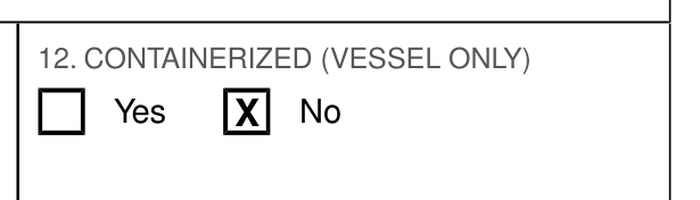
1:35 Box 11 type of move, and the second box 12. CY/CY is yard to yard. The containerised tick reads No on a full container — our defect, as printed.
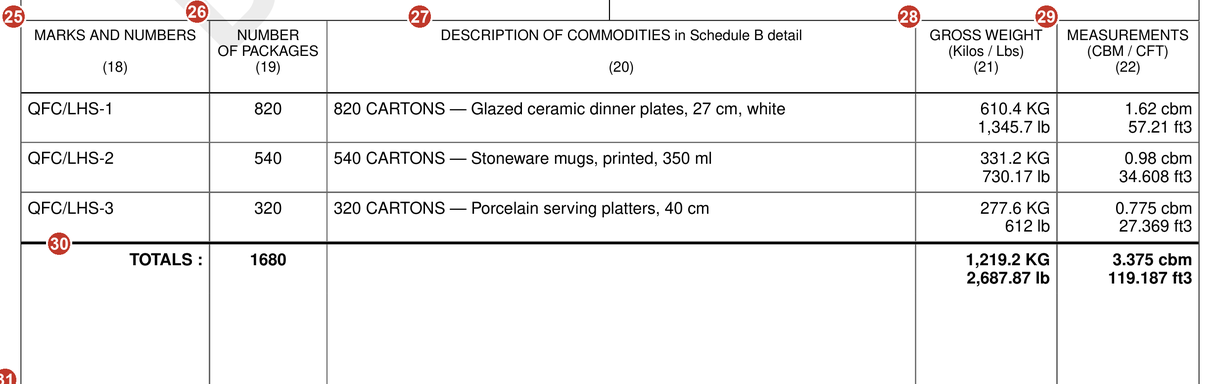
1:47 Boxes 18, 19, 20 — marks, packages, goods. One line per commodity. The tally clerk reads the marks; a customs officer reads the description.
1:59 Boxes 21 and 22 — gross weight and measurement. Totals must be the sum of the lines, and gross weight below net is arithmetically impossible.
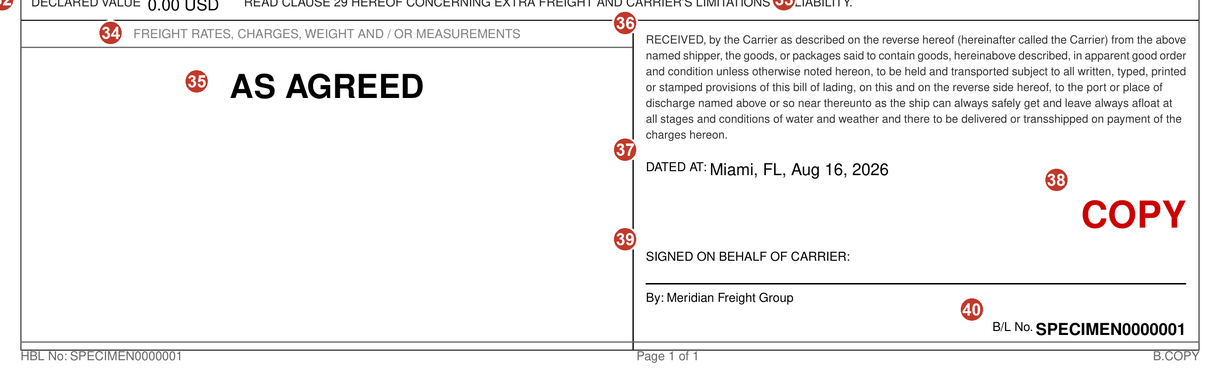
2:09 The charges block — who owes the freight. This print is unrated, so it reads AS AGREED. A rated print shows PREPAID and COLLECT columns.
2:19 DATED AT — place and date of issue. A bank reading a letter of credit compares these against the shipment date and credit terms.
2:29 Signed on behalf of carrier. The carrier or its authorised agent issues and signs it. This sheet is neither issued nor signed.
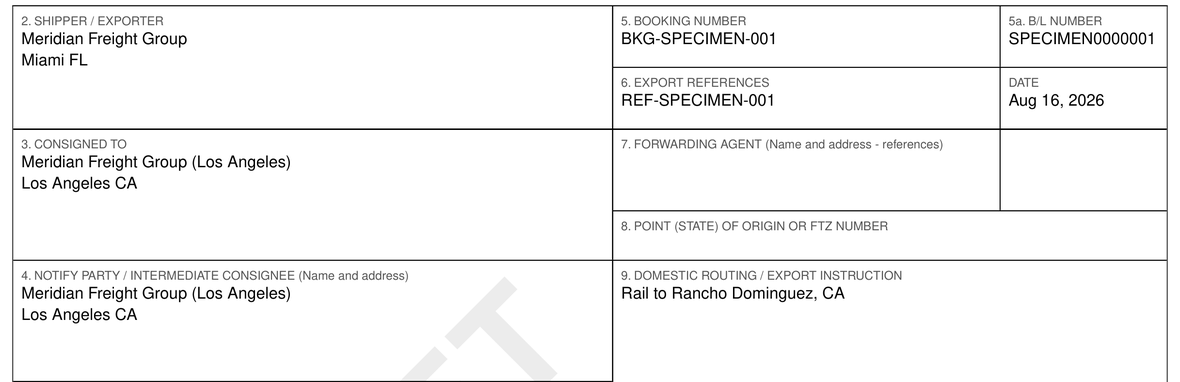
2:39 House bill vs master bill — three boxes. Only shipper, consignee and notify differ. Vessel, ports, marks, packages and weights match.
2:51 Two boxes this form does not carry. No number of originals, and no shipped-on-board date. If your form has them, fill them in.
3:01 You don’t fill out the bill — you fill out the shipment. The boxes print answers already on the file: parties, vessel, ports, marks, packages, weights.
3:13 The full annotated sample, with every callout. linbis.com/bill-of-lading — the filled example, the legend and a preparation checklist.
A filled bill of lading, box by box
The sample below is a complete ocean house bill of lading for one invented export. It is a real print from a real document template, produced for this page and left plainly marked as what it is: the diagonal DRAFT watermark and the two red COPY stamps are the template’s own, the signature line is empty, and the carrier, the parties, the vessel and every reference number on it are invented.
The sheet prints its own box numbers, and they do not run in the order the boxes appear — on this form there is no box 1 at all, and 12 is used twice. So the red callouts are ours, numbered 1 upward in reading order, and each entry in the legend carries the document’s own printed label beside it so you can find the box on the sheet. Esta página también existe en español: ejemplo de Bill of Lading, casilla por casilla.
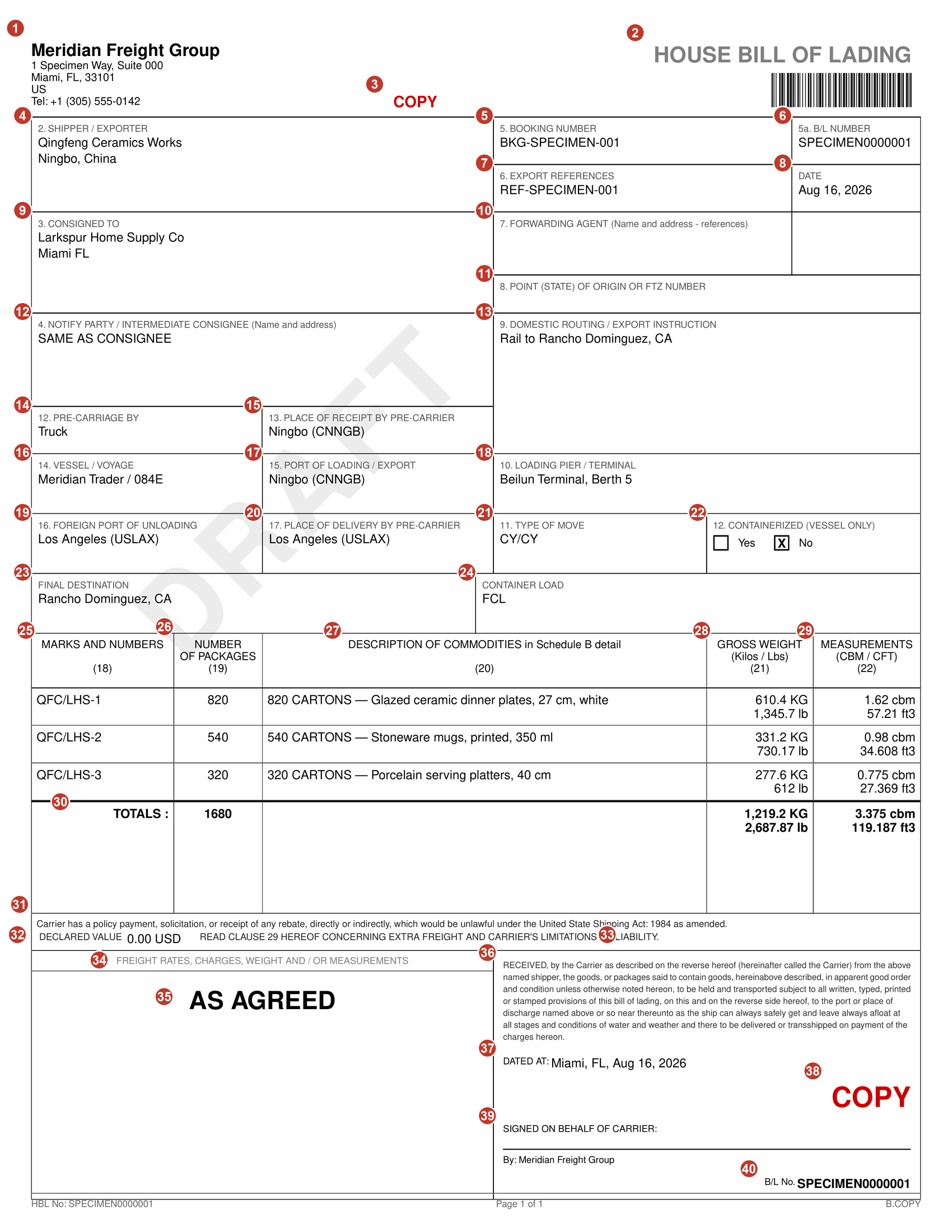
The legend
Each entry gives our callout number, then the label the document itself prints, then what the box is for.
- Issuer blockMeridian Freight Group, address, telephoneWho issued this bill. On a house bill that is the forwarder acting as carrier for the shipment, not the ocean line.
- Document titleHOUSE BILL OF LADINGThe title tells you which of the two documents you are holding. The master print of the same file titles itself BILL OF LADING — see the pair below.
- Copy designationCOPYWhat this print is. A print marked COPY is a record copy. The designation, not the paper, is what says whether an original was issued.
- Shipper box2. SHIPPER / EXPORTERThe party contracting with the carrier. On a house bill this is the real exporter; on the master bill it is the forwarder.
- Booking number5. BOOKING NUMBERThe carrier’s reference for the space. Copy it from the booking confirmation, not from the last shipment.
- B/L number5a. B/L NUMBERThe number that identifies this bill. Read the whole sheet: this form repeats it bottom-right and again in the footer, and on a master print this same slot carries the house number while the bottom-right carries the master’s.
- Export references6. EXPORT REFERENCESShipper’s reference, purchase order, contract number. The buyer’s PO goes here and the commercial invoice reconciles against it later.
- DateDATEThe date in the reference block. Not the same thing as the place and date of issue at the foot of the sheet.
- Consignee box3. CONSIGNED TOThe box that decides negotiability. A named company is straight; the words “to order” make it negotiable.
- Forwarding agent7. FORWARDING AGENT (Name and address - references)The agent arranging the carriage, with its address. Empty on this specimen.
- Origin / FTZ8. POINT (STATE) OF ORIGIN OR FTZ NUMBERA US state or a foreign-trade-zone number — not the country the goods were made in. Empty on this specimen.
- Notify party4. NOTIFY PARTY / INTERMEDIATE CONSIGNEE (Name and address)Who the carrier calls on arrival. Left blank on an order bill, nobody at destination knows the cargo is coming.
- Domestic routing9. DOMESTIC ROUTING / EXPORT INSTRUCTIONThe inland leg beyond the port, and anything the carrier must be told about it.
- Pre-carriage12. PRE-CARRIAGE BYThe truck, rail or feeder that brought the cargo to the load port. Note the printed number: this form uses 12 here and again further down.
- Place of receipt13. PLACE OF RECEIPT BY PRE-CARRIERWhere the carrier’s responsibility begins on a door or multimodal move. Not the same as the port of loading — and that difference is what gets argued about after a claim.
- Vessel and voyage14. VESSEL / VOYAGEThe ship and the voyage number. Often shown as TBN — to be nominated — until the booking is firm.
- Port of loading15. PORT OF LOADING / EXPORTWhere the cargo goes on board.
- Loading pier10. LOADING PIER / TERMINALThe terminal the cargo is delivered to for loading.
- Port of discharge16. FOREIGN PORT OF UNLOADINGCheck the country as well as the city: there is more than one Valencia and more than one Santiago.
- Place of delivery17. PLACE OF DELIVERY BY PRE-CARRIERWhere the move ends when it does not end at the discharge port. The printed label says pre-carrier; the box is the one at the far end of the move, so read it as the delivery place and confirm the wording against your own carrier’s form.
- Type of move11. TYPE OF MOVEHow the container is handed over at each end — this specimen reads CY/CY, container yard to container yard.
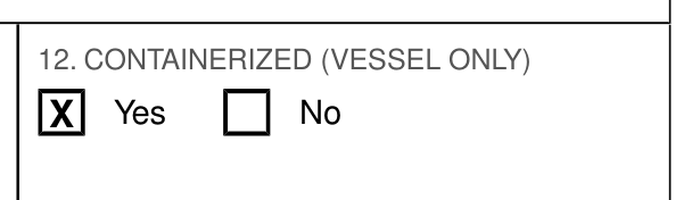
- Containerised12. CONTAINERIZED (VESSEL ONLY)A yes/no tick. This is the form’s second box numbered 12. On this house print the tick reads No even though the move is a full container — see the note under the pair below.
- Final destinationFINAL DESTINATIONWhere the cargo is finally going, when that is past the place of delivery.
- Container loadCONTAINER LOADFCL or LCL — whether the box is yours alone or shared.
- Marks and numbersMARKS AND NUMBERS (18)What is actually painted or labelled on the cartons. The tally clerk reads this, not the description.
- Number of packagesNUMBER OF PACKAGES (19)The count. This form prints the number alone and leaves the kind of package to the description column — many forms print both here, so check yours. “One container” is not a package count.
- Description of goodsDESCRIPTION OF COMMODITIES in Schedule B detail (20)The commercial description, kept close to the invoice because a customs officer will read both. Give each commodity its own line; one line for three commodities tells the reader nothing about any of them.
- Gross weightGROSS WEIGHT (Kilos / Lbs) (21)With its unit. Gross below net is arithmetically impossible, and it is a common reason a bill comes back.
- MeasurementMEASUREMENTS (CBM / CFT) (22)The volume. With the gross weight it drives chargeable weight, and therefore the freight.
- TotalsTOTALS :The sum of the lines above it. If it is not, something upstream is wrong.
- Carrier’s rebate clauseCarrier has a policy payment, solicitation, or receipt of any rebate…A standing statement about rebates. Read the sentence on this form carefully — see the note directly beneath this legend.
- Declared valueDECLARED VALUELeft at zero unless the shipper declares a higher value and pays for it. Declaring a value changes what the carriage costs and what the carrier’s terms limit.
- Clause cross-referenceREAD CLAUSE 29 HEREOF CONCERNING EXTRA FREIGHT AND CARRIER’S LIMITATIONS OF LIABILITYThis form’s own pointer to a clause on its reverse. Clause numbering differs from carrier to carrier — read your own carrier’s terms, not this number.
- Charges block headingFREIGHT RATES, CHARGES, WEIGHT AND / OR MEASUREMENTSThe heading over the money. What sits under it depends on whether the print is rated or not.
- RatingAS AGREEDThis specimen is an unrated print, so the charges block reads AS AGREED and no amounts appear. A rated print of the same file puts the charge lines here under PREPAID and COLLECT columns — which is where freight terms become visible on the face of the document.
- Received clauseRECEIVED, by the Carrier as described on the reverse hereof…The receipt half of the document, in the carrier’s own words, including “said to contain goods” — the phrase that puts the cargo description on the shipper.
- Place and date of issueDATED AT:A bank reading a letter of credit will compare these against the shipment date and the credit terms.
- Copy designation (foot)COPYThe same designation repeated at the signature block, where a reader looks first.
- Signature lineSIGNED ON BEHALF OF CARRIER:Blank on this specimen, deliberately. It is the carrier or its authorised agent that issues and signs a bill of lading, in a stated capacity — this sheet has been neither issued nor signed.
- B/L number (foot)B/L No.Repeated bottom-right and again in the page footer, so a loose sheet can be put back with its set.

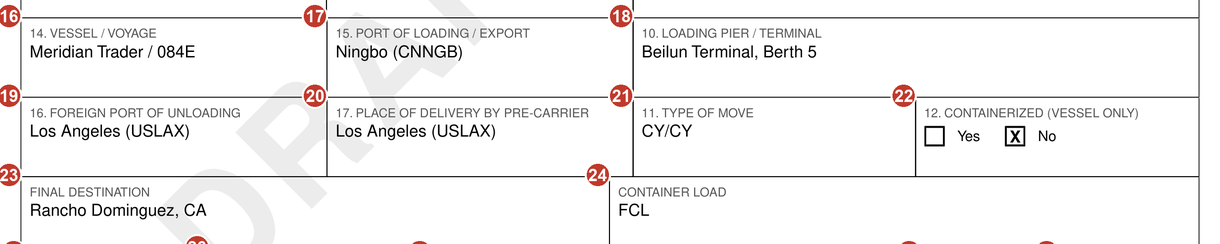
Three things on this specimen are worth pointing at rather than passing over. First, the form numbers a box 12 twice — once for pre-carriage and once for the containerised tick — and has no box 1; that numbering is inherited from the legacy layout this template reproduces, and it is on our list. Second, the containerised tick reads No on a full-container move, because the house print does not yet pass that value through to the box; the master print of the same file, further down this page, ticks Yes. Third, read the rebate sentence closely: as printed it says the carrier has a rebate policy, where the trade-standard wording is that the carrier has no such policy, and it spells the statute “United State”. We are showing you the sheet as it prints rather than retouching it.

How to fill out a bill of lading, box by box
Work down the sheet in the order the boxes are numbered on it. Each block below is one pass: what goes in the box, where the value comes from, and what happens when it is wrong — which is usually weeks later and somewhere else. The box numbers are the ones printed on the specimen above; your carrier’s form may number them differently, which is what the label table further down is for.
Boxes 2, 3 and 4: shipper, consignee, notify party
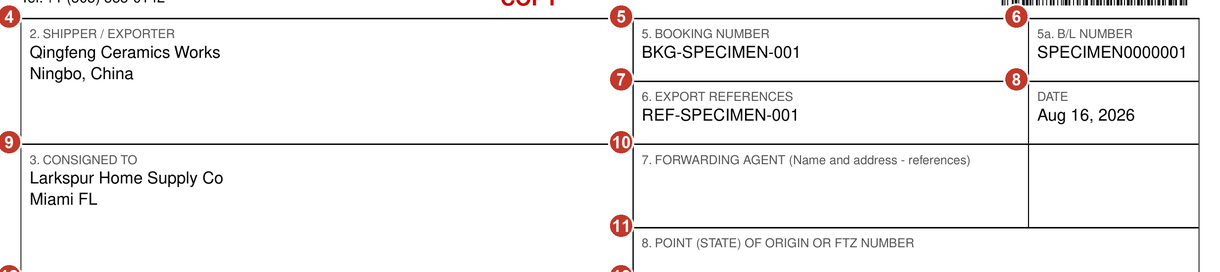
Full legal names and full addresses, as they appear on the commercial invoice. The consignee box is the only box on the sheet that changes who may take the cargo, so write it deliberately: a named company, or “to order”, or “to order of” a named bank. If you consign to order, the notify party is not optional in practice — it is the only name the carrier has to call.

Boxes 5, 5a and 6: booking number, B/L number, export references
These are the cross-references that let three systems — yours, the carrier’s and the buyer’s — recognise the same shipment. The B/L number is the document’s identity and repeats lower down the same sheet. Export references carry the buyer’s purchase order, which is what makes the invoice reconcile at the other end.

Boxes 12 to 17: place of receipt, vessel and voyage, ports
Place of receipt and place of delivery describe a door or multimodal move; port of loading and port of discharge describe the sea leg. They are different boxes because they answer different questions — where responsibility starts and ends, versus where the ship calls. Filling the ports in and leaving receipt and delivery blank on a door move is a common error.
Boxes 18 to 22: marks, packages, description, gross weight, measurement
Copy the marks from the cartons, not from the packing list. State the package count, and state the kind of package somewhere the reader will find it — on this form the count sits alone in its own column and the kind belongs in the description. Give each commodity its own line. Keep the description close to the commercial invoice, because a customs officer will read both. Weight and measurement must be consistent with each other and with everything else you have declared: this block is the one that gets checked arithmetically.
The charges block, and what your own form may or may not carry
Prepaid or collect decides who owes the freight, and in most carriers’ terms it is tied to what the carrier may hold the cargo for. “Freight payable at” must agree with it; prepaid at origin while payable at destination is a contradiction on the face of the document. On this specimen the block reads AS AGREED, because it is an unrated print — a rated print of the same file shows the charge lines under PREPAID and COLLECT columns instead.
Two things this carrier’s form does not carry, and many do: there is no box for the number of originals issued, and there is no shipped-on-board notation or on-board date. Both matter. A full set is conventionally three originals, and once one has been surrendered against delivery the rest of the set is, under the usual bill-of-lading wording, spent. If your form has those boxes, fill them; if it does not, establish both facts another way before the documents go out.
Place and date of issue, and the signature
The place and date of issue are not decoration — a bank reading a letter of credit will compare them against the shipment date and the credit terms. If the bill claims “shipped on board”, it needs an on-board date to go with the claim. And the last line matters most of all: it is the carrier or its authorised agent that issues and signs a bill of lading, in a stated capacity — as carrier, or as agent for a named carrier. The specimen on this page has been neither issued nor signed, which is why its signature line is empty.
The same box, a different label: reading someone else’s form
The boxes are standard; the words printed above them are not. Every carrier lays out its own bill of lading, and the same box turns up under half a dozen different headings from one form to the next. That is the single most common reason a box gets filled in wrongly — not that the operator did not know what the box was for, but that they were looking for a heading that this particular form does not print.
The left-hand column below is the label exactly as it prints on the specimen at the top of this page. The right-hand column is the other headings the same box travels under. If your form prints something in the right-hand column, it wants the value described in the middle.
| On this form | What goes in it | Other labels for the same box |
|---|---|---|
2. SHIPPER / EXPORTER | The party contracting with the carrier, with its full legal name and address | Shipper · Consignor · Exporter · Shipper / Exporter (complete name and address) |
3. CONSIGNED TO | Who may take the cargo — a named company, or the words “to order” | Consignee · Consigned to order of · Consignee (complete name and address) |
4. NOTIFY PARTY | Who the carrier calls on arrival | Notify party · Notify address · Also notify · Second notify party |
5. BOOKING NUMBER | The carrier’s reference for the space, copied from the booking confirmation | Booking No. · Booking ref. · Carrier’s booking reference |
5a. B/L NUMBER | The number identifying this bill, repeated elsewhere on the same sheet | B/L No. · Bill of Lading Number · Document No. · Waybill No. |
6. EXPORT REFERENCES | The shipper’s reference and the buyer’s purchase order | Shipper’s reference · Forwarder’s reference · Customer order no. · PO number |
12. PRE-CARRIAGE BY | The truck, rail or feeder that brought the cargo to the load port | Pre-carriage by · Precarriage · Inland carrier |
13. PLACE OF RECEIPT | Where the carrier’s responsibility begins on a door or multimodal move | Place of receipt · Place of acceptance · Point of origin |
14. VESSEL / VOYAGE | The ship and the voyage number, as confirmed on the day you issue | Ocean vessel · Vessel / Voy. · Vessel and voyage no. · Export carrier |
15. PORT OF LOADING | The port where the cargo goes on board | Port of loading · Port of lading · Loading port |
16. FOREIGN PORT OF UNLOADING | Where the sea carriage ends — check the country, not only the city | Port of discharge · Port of unloading · Discharge port |
17. PLACE OF DELIVERY | Where the move ends when it does not end at the discharge port | Place of delivery · Final place of delivery · On-carriage to |
18–20 (cargo table) | Marks and numbers, the package count, and the commercial description | Marks & Nos. · Container / Seal No. · No. of pkgs · Kind of packages · Description of goods · Particulars furnished by the shipper |
21. GROSS WEIGHT | The gross weight with its unit | Gross weight · Gross wt. (kgs) · Weight |
22. MEASUREMENTS | The volume | Measurement · Cube · CBM · Volume |
| Not on this form | How many originals are being issued | Number of original B(s)/L · No. of original Bs/L · Originals issued |
| Not on this form | The date the goods were loaded, where the bill claims shipped on board | Shipped on board date · Laden on board · On board date |
The last two rows are the ones to watch. This carrier’s form carries neither box, and both facts still have to exist somewhere: a bank reading a letter of credit will ask for the on-board date, and nobody can tell when a set of originals is spent without knowing how many were issued. If your form does not print the box, establish the fact another way before the documents go out.
Straight, to order, or bearer — what makes a bill of lading negotiable
Negotiability is usually explained in the abstract. It is simpler than that: it is decided by the literal words typed into the consignee box. Here are all four, exactly as they are typed. If you only ever issue the first row, the straight bill of lading has its own guide; for the wider background, bills of lading explained covers the ground this page assumes.
| Consignee box reads | Negotiable? | Who takes the cargo | When you would issue it |
|---|---|---|---|
LARKSPUR HOME SUPPLY CO, MIAMI FL | No — straight / non-negotiable | Typically the named consignee, identifying itself; some jurisdictions still expect an original to be presented — check the law of the contract | Paid-up cargo, related parties, express release |
TO ORDER | Yes | The holder of a properly endorsed original, on the terms of the bill | Cargo sold in transit; the shipper endorses in blank |
TO ORDER OF SHIPPER | Yes | Whoever the shipper endorses it to | The shipper keeps control until it is paid |
TO ORDER OF [BANK] | Yes | The bank, until it releases the documents | Letter of credit |
A sea waybill sits outside this table altogether: it is non-negotiable by design, there is no original to surrender, and the named consignee simply identifies itself at destination. It moves cargo faster and it gives the shipper no leverage — which is the whole trade-off. It is also one of four documents that regularly get confused with a bill of lading, which is the next section.
Bill of lading vs sea waybill, air waybill, packing list and delivery order
One shipment produces a stack of paper, and four of those documents get called “the bill of lading” by somebody at some point in the file. They are not interchangeable, and the difference that matters is not what they look like — it is who issued it and whether holding it lets you take the cargo. Only one document on this page does the second thing.
| Document | Issued by | Can it be negotiable? | What it does |
|---|---|---|---|
| Bill of lading | The carrier or its authorised agent | Yes — when the consignee box is made out to order | Receipt for the goods, evidence of the contract of carriage, and, made out to order, the document used to control delivery |
| Sea waybill | The carrier or its authorised agent | No — never | Receipt and evidence of the contract. The named consignee identifies itself at destination; there is no original to surrender |
| Air waybill | The airline, or a forwarder as issuing agent | No — never | The air equivalent: receipt and evidence of the contract of carriage. It is not a document of title, so it cannot be endorsed to pass the cargo on |
| Packing list | The shipper | Not applicable | Says what is inside each package. No contractual relationship with the carrier at all |
| Delivery order | The carrier, its agent, or the forwarder at destination | Not applicable | Instructs a terminal or warehouse to release named cargo to a named party. It follows the release; it does not create the right to it |
Bill of lading
The only one of the five that can be a document of title. It does three jobs at once — receipt, evidence of the contract of carriage, and, when the consignee box reads “to order”, the instrument the parties use to decide who collects the cargo. That third job is what makes it the document a bank will hold against a letter of credit, and it is the reason the consignee box is the most consequential box on the sheet. Everything above on this page is about filling this one in.
Sea waybill
Same carrier, same cargo, same boxes — a different instrument. A sea waybill is non-negotiable by construction: the consignee is named, no original travels, and the consignee identifies itself at destination rather than presenting paper. Reach for it when nobody needs to hold the document: related parties, an open account, cargo already paid for. Do not reach for it when the goods may be sold in transit or a bank is involved, because a sea waybill gives the shipper nothing to withhold.
Air waybill
The air-freight counterpart, and the difference people get wrong is that it is never negotiable. An air waybill is a receipt and evidence of the contract of carriage, and that is all — it is not a document of title, so it cannot be endorsed over to pass control of the cargo to somebody else. The house and master split works the same way it does at sea: a forwarder issues its own house air waybill to the customer, and the airline issues the master air waybill to the forwarder. The full air waybill guide covers the AWB box by box, and the air side of the platform works the same way as the ocean side.
Packing list
Written by the shipper, not the carrier, and it carries no contractual weight against the carrier whatsoever. What it does is say what is in each carton — which is exactly what the bill of lading does not say, because the bill of lading records what the shipper declared and prints the carrier’s “said to contain” wording over it. When a customs officer or a claims adjuster wants to know what was actually in package 412, the packing list is the document that answers. See how a packing list is built from the same shipment record.
Delivery order
Issued at the destination end, after the release decision has already been made. It tells a terminal, a container yard or a warehouse to hand named cargo to a named party. It is downstream of the bill of lading, not a substitute for it: the bill of lading (or the telex release, or the express release) is what establishes that the cargo may go; the delivery order is the instruction that makes it physically move. Confusing the two is how cargo gets released to somebody who was never entitled to it.
Two of these documents get compared far more often than the rest. A commercial invoice and a bill of lading answer different questions about the same cargo → · And once the bill is issued, its number is what the shipment is tracked by.
House bill of lading vs master bill of lading
One shipment, two documents, and the difference is only three boxes. A forwarder acting as an NVOCC issues its own house bill to the actual customer; the ocean carrier issues the master bill to the forwarder. Everything except shipper, consignee and notify party has to match exactly between them — and it is the rule that causes the most trouble when it is broken.
Below is the same shipment printed twice: the house bill on the left, the master bill on the right. Nothing was retyped between them.
| House bill of lading | Master bill of lading | |
|---|---|---|
| Issued by | The forwarder / NVOCC | The ocean carrier |
| Shipper box | The real exporter | The forwarder |
| Consignee box | The real buyer, or to order | The forwarder’s destination agent |
| Notify box | The buyer or its customs broker | The destination agent |
| Who holds it | The exporter, then the buyer or its bank | The forwarder |
| What must match the other | Everything else — vessel and voyage, both ports, marks, packages, description, gross weight and measurement | |
Consolidating several customers under one master bill is the ordinary shape of an ocean import. See how the same shipment prints as a house bill and a master bill → The air-freight equivalents are the house and master air waybill — the air side works the same way.
After it is issued: originals, telex release, express release, switch B/L
Original bills and surrender
Originals are issued as a set, conventionally three, and travel separately from the cargo — usually by courier to the buyer or its bank. Delivery is made against the surrender of one; under the usual wording on the face of the bill, the rest of the set is then spent. Which is why, on a form that carries a number-of-originals box, that box is not paperwork trivia.
Telex release and express release
Both get the cargo out without a paper original at destination, and they are not the same thing. A telex release starts life as a normal set of originals: they are surrendered at origin, and origin messages destination to release without presentation. An express release is decided at issue — the bill goes out non-negotiable with no original to surrender at all. Choose telex when the set already exists; choose express when you know at booking that nobody needs to hold the document. The telex release guide goes through the message and the sequence in detail.
Switch bill of lading
A second set issued in place of the first — usually to change the shipper shown or the port named, so a trader’s supplier and customer do not see each other. The first set must be surrendered before the second is issued: two live sets on one cargo is a well-known route to a double release, and a well-known route to a fraud. The signs a bill of lading has been tampered with are worth knowing before you accept one.
Corrections and amendments
Before the vessel sails, corrections are routine. After it sails they become a carrier amendment with a fee; once originals are out, they usually require the whole set back.
What gets a bill of lading rejected
Rejections are boringly repetitive. Five that come up over and over — not an exhaustive list — and every one of them is visible on the face of the document before it is sent:
- Consigned “to order” with no notify party. Nobody at destination knows the cargo has arrived, and nobody can be told.
- Number of originals left blank, on a form that has the box. Neither the carrier nor the bank knows what a complete set is, so nobody knows when the set is spent.
- “Shipped on board” claimed with no on-board date. A common letter-of-credit rejection.
- Freight marked prepaid while “freight payable at” reads destination. The document contradicts itself about who owes the money.
- Gross weight below net weight. Arithmetically impossible, and it undermines everything else declared alongside it.
Before you issue a bill of lading: the preparation checklist
Gather these before you open your carrier’s form. Nothing on this list is a bill of lading — it is what you need in front of you so the document you eventually issue does not have to be corrected. Work down it once with the file open beside you; anything you cannot tick is a question for the shipper, the carrier or your own operations before the document is prepared.
The parties — who is on the document
- Shipper / exporter: full legal name, address, country, and a contact who can answer out of hours
- Consignee: the exact wording, decided before anyone types
- Notify party: a separate decision from the consignee, taken on purpose
- The issuing company: your own legal name and address, as they appear on the rest of your paperwork
The references — how the document is found again
- Bill of lading number, allocated from your own series before you start
- Carrier booking number, copied from the booking confirmation itself
- Shipper’s reference, purchase order or export reference
The route — where the carriage starts and stops
- Place of receipt and place of delivery, only where the carriage genuinely starts or ends inland
- Port of loading — the port, not the nearest city
- Port of discharge — where the sea carriage ends
- Vessel and voyage, taken from the carrier’s confirmation on the day you issue
The cargo particulars — what the shipper is furnishing
- Marks and numbers, read off the cartons rather than off the last shipment
- Number and kind of packages, counted at the level everyone else counts
- Description of goods: the plain commercial description, agreed with the shipper
- Gross weight, with the unit written next to it
- Net weight and volume, where you have them and consistent with everything else
- Totals that are the sum of the lines
If the cargo moves in a container
- Container number: four letters and seven digits, with the check digit verified
- Seal number, size and type, and the tare read off the container’s own plate
- Verified gross mass, and which method produced it
Freight, issuance and condition
- Freight terms, and where the freight is payable
- How many originals are being issued — decided with the customer, not at the printer
- Place and date of issue
- On-board status and date, where the goods are already loaded
- The condition of the cargo as it was actually received
- The carrier’s own form and its terms, confirmed before you prepare anything
You don’t fill out a bill of lading — you fill out the shipment
Everything above is the document. Here is the part that changes the work: in a freight forwarding system the bill of lading is not a form you type into — it is a view of a record you already created. The boxes are not asking questions. They are printing answers you gave at booking.
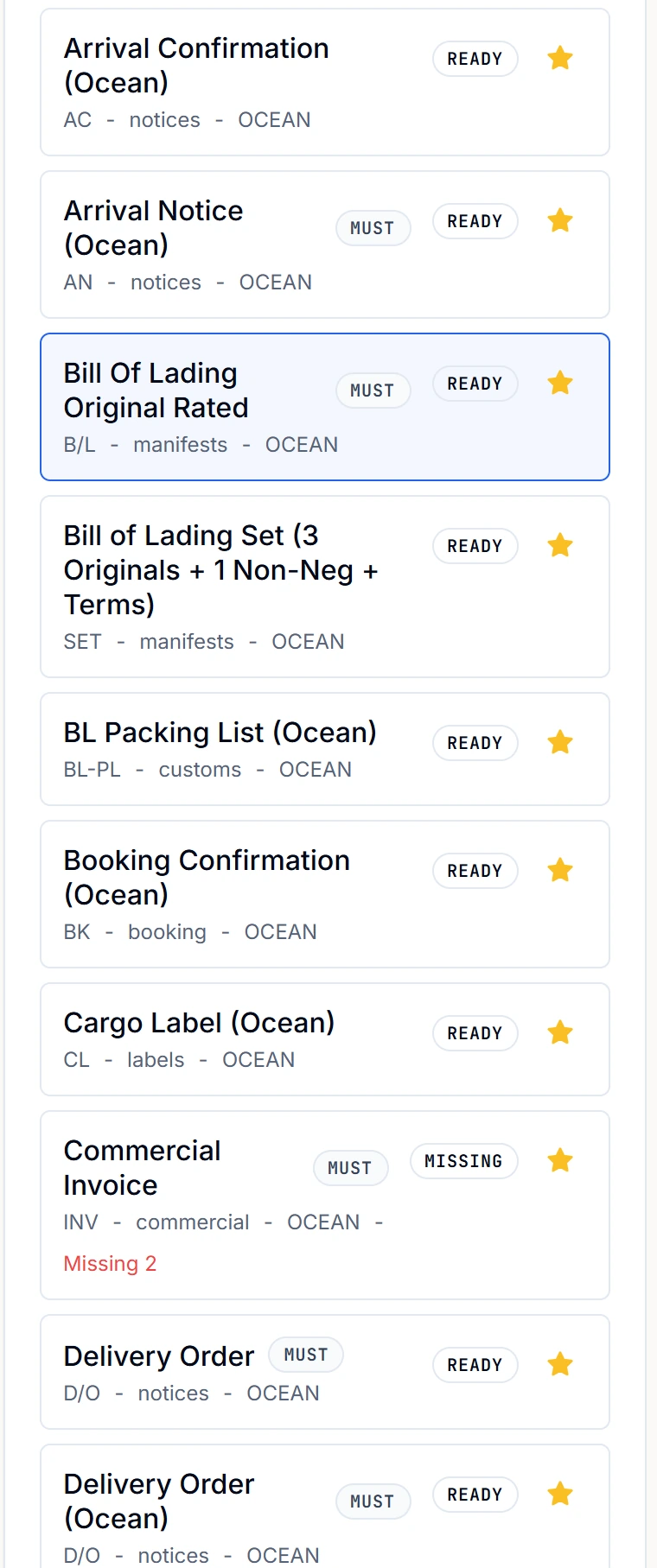
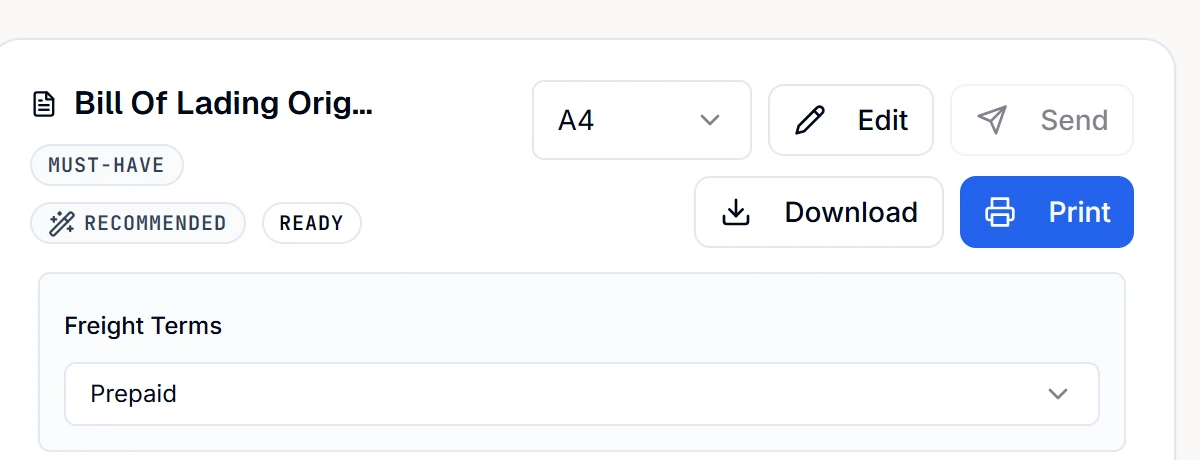
- Open the shipment. Shipper, consignee, notify party, vessel and voyage, both ports, marks, packages, weight and volume are already on the record. They were entered once, at booking — or carried across from the quote when it was accepted.
- Open the Forms tab. Linbis lists the documents this file needs and marks the ones that matter most for this kind of file, so the operator picks from a shortlist.
- Pick the bill of lading. It sits in the list badged MUST-HAVE, RECOMMENDED and READY, with Edit, Send, Download and Print beside it. The master bill, the sea waybill, the delivery and pickup orders, the arrival notice and the manifest come off the same file.
- Choose the variant. Freight terms sit on the document itself. The bill of lading prints in six variants — original or non-negotiable; rated, freight-only or non-rated — and as a seven-copy set of three originals and four non-negotiable copies, each with its terms.
- It prints on your letterhead. Your logo and your brand colour are computed from company settings and contrast-checked, so a pale brand is flipped to a legible colour rather than printing white on white — on screen and in the PDF.
- The file tells you what is still short. In the same list, the Commercial Invoice reads MISSING with what it still needs. The gaps are named next to the document rather than discovered by the person who receives it.
- The house bill and the master bill come off one record. That is why everything except shipper, consignee and notify party is identical by construction — and why an edit to the master’s carrier, vessel, voyage, ETD or ETA writes itself onto every house bill underneath it, in a single transaction.
Two things follow from the document being a view rather than a file. Documents generate themselves at the right milestone — booking confirmed produces the booking confirmation and the house bill, and so on down the timeline. And you can design your own documents without a developer: in Forms Studio, a drag-and-drop page designer, you start from one of 22 ready-made templates (house and master bills of lading among them) or from a blank page, lay it out with your logo and your wording, and bind freight fields into the page by picking them from a list.
The record starts earlier than the bill of lading does. See how an accepted quotation carries its parties, charges and commodities straight into the file → · If the cargo is received into a building before it sails, that is where the pieces are counted.
Bill of lading FAQ
What does a bill of lading actually look like?
A single sheet of boxes in three bands. Parties across the top — shipper, consignee, notify party, forwarding agent. Routing through the middle — pre-carriage, place of receipt, vessel and voyage, port of loading, port of discharge, place of delivery. Cargo at the foot — marks and numbers, number of packages, description, gross weight, measurement — followed by the charges block and the place, date and signature of issue. The annotated sample above shows every one of them filled in.
How do I fill out a bill of lading, step by step?
Work down the sheet in the order the boxes are numbered on it. Boxes 2, 3 and 4 are the parties — shipper, consignee, notify party — and the consignee box is the one that decides who may collect the cargo, so it is settled before anyone types. Boxes 5, 5a and 6 are the references: the carrier’s booking number, your own B/L number, and the buyer’s purchase order. Boxes 12 to 17 are the routing: place of receipt, vessel and voyage, port of loading, port of discharge, place of delivery. Boxes 18 to 22 are the cargo: marks and numbers, the package count, the commercial description, gross weight and measurement, over a totals row that must be the sum of the lines. Then the charges block, and the place, date and signature of issue. The walkthrough above takes each block in turn against a filled example, and the checklist gathers every value before you open the carrier’s form.
Where do I get a blank bill of lading form?
This page does not publish a blank form to issue from, and that is deliberate. A bill of lading takes effect when a carrier or its authorised agent issues and signs it, on that carrier’s own form and on that carrier’s terms — a blank sheet downloaded from a website is not a carrier’s form, and filling one in does not create a contract of carriage. What this page does publish is more useful for the work: a filled, annotated specimen, a legend for all forty callouts, a table of what other carriers’ forms call each box, and a preparation checklist you can download and work through before anything is issued. Ask your carrier or your NVOCC for their form; use this page to prepare the values that go on it.
Is a bill of lading the same as a packing list or a shipping label?
No. The packing list says what is inside the boxes. The label routes an individual box. The bill of lading is the carrier’s receipt for the goods, evidence of the contract of carriage, and — when it is made out to order — the document the parties use to control who may collect the cargo at destination.
Who issues the bill of lading — the carrier, the forwarder, or the shipper?
The carrier or its authorised agent issues it. A forwarder acting as an NVOCC issues its own house bill of lading to its customer; the ocean carrier issues the master bill of lading to the forwarder. A shipper never issues one to itself.
What makes a bill of lading negotiable?
The consignee box, and nothing else. A named consignee makes it straight and non-negotiable. “To order”, “to order of shipper”, or “to order of” a named bank makes it negotiable, so that it passes by endorsement and delivery and the holder of a properly endorsed original can present it for the cargo on the terms of the bill.
What is the difference between a bill of lading and a sea waybill?
Both are issued by the carrier for the same cargo, and both are a receipt for the goods and evidence of the contract of carriage. The difference is control. A bill of lading made out to order is a document of title: it passes by endorsement and delivery, and the holder of a properly endorsed original can claim the cargo on the terms of the bill — which is why a bank will hold one against a letter of credit. A sea waybill is never negotiable. The consignee is named, no original travels, and that named consignee simply identifies itself at destination. Use a sea waybill when nobody needs to hold the document; use a bill of lading when somebody does.
How many original bills of lading are issued, and what happens to the other two?
Conventionally three. Once one original has been surrendered against delivery, the usual wording on the face of the bill treats the rest of the set as spent. Where the form carries a number-of-originals box, leaving it blank is how the same cargo ends up being released twice.
What is the difference between a house bill of lading and a master bill of lading?
Same shipment, two documents. The house bill names the real shipper and the real consignee; the master bill names the forwarder and its destination agent. Everything else — vessel and voyage, both ports, marks, packages, description, gross weight and measurement — must match exactly between them. This page shows the same file printed both ways, side by side.
What is a telex release, and how is it different from an express release?
Both release cargo without a paper original at destination. A telex release surrenders the originals at origin and messages destination to release without presentation. An express release issues the bill non-negotiable from the start, so there is no original to surrender at all.
What gets a bill of lading rejected?
Five that come up over and over, and not an exhaustive list: consigned to order with no notify party; the number of originals left blank on a form that has the box; “shipped on board” claimed with no on-board date; freight marked prepaid while freight payable at reads destination; and gross weight below net weight.
Can I use the sample on this page for a real shipment?
Use it to read, prepare and check your own paperwork — that is what it is for, and the checklist above is the practical half of it. The sample itself is an annotated specimen: it carries the template’s DRAFT watermark and COPY stamps, its signature line is empty, it is not issued by a carrier, Linbis is not a carrier, and no goods have been received against it. It is the carrier or its authorised agent that issues and signs a bill of lading. Confirm the form and its terms with your carrier.
Can I change what the bill of lading looks like in Linbis?
Yes. Forms Studio lets you design your own bill of lading without a developer — a drag-and-drop page designer with your own logo, layout and wording, starting from the ready-made house or master bill of lading or a blank page — and freight data fields are bound into it by picking them from a list. The standard bill of lading also prints in six variants (original or non-negotiable; rated, freight-only or non-rated) and as a seven-copy set: three originals and four non-negotiable copies, each with its terms.
Does Linbis file the bill of lading with customs?
No, and the two are different things. A bill of lading is a contract-of-carriage document: the carrier or its authorised agent issues and signs it, and Linbis produces it from the shipment record. It is not filed with customs. The filings that do go to US Customs and Border Protection on the same shipment are the ISF and the manifest, and they are separate documents with their own deadlines and their own data. Those you can send from the platform: Linbis is a CBP-approved software provider. File your ISF and manifest directly from Linbis — under your own CBP filer credential; your SCAC, your bond, your approval. The filing is yours and stays yours; the platform is the channel it travels through.
About this sample
The bill of lading shown on this page is an annotated specimen: a filled example, prepared to be read rather than used. It carries the template’s own diagonal DRAFT watermark and its COPY designation, its signature line is empty, and the carrier, the parties, the vessel and every reference number on it are invented. It is not issued by a carrier, Linbis is not a carrier, and no goods have been received against it. It is the carrier or its authorised agent that issues and signs a bill of lading, in a stated capacity — this sheet has been neither issued nor signed. Linbis makes no certification or regulatory-filing claim for this sample or for the checklist.
The red callout numbers are our own annotation, added in reading order so the legend and the document can be read side by side; the black numbers inside the boxes are the form’s own, and they neither start at 1 nor run in order. The specimen prints this carrier form’s own cross-reference to clause 29 on its reverse; clause numbering differs from carrier to carrier, so read your own carrier’s terms, not this number. This page is not legal advice, and the practice described here varies by jurisdiction and by the terms of the particular bill; where a shipment is moving under a letter of credit or a disputed contract of sale, the wording of the bill is a matter for the parties and their advisers.
See the same shipment printed as a house bill and a master bill
The document is a view of the record. See how one ocean file produces its house bills, its master bill and the rest of the paperwork without anything being retyped. Linbis is freight forwarding software for forwarders, NVOCCs, customs brokers and 3PLs.
Ocean freight in LinbisThe product screens on this page are the real Linbis product, captured on a demonstration company; the workflows shown are production features. The specimen was rendered from the product’s own ocean bill-of-lading template; company and cargo details on it are invented for illustration.