
Linbis › Compare › GoFreight vs Linbis
Compare · GoFreight vs Linbis
GoFreight vs Linbis for Freight Forwarders and NVOCCs (2026)
Two cloud platforms that get shortlisted together by US-facing forwarders and NVOCCs. Compared on the things that decide the choice: who publishes a price, how the money is kept, whether customs is filed from the shipment, how a consolidation is built, what the AI is allowed to do, and how you get live.
Short answer. GoFreight positions itself as “AI-powered freight forwarding software and an all-in-one TMS” for forwarders and NVOCCs, with ocean, air and trucking modules, accounting inside, a customer portal, a large lessons-style knowledge base — and a pricing page that asks you to fill in a form: on the date above, gofreight.com/pricing returned a page with zero dollar amounts. Linbis runs the same file — quote, shipment, consolidation, warehouse, documents, ISF and AMS to CBP, invoice, vendor bill and a double-entry ledger — on one record in seven interface languages, and publishes the price before the demo: $150 a month including one user, $299 including three, free trial without a card.
If you want a vendor with a large published training curriculum and a sales team to size a plan for you, read the GoFreight section below. If you want the price up front, the ledger inside, customs filed from the shipment under your own bond, and a consolidation engine built for five hundred orders at once, read the Linbis one — and then test both on one live shipment.
The comparison table
Alphabetical. GoFreight rows are its public positioning — what gofreight.com and its knowledge base say — because we have not operated the product, and we say so. The Linbis column describes the shipped product, with counts taken from its configuration.
| Row | GoFreight (public positioning) | Linbis |
|---|---|---|
| Built for | Forwarders and NVOCCs wanting an “AI-powered all-in-one TMS” with a modern interface; US-facing | Forwarders, NVOCCs, customs brokers and 3PLs — one office or many — that want enterprise configuration (24 shipment workflow flows, a 79-permission role grid, a document designer, a screen designer, per-customer contract pricing) without a consulting project, and the price up front |
| Published price | Page exists, no figure — gofreight.com/pricing shows “Simple pricing. Smart forwarding.” and a form to “consult with our experts” | Published. $150 / month incl. 1 user · $299 / month incl. 3 users · Enterprise by quote — linbis.com/pricing |
| Price shape | Per-user plans sized by sales (public positioning); a billing-usage report exists in its knowledge base | Flat monthly plans with seats included; not per-transaction, not per-container |
| Modules | Ocean export/import, air, trucking, accounting, quotation, tracking, warehouse items linked to shipments, EDI, an API (knowledge base) | Quote, shipping orders, shipments (air, ocean, ground), consolidation, warehouse, documents, customs filing, invoicing, AP, general ledger, agents, CRM, portal, email copilot |
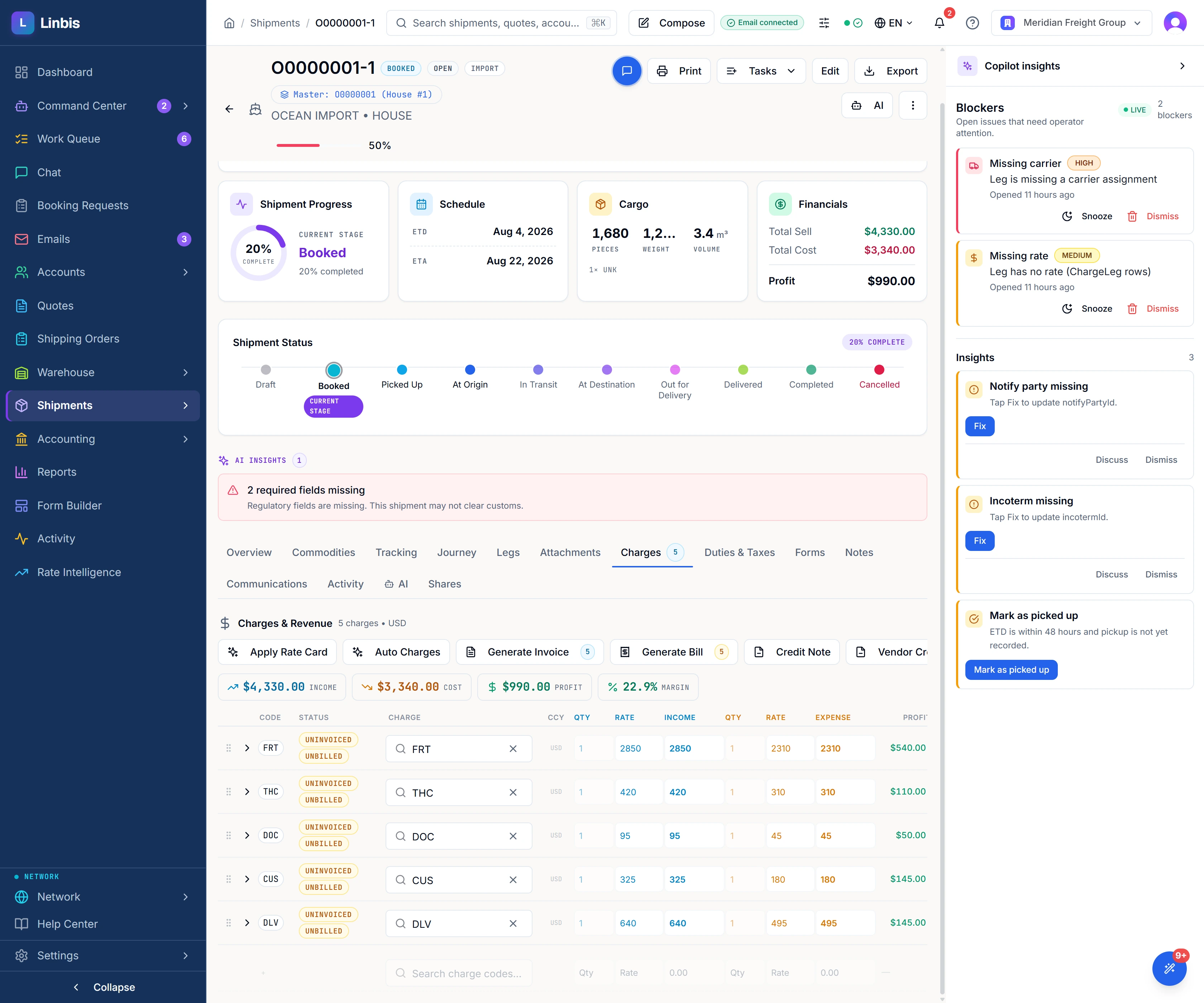
| Accounting | Accounting module inside: AR/AP, receive payment, journal report, revenue-cost report (knowledge base lessons) | Income and expense on one charge line in two currencies with profit per line; 91-account freight chart of accounts; periods that close; AR/AP subledgers; agent statements; books in Linbis, in QuickBooks Online, or both via a sync across 13 entity types (payments both ways) |
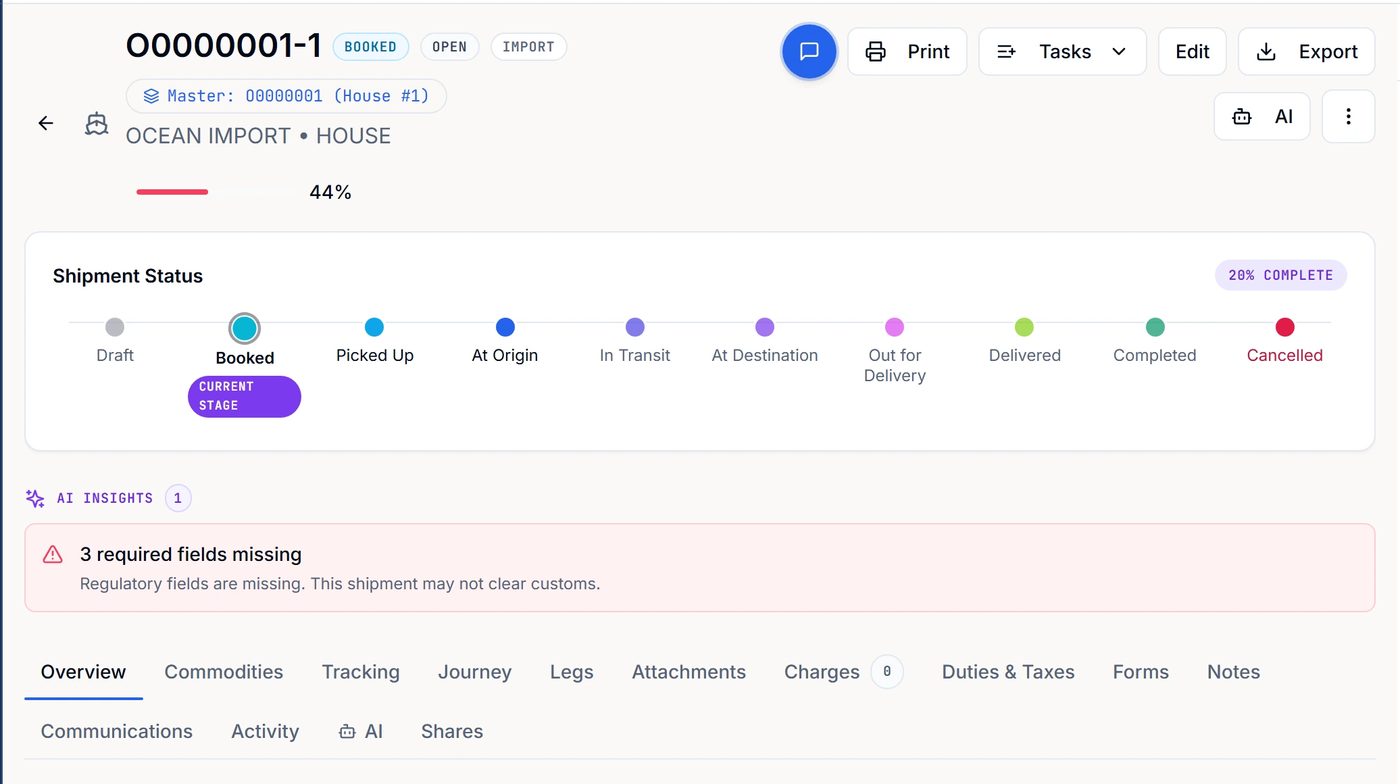
| Customs filing | Customs filing listed among its modules (public positioning) | ISF 10+2 assembled from the shipment, completeness-scored, transmitted to CBP standalone or as ISF-5 on the AMS manifest bill, under your own SCAC and bond; CBP-approved software provider; EEI validation; denied-party screening (US, EU, UK, UN); duty and landed cost per line. Entry (ABI) is the broker’s path |
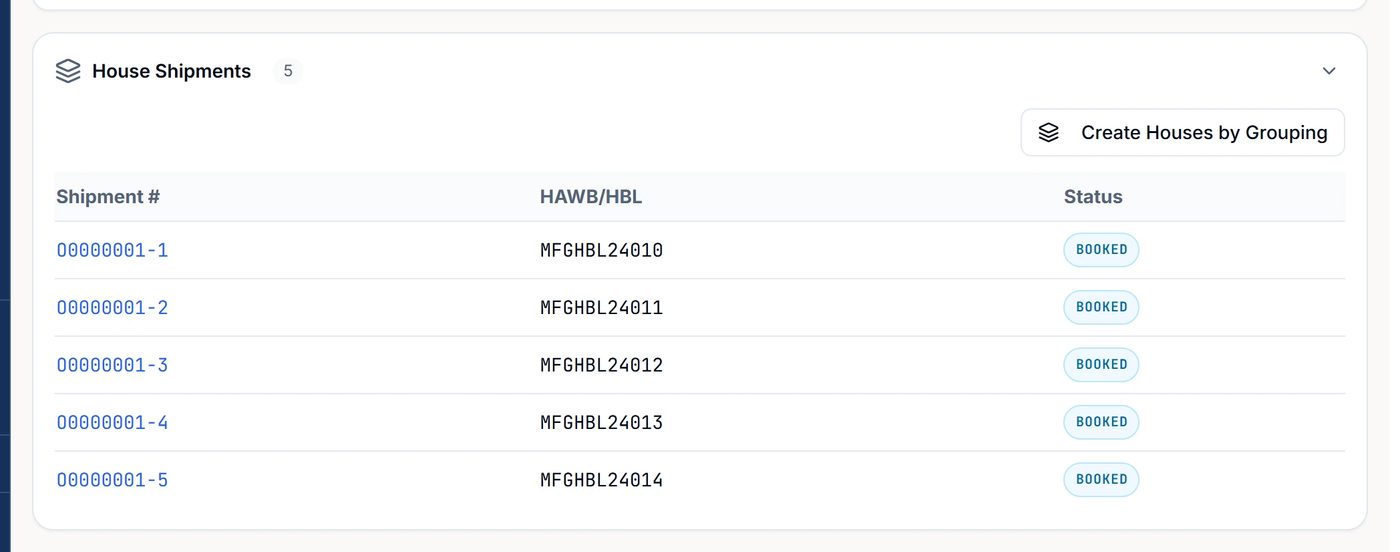
| Consolidation | Master/house for ocean and air (public positioning) | Up to 500 shipping orders per import → houses in one action (batches of 50), each with its own file number, leg plan and copied charges; 19 fields cascade master → house; change the carrier, vessel, voyage, flight, ETD or ETA on the master and every house updates |
| Warehouse | Warehouse items linked to shipments (knowledge base) | On Premium: receipts and releases with proof of delivery, zones and bins, piece/pallet/container nesting, an installable scan app that works offline, manifest import with per-line reconciliation, snapshot storage billing, releases that cannot be self-approved |
| Documents | Document generation and emailing from the record (knowledge base) | More than 90 templates, over 75 of them rendered live from the record; Forms Studio, a browser designer binding up to 288 fields on a shipment document; bills of lading print in six variants and as a seven-copy set; air MAWBs print as a 12-copy set |
| Tracking | GoFreight Tracking module; HBL status checks (knowledge base) | Container milestones from Maersk and CMA CGM over DCSA, pulled on request with your own carrier credentials and cascaded from master to house; flights on 50 major cargo and passenger airlines followed by live aircraft position every five minutes once OpenSky Tracking is switched on, with departure and arrival recorded on the file; four container clocks, each with its own free time and daily rate |
| AI | “One AI to power every step” (homepage); AI positioned across the workflow | Out of the box the AI proposes and a person approves: 24 email classifications (23 freight types plus unknown) with a confidence score on each, extraction from PDF and image attachments with evidence, one Approve creates the record and fires its workflow. Then four autonomy levels across 35 action categories, an envelope you define, high-risk actions always human, replay against history before enabling |
| Customer visibility | Customer portal (public positioning) | Portal with 18 routes — booking and quote requests that arrive assigned, document approvals, warehouse inventory, delivery scheduling, messaging — in 8 languages; no-login tracking links |
| Languages | English (public positioning) | 7 interface languages — English, Spanish, Portuguese, French, German, Italian, Chinese; portal in 8 |
| Getting live | Sales-led onboarding; a lessons-style knowledge base with numbered courses (public positioning) | Free trial, no card; a working chart of accounts, more than 90 templates and a permissive workflow from the first login; import wizards (shipments, accounts, shipping orders, warehouse receipts) with dry-run preview; phased migration on Premium and Enterprise for customers leaving the old Linbis Logistics platform |
| Honest weakness | No published price; the plan is sized by a sales conversation | Smaller company; small, old public review base; electronic customs filing is US CBP only; divisions are a reporting tag, not per-entity ledgers |
GoFreight rows are its public positioning as read on gofreight.com and its knowledge base on the date above; we have not operated the product. We do not reprint third-party star ratings; check G2 and Capterra directly and note the review counts and dates.
What GoFreight publishes about itself
Read GoFreight’s own site before anyone’s comparison, ours included. On the date above its homepage title is “AI-Powered Freight Forwarding Software & All-in-one TMS,” its headline asks “What if AI handled the forwarding, so you could handle the winning?”, and it promises “One AI to Power Every Step.” Its sitemap lists solution pages by module (ocean export among them), a blog that covers freight-workflow automation and the quarterly earnings of the large forwarders, webinars, a glossary, and a knowledge base organised as numbered lessons — freight release, shipment memo, quotation printing, payment status tracking, journal reports, revenue-cost reports, a billing-usage report, EDI history, a write-back function, an API FAQ, and linking warehouse items to a shipment. That is a real product with a real training curriculum, and a forwarder who wants a vendor to teach the desk from a syllabus should weigh it.
What its site does not publish is a price. The pricing page’s own description reads: “get a TMS pricing plan built for your specific scale. Fill out the form to consult with our experts.” We record that as it is — a pricing page with no figure — rather than guessing a number. GoFreight’s blog does publish figures about someone else: it reports the per-container and per-entry rates circulating after CargoWise’s December 2025 repricing, which we quote, attributed, on the CargoWise alternatives page.
Pricing: what each vendor will tell you before the call
Vendors quote different units on purpose. Put every offer into the same one before you compare: dollars per year for your team at your volume.
| Model | Who uses it | What moves the bill | A three-seat desk moving 400 shipments a month | Trade-off |
|---|---|---|---|---|
| Flat monthly plan, seats included | Linbis | Nothing until you add seats | $3,588 a year on the $299 plan — the same in a 40-shipment month | You pay the same in a slow month |
| Per-user, sized by sales | GoFreight (public positioning) | Headcount — and whatever the plan conversation adds | Not published; multiply the quoted per-user figure by every login, including accounting and the warehouse | Nothing to compare until a salesperson writes a number |
| Usage-based value packs | CargoWise since 1 Dec 2025 | Transactions — containers, entries, shipments | Not published; the only authoritative rate is your renewal letter | Falls in a quiet quarter, rises in a busy one; hardest to forecast |
Two costs sit outside every quote: implementation (a partner-led project for enterprise platforms; sales-led onboarding for GoFreight; self-serve for Linbis) and migration — the hours your staff spend re-keying if the vendor cannot import your history from files. Linbis imports shipments, accounts, orders and warehouse receipts with a dry-run preview, and Premium and Enterprise include a phased migration for customers moving off the old Linbis Logistics platform. Ask GoFreight what its data import covers and whether it is included.
Accounting: where the money lives
Both platforms say “accounting inside,” and the phrase hides the two questions that matter.
Is the charge one row or two? On Linbis, the customer’s price and the carrier’s cost sit on the same charge line, in independent currencies, with the profit per line and the P&L per file computed from them — and a line’s tax follows its principal down the same conversion path so the two cannot drift. The invoice and the vendor bill are issued from those same rows. GoFreight’s knowledge base documents a revenue-cost report, receive-payment across parties, and journal reports; ask in the demo whether sell and buy live on one line or are reconciled after the fact.
Can you file from the ledger? Linbis ships a 91-account freight chart of accounts on day one — including agent receivable, agent payable and agent commissions — with periods that close and lock, balanced journal entries with reversals, trial balance, balance sheet and income statement. And you choose where the books live: in Linbis, in QuickBooks Online, or both, through a sync that covers thirteen QuickBooks entity types (payments and bill payments sync both ways; the chart of accounts and tax codes come in; the other nine, vendor credits and journal entries among them, go out) and handles the counterparty that is simultaneously your customer and your vendor — the overseas-agent case that breaks naive integrations. The agent statement nets what an agent owes you against what you owe them per shipment, with a hard currency guard because the document leaves the building.
Customs filing: from the shipment, under whose bond
GoFreight lists customs filing among its modules; ask which filings, transmitted how, and under whose credentials. On Linbis the ISF 10+2 is assembled from the parties and commodities already on the shipment, scored for completeness before it goes, converted to the X12 message CBP expects, and transmitted — standalone, or as an ISF-5 riding the AMS 309 manifest bill — under your own SCAC and bond, with an attestation on every transmission. Linbis is a CBP-approved software provider. Export declarations are validated for EEI; parties are screened against the US, EU, UK and UN denied-party lists; duty and landed cost are layered per line with the basis stated. Entry filing (ABI) remains the broker’s path, and filings outside the United States are documents handed to a broker — the honest limit on both platforms as far as their public pages say, and the one to test if you file in many jurisdictions. Details on the AMS and ISF page.
Consolidation and NVOCC work
An NVOCC lives on the master/house relationship, and the difference between platforms is whether consolidation is engineered or looped. On Linbis, up to five hundred shipping orders imported from a spreadsheet become house shipments under one master in one action, in batches of fifty, each house with its own file number, leg plan and copied charges; nineteen fields propagate from master to house; an edit to the master’s carrier, vessel, voyage, flight, ETD or ETA is written onto every house underneath it; and a five-hundred-record edit does not send five hundred emails, because bulk writes suppress per-record notifications at the database level. Container milestones from Maersk and CMA CGM, pulled over DCSA on request with your own carrier credentials, land on the master and cascade to every house; four container clocks — demurrage, detention, terminal storage and chassis per-diem — each run with their own free time and daily rate. GoFreight’s knowledge base covers ocean export and import, HBL lists and status checks, and batch changes to EDI history; ask in the demo how many houses it builds in one action and what cascades from the master.
Warehouse
GoFreight’s knowledge base describes linking warehouse items — a full quantity or part of it — to a specific shipment. Linbis includes a warehouse module on Premium: receipts and releases with proof of delivery, zones and bins, piece / pallet / container nesting, an installable barcode scanning app for receive, pick, pack, load and deliver that keeps working when the Wi-Fi drops and replays in order, manifest import with per-line arrival reconciliation, storage billing that freezes a per-piece snapshot per run, and releases that cannot be self-approved. The receipt lives on the customer’s file, and the customer sees their inventory in the portal. If the warehouse is part of your operation, receive one real consignment on each platform during the trial.
AI: what it proposes, what it may do alone
Both vendors lead with AI. The question to ask is not “is there AI” but “what is it allowed to do, and who decides.” On Linbis, out of the box, every inbound email is sorted into one of twenty-four classifications (twenty-three freight types plus unknown) with a confidence score, and unknown or low-confidence email goes to a person; fields are lifted from PDF and image attachments with the evidence beside each one; one Approve creates the shipping order, shipment, quote, vendor bill or pickup order and fires its workflow — the same entry point as a manual create — and nothing is written to operating data until that approval. Then, when you are ready, you decide per action category — thirty-five of them, across four autonomy levels — how much it may do alone, inside an envelope you define (modes, countries, cargo, value ceilings, customs regimes, established customers only). High-risk actions require a human at every level, and any policy change can be replayed against your own history before you switch it on. GoFreight’s homepage promises “one AI to power every step”; ask in the demo what that AI writes without a person, and where the audit trail is.
Customer portal, tracking and languages
GoFreight offers a customer portal and a tracking module (public positioning). The Linbis portal has eighteen routes: booking and quote requests that land on your desk already assigned to a file, document approvals, warehouse inventory, delivery scheduling, and a messaging thread with the internal notes structurally invisible — in eight languages, plus no-login tracking links for the customer’s own customers. The Linbis interface itself runs in seven languages — English, Spanish, Portuguese, French, German, Italian and Chinese — which matters for a Miami desk whose agents are in São Paulo and Shanghai, and for a European office whose customers do not read English. GoFreight’s public pages present the product in English.
Where GoFreight wins
- A published training curriculum. Its knowledge base is organised as numbered lessons across operations, accounting and tracking. A desk that learns from a syllabus will find that valuable.
- A larger public footprint. More blog output, webinars and industry commentary than Linbis publishes; a forwarder who wants a vendor visible at trade events may prefer that.
- A single-language product for a single-language desk. If every user and customer works in English, seven languages are not an advantage.
- Sales-sized plans. If you want someone to size the plan to your operation rather than choosing from three published tiers, that is what GoFreight’s pricing page offers.
Where Linbis wins
Mechanisms, not adjectives — each one is testable in the trial.
- The price is on the website. $150 including one user; $299 including three; enterprise by quote. Nothing to negotiate to find out whether you can afford it.
- One charge line carries both sides of the money, in two currencies, with the margin on it — and the invoice and the vendor bill are issued from those rows.
- A ledger you can file from — 91 accounts, closing periods, balanced journals — or QuickBooks, or both, through a sync across thirteen entity types (payments both ways) that handles agents who are both customer and vendor.
- Customs filed from the shipment under your own bond. ISF 10+2 and AMS assembled from the record, completeness-scored, transmitted to CBP by a CBP-approved software provider.
- Consolidation engineered for volume. Five hundred orders to houses in one action; nineteen fields cascade; an edit to the master’s carrier, vessel or ETA writes to every house; bulk edits do not send bulk emails.
- Documents that fix themselves. More than 90 templates, over 75 of which render from the record at print time; correct a weight once.
- Rate sheets in, priced quotes out. A carrier’s spreadsheet, PDF or scanned tariff becomes quote lines; a basis the engine does not understand is refused rather than guessed; customer contracts are fail-closed with four-eyes approval.
- Every tenant designs its own workflow — twenty-four shipment flows plus five other record types, automations that fire the same way from a click, an import, an AI write or an API call — without an implementation partner.
- An AI you can govern and audit — four levels, thirty-five categories, an envelope, replay before enabling — rather than an on/off switch.
- Seven interface languages, eight in the portal, on one login.
Switching from GoFreight: the 30-day plan
- Days 1–3 — export. Customers, vendors, agents, open shipments, open invoices and bills, warehouse inventory, document templates you customised. Ask GoFreight for exports in files, not screens.
- Days 4–7 — trial account, real data. Start the free Linbis trial (no card), run the import wizards in dry-run and read each preview before committing. Map your charge codes to the 91-account chart.
- Days 8–14 — one live shipment beside GoFreight. Book one real consolidation on Linbis; print the house bill from the record; issue the invoice from the charge lines; transmit one ISF if you file.
- Days 15–21 — the desk. Configure the workflow flows you actually use, the role grid, your document templates, customer contract cards; connect QuickBooks if the finance team keeps the books there.
- Days 22–30 — cut over. Move open files, freeze GoFreight to read-only, and run the month-end on Linbis. Premium and Enterprise include the phased migration with a specialist for customers leaving the old Linbis Logistics platform; GoFreight data comes in through the import wizards.
How to test both in one week, on one live shipment
Run the same five checks on each platform, with your own data. A demo shows you the vendor’s shipment; a trial shows you yours.
- Convert three real orders into houses under one master in one action, then change the vessel on the master and count how many houses updated.
- Correct one weight on the shipment and reprint the house bill, the arrival notice and the invoice. Count the documents you had to reopen.
- Put the customer’s price and the carrier’s cost on the same charge line in two currencies and read the margin. Then issue the invoice and the vendor bill from it.
- Assemble one ISF from the shipment and see what the platform says is missing before transmission — and whose SCAC and bond it files under.
- Forward one real booking email with a PDF attached and see what the AI proposes, what evidence it shows, and what it wrote without asking.
Questions forwarders ask
Does GoFreight publish its pricing?
Not on its pricing page as of the date above: gofreight.com/pricing shows a headline and a form to consult its experts, with no dollar figure. Linbis publishes $150 a month including one user and $299 including three at linbis.com/pricing.
Is GoFreight better for NVOCCs?
GoFreight positions itself for forwarders and NVOCCs and documents ocean export and import in its knowledge base. Linbis builds up to five hundred houses in one action, cascades edits to the master’s carrier, vessel and ETA to every house, runs four container clocks, and files AMS and ISF under your own SCAC and bond. The trial checks above settle it for your operation; for the three-way view with CargoWise, see Magaya vs CargoWise vs Linbis.
Which has the stronger accounting?
Both have accounting inside. Linbis has a double-entry ledger with a 91-account freight chart of accounts, dual-currency charge lines with profit per line, agent statements, and a QuickBooks Online sync across thirteen entity types (payments both ways). Ask GoFreight whether sell and buy sit on one line and whether you can close a period and file from its ledger.
Does either file customs?
GoFreight lists customs filing among its modules. Linbis transmits ISF 10+2 and AMS to CBP from the shipment under your own SCAC and bond and is a CBP-approved software provider; entry filing (ABI) is the broker’s path on Linbis.
How does GoFreight compare to CargoWise?
Both appear in the six-vendor CargoWise alternatives table, where GoFreight has its own section and the December 2025 CargoWise repricing is explained with the figures GoFreight’s own blog reports.
Can I move from GoFreight to Linbis without re-keying?
Yes — import wizards bring shipments, accounts, shipping orders and warehouse receipts across from files (CSV, and Excel for shipping orders and receipts), with a dry-run preview that writes nothing until you confirm. Premium and Enterprise include a phased migration with a specialist, but only for customers leaving the old Linbis Logistics platform. The 30-day plan above is the sequence.
See the price before the demo.
Plans are published. The trial is free and does not ask for a card. Start with one live shipment beside your current system.