
Linbis › Compare › CargoWise alternatives
Compare · CargoWise alternatives
CargoWise Alternatives for Freight Forwarders (2026)
Six platforms compared on what actually decides a switch: who publishes a price, how a forwarder gets live without an implementation project, and what changed when WiseTech repriced CargoWise in December 2025.
Short answer. If you are looking for an alternative to CargoWise because the December 2025 repricing turned a fixed bill into a variable one, start with the vendor that will tell you the price before the sales call: on the date above, Linbis was the only platform on this page with a figure at its public pricing URL — $150 a month including one user, $299 including three, free trial without a card. Logitude World quotes per-user plans on its site but not at its pricing URL; GoFreight has a pricing page with no numbers on it; CargoWise, Magaya and Descartes publish none.
Linbis runs the whole file — quote, shipment, consolidation, warehouse, documents, customs filing, invoice, vendor bill and a double-entry ledger with a 91-account freight chart of accounts — on one record, and transmits ISF 10+2 and AMS filings to CBP from the shipment under your own SCAC and bond.
If your group is several legal entities filing customs entries in many jurisdictions and consolidating books across them, CargoWise is still the deepest platform on this list, and this page says so in its own section.
The comparison table
Linbis: $150 / month (1 user) · $299 / month (3 users) — published. Every other vendor on this page: no figure at its public pricing URL on the date above.
Alphabetical. The price column records exactly what each vendor’s public pricing URL returned when we checked it — a figure, a page with no figure, or no page. Nothing in that column is an estimate. Capability rows for competitors are kept to their public positioning; we have not operated their products, and we say so.
| Vendor | Best for | Published price (public pricing URL) | Price shape | Getting live |
|---|---|---|---|---|
| CargoWise (WiseTech Global) | Global networks; groups of separate legal entities filing customs in many jurisdictions, with in-house IT | Not published — cargowise.com/pricing returns 404. Priced through WiseTech and partners; see the December 2025 section. |
Usage-based “value packs” since 1 Dec 2025; the bill moves with transaction volume | Partner-led implementation; a project measured in months (public positioning) |
| Descartes | Enterprise customs, security filing and carrier connectivity as part of a larger Descartes stack | Not published — descartes.com/pricing returns 404 |
Quote-based | Enterprise sales and implementation (public positioning) |
| GoFreight | US-based forwarders and NVOCCs that want a modern interface with accounting built in | Page exists, no figure — gofreight.com/pricing returns 200 with zero dollar amounts |
Per-user (public positioning); the number arrives through sales | Sales-led onboarding (public positioning) · GoFreight vs Linbis |
| Linbis | Forwarders, NVOCCs, customs brokers and 3PLs from one user to multi-office operations with overseas agents — the ones who want enterprise configuration (24 shipment workflow flows, per-customer pricing, screen and document designers, seven interface languages) without a consulting project, and the price up front | Published. $150 / month including 1 user · $299 / month including 3 users · Enterprise by quote. linbis.com/pricing | Flat monthly plans with seats included — not per-seat, not per-transaction | Free trial, no card. A working chart of accounts, more than 90 branded document templates and a permissive workflow on day one; import wizards with dry-run preview for shipments, shipping orders, accounts and warehouse receipts; for customers moving from the old Linbis Logistics platform, a Linbis-run legacy migration on Premium and Enterprise |
| Logitude World | Cloud-first forwarders wanting per-user plans | Not at the pricing URL — logitudeworld.com/pricing returns 404; per-user figures ($39–$79 per user / month billed annually) are on its Spanish pricing page |
Per-user | Self-serve sign-up (public positioning) · Logitude vs Linbis |
| Magaya | Positions itself on forwarding plus warehouse in one system, with a long US–Latin America presence — see the Linbis row and the warehouse comparison below | Not published — magaya.com/pricing returns 404 |
Quote-based | Sales-led implementation (public positioning) · Magaya vs CargoWise vs Linbis |
We do not reprint third-party star ratings here. They change monthly and belong to the sites that collect them; check G2 and Capterra directly and note the review counts and dates.
What changed in December 2025
Most people reading this page arrived because of one event. On 1 December 2025 WiseTech Global moved CargoWise customers onto its new commercial model. In WiseTech’s own release, the company states that there are “no longer any CargoWise Cloud standard hosting costs or seat fees” and that more than 95% of customers were informed of their new arrangements on 31 October 2025.
What that means in practice differs by customer. Removing seat fees and hosting fees while moving to usage-based “value packs” lowers the bill for some operations and raises it for others, depending on transaction volume. WiseTech publishes no rate card. The figures that circulate — GoFreight’s blog reports roughly $19.95 per full import container and $9.95 per standalone customs entry — are third-party numbers from an interested competitor, and we label them as such rather than repeat them as fact. Read your own renewal letter; that is the only authoritative source for what your CargoWise bill is now.
What we can say with confidence is structural: the repricing turned CargoWise’s cost from a fixed, predictable line into a variable one tied to volume. For a forwarder who values a bill that does not move when a good month arrives, that is the single biggest reason this comparison exists.
Pricing models compared
Vendors quote different units on purpose, so put every offer into the same one before you compare: dollars per year for your team at your volume. Three shapes appear on this page.
| Model | Who uses it | What moves the bill | A three-seat desk moving 400 shipments a month | Trade-off |
|---|---|---|---|---|
| Flat monthly plan, seats included | Linbis | Nothing until you add seats | $3,588 a year on the $299 plan — the same in a 40-shipment month | You pay the same in a slow month |
| Per-user meter | Logitude World; GoFreight (public positioning) | Headcount — count the warehouse and accounting seats vendors leave out of the first quote | Not published at the pricing URL; multiply the per-user figure by every login | Cheap to start, grows with the team |
| Usage-based value packs | CargoWise since 1 Dec 2025 | Transactions — containers, entries, shipments | Not published; the only authoritative rate is in your renewal letter | Falls in a quiet quarter, rises in a busy one; hardest to forecast |
| Quote-based | Magaya, Descartes | Whatever the quote says | Not published | Nothing to compare until a salesperson writes a number |
Two costs sit outside every quote: implementation (a partner-led project for enterprise platforms; self-serve setup for the smaller ones) and migration — the hours your own staff spend re-keying if the vendor cannot import your history from files. On a small team, migration is routinely the largest line, and it is the one no pricing page shows.
How we compared them
- Price transparency was checked, not assumed. We requested
/pricingon each vendor’s primary domain and recorded the HTTP status and the count of dollar figures in the visible text. That is the whole basis of the price column. - Vendors are listed alphabetically. Linbis is not placed first and is not awarded a trophy. Its row is shaded so you can find it.
- Every Linbis claim is a mechanism you can test in the trial — a count, a screen, a document — not an adjective. Capability claims about competitors are kept to their public positioning, and where a competitor genuinely leads, the “Where CargoWise still wins” section says so in plain words.
- We disclose the conflict. Linbis publishes this page. Read the concessions before you read the recommendations, and tell us if we got a vendor wrong — see the corrections line at the bottom.
CargoWise competitors, one by one
CargoWise vs Linbis
The category’s reference platform. Deep customs coverage across many jurisdictions, a large partner ecosystem, and a single database that spans forwarding, brokerage, warehousing and accounting for groups of separate legal entities. Its weaknesses for anyone below that scale are the ones you would expect from an enterprise platform: implementation is a project delivered through partners, the learning curve is real, and since December 2025 the cost model is usage-based and not published. If you have a twelve-country network of separate entities and an IT team, none of that is a reason to leave. If you have eight users and one office, all of it is — and the Linbis section below is the comparison you want.
Descartes vs Linbis
Descartes sells a broad connectivity and compliance network — customs filing, security filing, carrier messaging and denied-party screening — and forwarding functionality that lives inside that stack. It is the right conversation for a customs broker whose primary pain is filing entries across many carriers and regimes. It is quote-based and enterprise-sold; it is not a platform you trial on a Saturday. Linbis covers the forwarder’s side of that ground — ISF and AMS transmitted to CBP from the shipment, denied-party screening against US, EU, UK and UN lists, EEI/AES data validated — and leaves entry filing (ABI) to the broker.
GoFreight vs Linbis
A modern, well-designed platform aimed squarely at US forwarders and NVOCCs, with accounting in the product and a strong emphasis on ocean import. GoFreight publishes comparison content of its own and a pricing page — but the pricing page carries no figures, so the number still arrives through a sales conversation. If you value interface polish and want a US-focused vendor, it belongs on your shortlist; ask for the price in writing early. Head to head: GoFreight vs Linbis.
Linbis
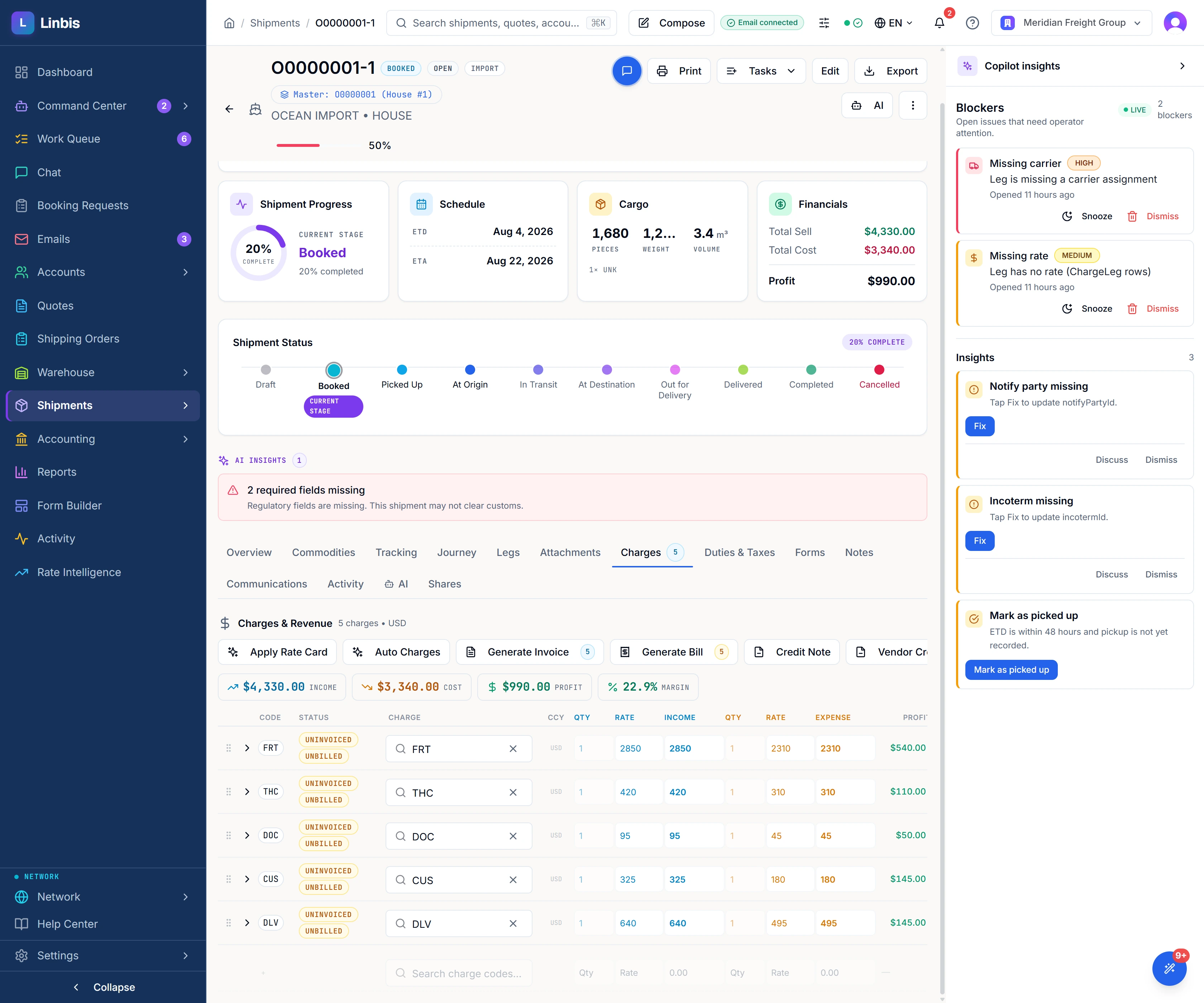
Linbis runs the whole file — quote, booking, shipment, warehouse, documents, customs filing, invoice, vendor bill and the general ledger — on one record with one set of charge lines, so the price you quoted, the cost you accrued and the invoice you sent are the same rows. Income and expense sit on the same charge line in independent currencies with the profit per line. It ships a real double-entry ledger with a 91-account freight chart of accounts, and lets you keep the books in Linbis, in QuickBooks only, or both, through a QuickBooks Online sync across 13 entity types (payments and bill payments both ways). The plans are flat monthly fees with seats included rather than per-user meters: $150 a month including one user, $299 a month including three, and a quoted plan for larger teams. Every plan starts with a free trial that does not ask for a card.
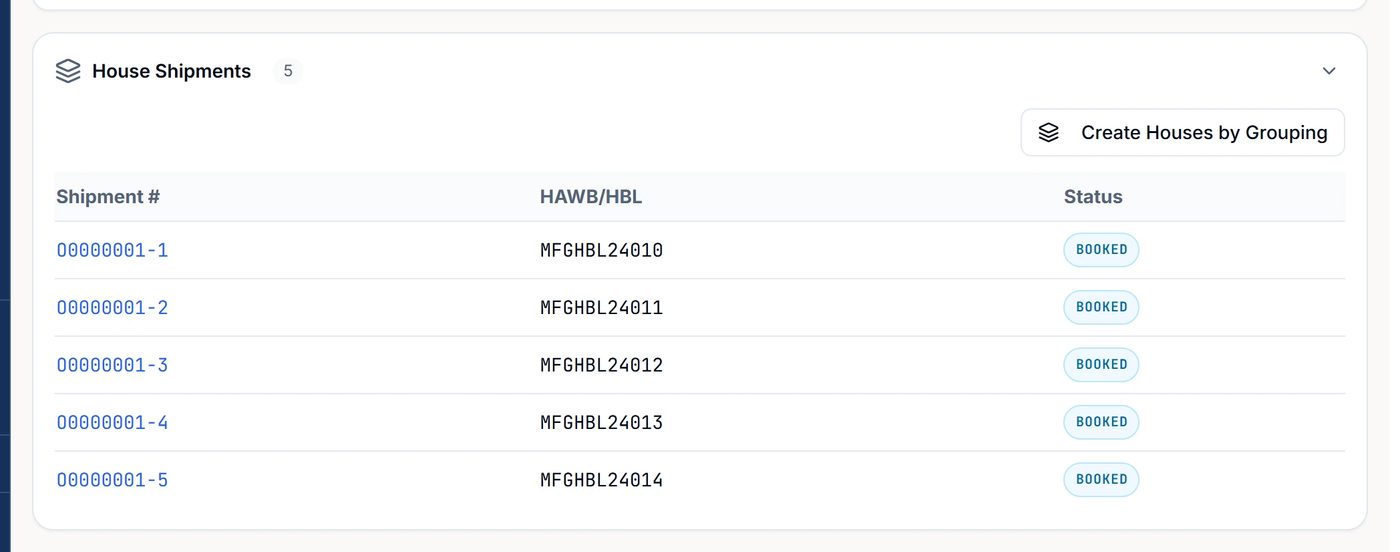
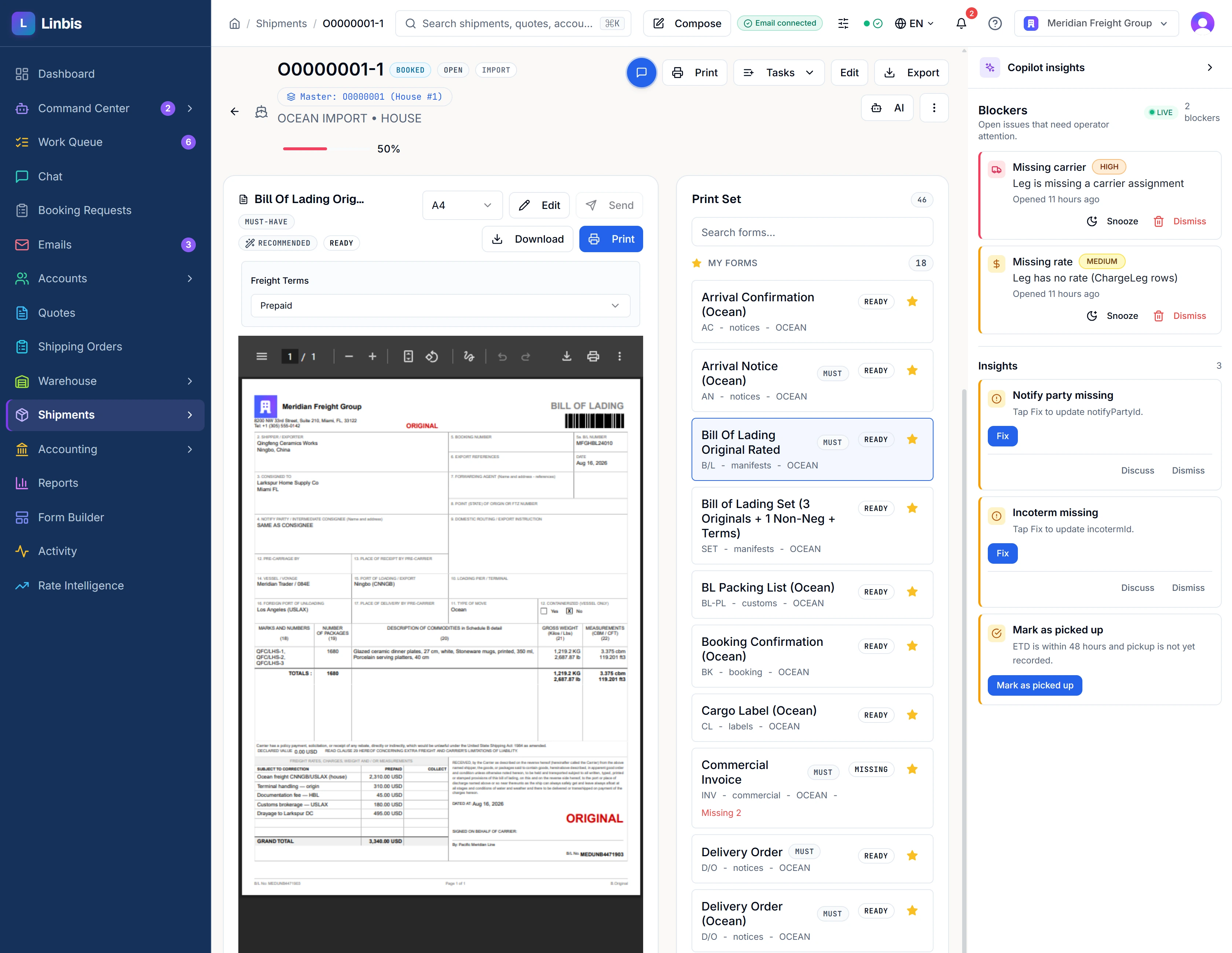
Four things are worth testing on a live shipment during that trial, because they are where the engineering has gone. First, documents render from the record at print time — more than 90 templates, over 75 of them used in the app (the bill of lading in six variants, air MAWBs as a 12-copy set), plus the layouts you build yourself in Forms Studio, a browser document designer that binds up to 288 fields on a shipment document — so a corrected weight is corrected everywhere. Second, consolidation is engineered, not looped: up to 500 shipping orders imported from a spreadsheet become house shipments under one master in one action, nineteen fields propagate master to house, and an edit to the master’s carrier, vessel, voyage, flight, ETD or ETA is written onto every house underneath it. Third, the AI proposes and you approve out of the box — every inbound email sorted into 24 classifications (23 freight types plus unknown), fields lifted from PDF and image attachments with their evidence, one Approve creating the shipment and firing its workflow — and then you choose, per action category, how much it may do alone inside an envelope you define. Fourth, your carrier’s rate sheet — spreadsheet, PDF or scanned page — becomes priced quote lines, and a basis the engine does not understand is refused rather than guessed. Linbis is headquartered in Miami and runs in seven interface languages — English, Spanish, Portuguese, French, German, Italian and Chinese — with the customer portal in eight.
The honest weaknesses: Linbis is a smaller company than any other vendor here; its public review base is small and old; its electronic customs filing is US CBP — ISF and AMS, filed under your own SCAC and bond — so other jurisdictions are documents handed to a broker, against the multi-jurisdiction breadth CargoWise offers; and divisions are a reporting tag that flows into QuickBooks departments, not separate per-entity ledgers.
Logitude World vs Linbis
A cloud-first forwarding platform with per-user plans and self-serve sign-up. It suits a forwarder who wants a quick start and is comfortable with a per-user meter as the team grows. Note that the obvious URL, /pricing, returns 404; the figures are on other pages of the site, which is worth knowing before you conclude they are hidden. The comparison that matters is the shape of the bill: a per-user meter that grows with headcount against a flat plan with seats included, a double-entry ledger and ISF filing from the record. Head to head: Logitude World vs Linbis.
Magaya vs Linbis
Magaya’s public positioning pairs forwarding with warehouse operations in one system, with a long presence on US–Latin America trade lanes. Pricing is not published — the pricing URL returns 404 — and implementation is sales-led. Linbis pairs them too: receipts and releases with proof of delivery, an installable barcode scan app that keeps working when the Wi-Fi drops, manifest import with per-line arrival reconciliation, and storage billing that freezes a per-piece snapshot per run — on the same record as the shipment, and with a Magaya-style warehouse receipt, modelled on Magaya’s receipt and restyled in Linbis’s document design, as the default receipt form. Test both on one live receipt rather than assume. The three-way comparison for multi-office forwarders is at Magaya vs CargoWise vs Linbis.
Where Linbis wins
Each line is a mechanism you can verify in the trial, not an adjective.
- The price is on the website. $150 a month including one user, $299 including three, Enterprise by quote; free trial without a card. On the date above it was the only vendor on this page publishing a figure at its pricing URL.
- One charge line carries both sides of the money in two currencies. Income and expense on the same row with independent currencies and per-line profit — bill in USD, cost in EUR, see the margin on the line, not at month-end.
- A real double-entry ledger, seeded for forwarding. A 91-account freight chart of accounts on day one, AR and AP subledgers, periods that close, per-file P&L, revenue recognised on delivery — and a choice of Linbis GL, QuickBooks only, or both, through a QuickBooks sync across 13 entity types (payments and bill payments both ways) that handles the overseas agent who is your customer and your vendor at once.
- Rates come in without typing. Drop the carrier’s spreadsheet, PDF or scanned tariff, or capture it off eleven carrier portals with the browser extension; AI structures it into buy and sell lines, weight-or-measure groups and weight breaks; a basis the engine does not understand is refused, never guessed.
- Customer contract pricing that cannot leak. A rate card scoped to one customer is invisible to every other customer, and every change is four-eyes approved with approver ≠ creator enforced by the database.
- The printed quotation is edited inside the email thread and goes back as a reply — letterhead, brand colour, cargo table with HS codes, charges with tax — priced off your own contracts and blocked from sending stale.
- Approve an email and the record exists, with its workflow already firing. 24 email classifications (23 freight types plus unknown) with confidence shown on each, extraction from PDF and image attachments with per-field evidence, one Approve creating the shipment, quote, vendor bill or pickup order.
- Every tenant designs its own workflow — 24 shipment flows (transport mode × import, export, domestic, cross-trade) plus five other record types — and automations fire from database triggers, so an operator click, an AI write, a spreadsheet import, a bulk edit and an API call all behave identically.
- AI you can govern and audit. Four autonomy levels across 35 action categories, an operating envelope (modes, countries, cargo, value ceilings, established customers), financial and high-risk actions human-only at every level, a replay of any policy change against your own history before you enable it — and 19 background checks sweeping the book for demurrage, ISF deadlines, cut-offs and duplicate bills.
- Documents and screens you design yourself. More than 90 templates, over 75 of which render live from the record, and Forms Studio, a browser designer where you start your own layouts from 22 ready-made templates or a blank page and bind up to 288 fields on a shipment document; rename or hide any field, drag cards and tabs, publish a locked company layout with version history.
- Seven interface languages, a customer portal in eight, and milestone names you rename per trade lane.
- ISF and AMS transmitted to CBP from the shipment record — Linbis is a CBP-approved software provider; you file under your own SCAC, bond and credential, with an attestation on every transmission and CBP responses on the timeline. EEI/AES data validated; denied-party screening against US, EU, UK and UN lists; duty and landed cost layered the way customs stacks it (MFN, Section 301, Section 232, AD/CVD, MPF/HMF) and versioned to the day you quoted. Details: ISF and AMS filing for freight forwarders.
- Tracking that cascades. Container milestones from Maersk and CMA CGM over DCSA, pulled on request with your own carrier credentials; flights on 50 major cargo and passenger airlines followed by live aircraft position every five minutes once OpenSky Tracking is switched on, with departure and arrival recorded on the file; each container milestone polled on the master copied onto every house — and four cost clocks per container: carrier demurrage, carrier detention, terminal storage, chassis per-diem, each with its own free time and daily rate.
- A customer portal that is shipped, not roadmap: 18 screens — booking and quote requests that land already assigned, document approvals, warehouse inventory, delivery scheduling, a message thread with your internal notes structurally invisible, and no-login tracking links.
- A warehouse that works in dead zones. Offline-first barcode scanning with ordered replay and no double counting, and storage billing that freezes a per-piece snapshot per run so a disputed invoice is reconstructed line by line.
- The overseas-agent problem solved three ways: a single charge routed to an AGENT bill-to; a netting statement per shipment per counterparty; an agent master with commission tiers and its own control accounts.
- Tenant isolation enforced by PostgreSQL row-level security, a hash-chained audit trail, and 79 permission keys, plus a per-person switch that hides costs, buy rates and margin.
Where CargoWise still wins
It would be dishonest to publish a CargoWise-alternatives page without this section. CargoWise wins on breadth of customs jurisdictions, on multi-entity accounting across countries — Linbis’s divisions are a reporting tag rather than separate ledgers, so a twelve-country group of separate entities is CargoWise’s home ground — on the depth of its partner and integration ecosystem, and on the simple fact that many large shippers and agents already run it, which smooths data exchange. If those are your constraints, the right response to the December 2025 repricing is to renegotiate, not to switch. This page is for the forwarder for whom they are not.
CargoWise alternatives for US customs filing
If the reason you are looking is customs, separate two jobs. Security filing — ISF 10+2 for ocean imports and the AMS manifest — is a forwarder’s and NVOCC’s job, and Linbis transmits both to CBP from the shipment record under your own SCAC and bond, with completeness scored against the deadline and the exact X12 previewed before it goes. Entry filing (ABI) is a broker’s job; Linbis carries the entry on the record and hands it to your broker rather than transmitting it, so if you are the broker filing entries at volume, weight Descartes and CargoWise. Read ISF and AMS filing for freight forwarders and customs clearance software before you shortlist.
CargoWise alternatives for transport management
If “transport management” means domestic trucking and dispatch rather than international forwarding, the answer is a TMS, not any vendor on this page — and CargoWise is the wrong comparison. If it means the transport legs of an international shipment, every platform here handles them; the difference is whether a truck move can be traced to the document that created it. In Linbis, pickup and delivery orders are created from the file and the driver manifest and loading guide print from it — see pickup and delivery and ground shipments.
Switching from CargoWise: the 30-day plan
Whatever you choose, the migration is the part vendors under-describe. Here is the plan we would run, week by week, with what Linbis does at each step — and what you should make any vendor prove.
- Week 1 — audit what you actually use. List the CargoWise modules your desk touches, the reports you cannot live without, and the documents your customers recognise. Export clients, shipments in flight and rates. Sign up for the free trial; a working chart of accounts, more than 90 branded document templates and a permissive workflow exist from the first login.
- Week 2 — import, don’t re-key. Bring the exports in through the import wizards — column mapping, party and port resolution, a dry-run preview with duplicates flagged, background creation — for shipments, shipping orders, accounts and warehouse receipts, from CSV files (shipping orders and receipts also from Excel). On Premium and Enterprise, Linbis runs a phased, resumable database migration for customers moving from the old Linbis Logistics platform; data from CargoWise comes in through the wizards. Configure your stages per trade lane, your customer contract rates, and your letterhead on the documents.
- Week 3 — run in parallel. One live shipment on Linbis beside CargoWise, then a lane, then the desk. Fix a weight and watch the documents follow; build a consolidation; send a quotation from the email thread; approve an inbound booking email into a record.
- Week 4 — cut over and close the old access. Turn on the customer portal and the tracking links, close the CargoWise seats to stop double entry, and schedule the first month-end close in the new ledger. Get the plan, seats and renewal terms in writing before this week — if a vendor cannot put a number in an email, you have learned something about the relationship.
How to test any of these in one week, on one live shipment
A demo shows you the vendor’s shipment. A trial shows you yours. Whichever platforms make your shortlist, run the same five checks on the same real file — a current import or export with a house bill, a consolidation and an invoice — and write down the answers.
- Fix one field and watch the paper. Change the gross weight on the shipment record. Do the house bill, the arrival notice and the invoice update themselves, or do you reopen each one? On Linbis the documents render from the record, so the answer should be “all of them, immediately”; make every vendor show you the same thing.
- Build a consolidation. Put three house bills under one master. Count the clicks and count the screens. Then change the vessel on the master and see whether the houses follow.
- Import, don’t type. Hand over a CSV of twenty customer accounts and ask to see them in the system the same day — with the dry-run preview before they land.
- Let the AI draft and read where it got its facts. Ask it to prepare the next action on the shipment and show its sources. Then confirm every write lands as an approval you can undo — and ask to see the settings where you decide, per action category, how much it may do alone.
- Get the price in an email before you sign anything. Plan, seats included, renewal terms. The vendor’s willingness to write a number down is itself a data point.
Questions forwarders ask
CargoWise vs GoFreight vs Magaya for multi-branch operations — which fits?
For a group of separate legal entities filing customs in several countries, CargoWise; that is what it is built for. For a US-based forwarder with several domestic branches, GoFreight and Magaya are both credible. Linbis puts every branch on one record and one login, tags divisions through to QuickBooks departments, and scopes who may edit what by role; divisions are a reporting tag, not separate ledgers — if your branches are separate legal entities, ask CargoWise about multi-entity accounting. GoFreight’s fit is compared line by line in GoFreight vs Linbis.
GoFreight vs CargoWise for a mid-sized NVOCC?
The mid-sized NVOCC is exactly the customer the December 2025 CargoWise repricing hit hardest, because volume-based pricing scales with the containers an NVOCC moves. GoFreight is the more common landing point among US NVOCCs; Linbis is the option if you want the price published, up to 500 imported shipping orders converted to houses in one action, and ISF and AMS filed to CBP from the shipment record. See GoFreight vs Linbis for the head-to-head.
Which CargoWise alternatives handle US customs filing?
Descartes is the deepest pure compliance stack. GoFreight and Magaya both position customs capability for US forwarders. Linbis transmits ISF and AMS to CBP from the shipment record under your own SCAC and bond, validates EEI/AES data and screens parties against four sanctions authorities. If you are the customs broker filing entries (ABI), weight Descartes and CargoWise more heavily — entry filing is a broker path Linbis does not transmit.
Is Logitude actually the best freight forwarding software for a small forwarder?
It will tell you a price on its site, though not at its pricing URL, and that alone puts it on a small forwarder’s shortlist. Whether it is best depends on whether you prefer a per-user meter (Logitude) or a flat monthly plan with seats included, a double-entry ledger and ISF filing from the record (Linbis). Trial both on the same live shipment.
Who are CargoWise’s competitors?
At enterprise scale: Descartes, and the large ERP-adjacent platforms. In the mid-market: Magaya and GoFreight (see GoFreight vs Linbis). For forwarders who want published pricing and enterprise-grade configuration without a consulting project: Linbis — and Logitude World if a per-user meter suits you. That is the list on this page, and the table above is how they differ.
Does Linbis work for a forwarder outside the United States?
Yes for operations, documents, seven interface languages, multicurrency on the charge line, invoice, bill and ledger, and overseas-agent accounting. The honest limit is electronic customs filing, which is US CBP; filings elsewhere are prepared as documents for a broker.
See the price before the demo.
Plans are published. The trial is free and does not ask for a card. Start with one live shipment beside your current system.
- WiseTech Global, “WiseTech Global launches CargoWise Value Packs”, 1 December 2025 — the “no longer any CargoWise Cloud standard hosting costs or seat fees” statement and the 31 October 2025 notification date.
- GoFreight, “CargoWise Pricing 2026” — the third-party per-container and per-entry figures quoted above, attributed to their source.
- Vendor pricing URLs requested 5 September 2026: cargowise.com/pricing (404), magaya.com/pricing (404), descartes.com/pricing (404), logitudeworld.com/pricing (404), gofreight.com/pricing (200, no dollar figures in visible text), linbis.com/pricing (200, figures published).
- Linbis plan figures from linbis.com/pricing on the same date; Linbis capability counts from the Linbis product inventory of the shipped platform (August 2026).
- Got a vendor wrong? Write to Linbis with the correction and we will fix it and note the date.