
Air freight software for forwarders who cut AWBs daily
Air freight is consolidation math on a deadline: houses under a master AWB, chargeable weight decided per line, and paperwork the airline will actually accept. This page shows how that runs in Linbis.
The short answer: Air freight software for a forwarder must do three things well: run consolidations (house air waybills under a master AWB, kept in sync), get chargeable weight right on every line (the greater of actual and volumetric at the carrier’s dimensional factor), and produce airline-ready paperwork from the file. Rate portals and airline booking sites do not do this work — it is forwarder software.
The consolidation: houses under a master, in sync
An air consolidation is one master air waybill with many customers’ houses underneath. In Linbis, change the airline, flight, ETD or ETA on the master and the change is written onto every house underneath it. Building at volume is one action: a pile of shipping orders becomes house shipments in a single conversion, built for hundreds at a time.
Profit is visible where air freight actually makes it: per house and per file, computed from charge lines that carry the buy and the sell together.
Chargeable weight — the number that decides the price
Air cargo pays for whichever is greater: what it weighs, or what its volume "weighs" at the dimensional factor (commonly 1:6,000 — one kilogram per 6,000 cubic centimetres). Quote the wrong one and the margin quietly leaves.
Linbis computes chargeable weight on every line, prices it against your rate cards, and refuses to invent a number when a rate basis cannot be resolved — an unpriced line says why, instead of showing a false zero.
Airline-ready paperwork, from the file
Master and house air waybills print from the file’s own data — no re-typing — among more than 90 finished document templates, over 75 of them rendered live from the file. Labels, manifests, and pre-alerts come from the same place. If your stationery differs, the drag-and-drop template designer binds up to 288 shipment fields into your own layout.
Watch: an air-eligible request becomes a quote
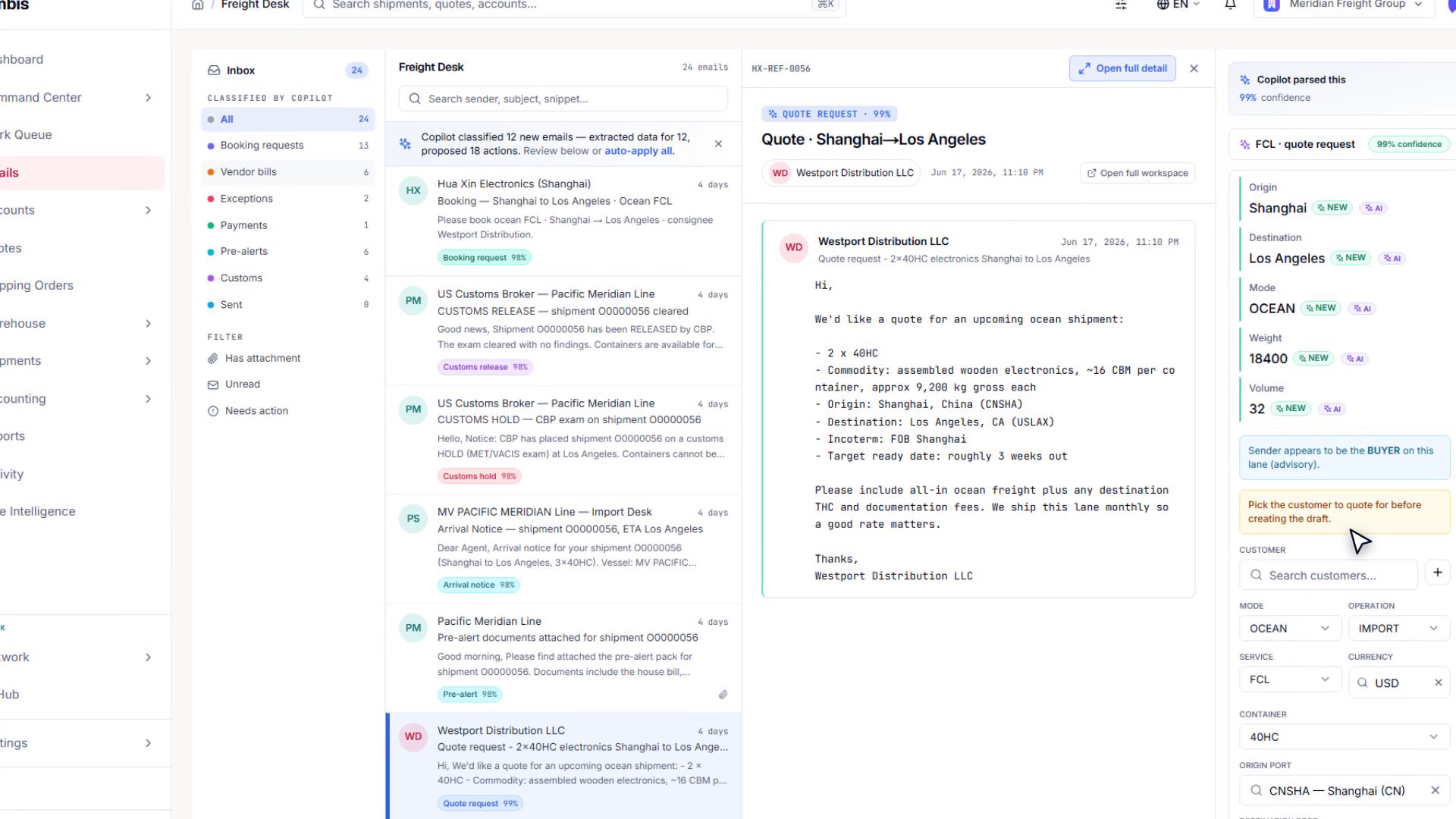
The freight desk reads a request, structures the cargo — weights, volume, equipment — and prepares the draft for the operator.
Video transcript
This is a silent screen capture of the Linbis freight desk. An email inbox is open, already classified by the copilot — booking requests, vendor bills, customs notices and pre-alerts sorted and counted. The operator opens a quote request: two forty-foot high-cube containers of electronics from Shanghai to Los Angeles. On the right, the copilot has parsed the request at 98 percent confidence into structured fields and asks the operator to pick the customer before it creates the draft quote. The operator confirms, and the draft quotation is prepared — nothing is sent without a person.
Tracked at the aircraft, not just the waybill
Air files carry live tracking at the aircraft level — live position on 50 major airlines, checked every five minutes once OpenSky Tracking is switched on in Settings, with departure and arrival recorded — alongside the file’s own milestones. Your customer sees progress on a branded tracking link that never exposes your costs or internal notes.
The file also knows what it is missing: readiness insights flag incomplete regulatory fields before they become an airline rejection.
Frequently asked questions
What is air freight software?
Software that runs a forwarder’s air operation: consolidations (house AWBs under a master AWB, kept in sync), chargeable-weight pricing, airline-ready documents generated from the file, and tracking down to the aircraft.
What is chargeable weight?
The greater of the cargo’s actual weight and its volumetric weight at the carrier’s dimensional factor (commonly 1 kg per 6,000 cm³ in air freight). Rates apply to the chargeable weight, so software must compute it per line.
What is the difference between a MAWB and an HAWB?
The master air waybill (MAWB) is the airline’s contract with the forwarder for the consolidation; house air waybills (HAWB) are the forwarder’s contracts with each customer whose cargo rides in it. One flight change on the master must reach every house — in Linbis, when you change the airline, flight, ETD or ETA on the master, the change is written onto every house.
Can Linbis build large consolidations quickly?
Yes — converting shipping orders into house shipments is one action, designed for hundreds at a time, with per-house profit visible afterward.
Does Linbis track flights?
Yes — for flights on 50 major cargo and passenger airlines, Linbis follows the aircraft by its live position every five minutes once OpenSky Tracking is switched on in Settings: departure and arrival are recorded on the file, alongside document and milestone tracking.
Cut the AWB set without the re-typing
Consolidations in sync, chargeable weight computed, paperwork the airline accepts — and the margin visible per house.
Start Free TrialThe screens and clips on this page are the real Linbis product recorded on a demonstration company; workflows shown are production features.