
Ocean freight software for freight forwarders and NVOCCs
Ocean freight is where software earns its keep or costs you money: master and house bills that must stay in sync, containers on the water for weeks, and free-time clocks that turn into invoices the day nobody is watching. This page shows what that discipline looks like in Linbis — on the real product, with a real import on screen.
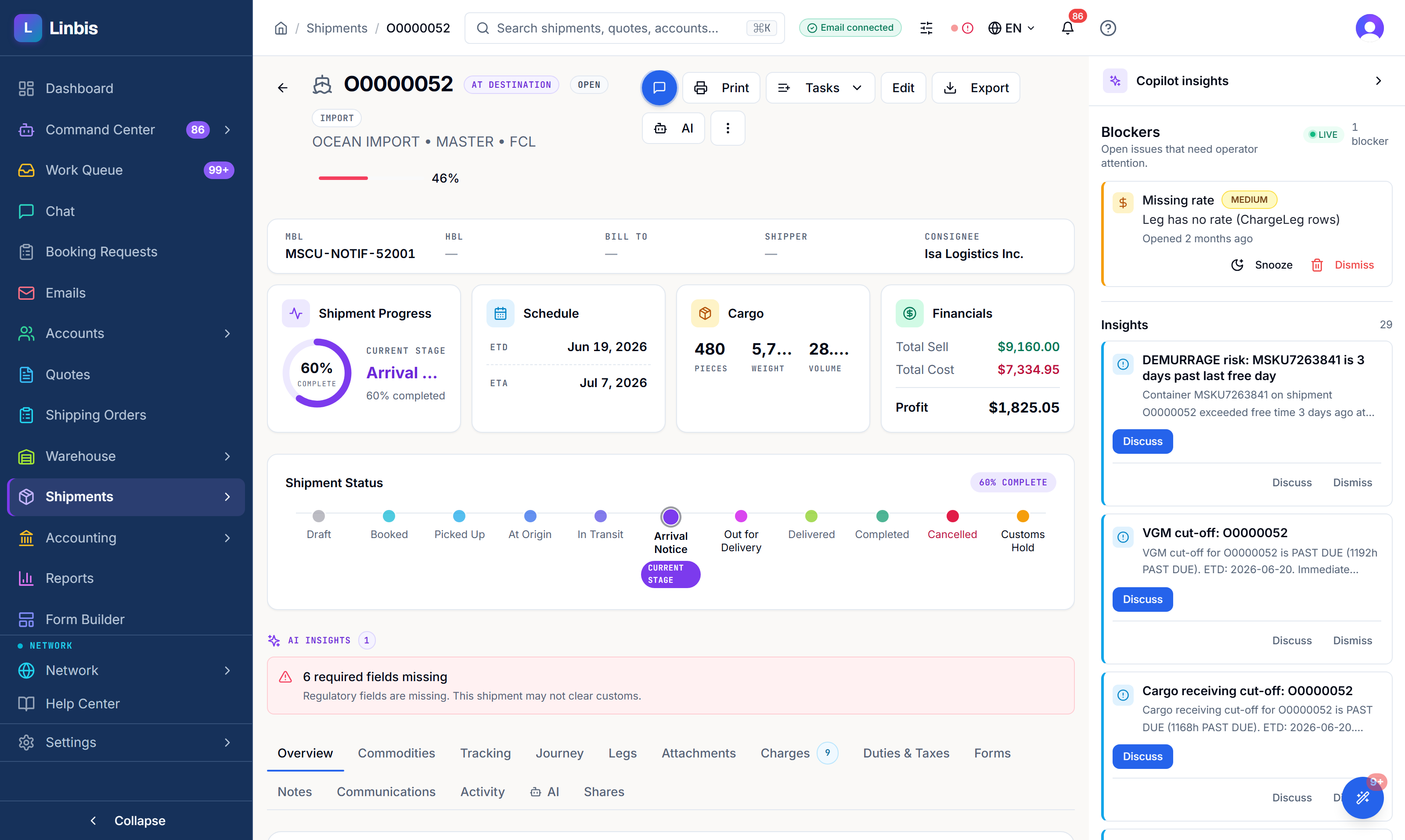
The short answer: Ocean freight software for a forwarder or NVOCC runs the consolidation (houses under a master, MBL and HBLs kept in sync), the containers (seals, VGM, load status, location), the paperwork (master and house bills of lading, arrival notices, delivery orders), the tracking (carrier milestones and the vessel itself), and — critically — the money clocks: demurrage, detention, storage, and chassis, each with its own free days and daily rate. Shipper-side container platforms and rate portals do not do this work; it is forwarder software.
What ocean freight management software has to do
Ocean freight management software is the system of record for a container file: it consolidates houses under a master and keeps the two in step, runs the cost clocks before the charges land, prints the paperwork from the same data, and carries the charges and the per-file profit. A rate portal or a shipper-side tracking app solves one slice each; the file itself is forwarder work.
| What the ocean file needs | What Linbis does with it |
|---|---|
| Master and house bills | Houses consolidate under one master; nineteen fields propagate master to house, and an edit to the master’s carrier, vessel, voyage, ETD or ETA is written onto every house underneath it. |
| Carrier milestones | Maersk and CMA CGM events over DCSA, pulled on request with your own carrier credentials, copied onto every house under the master. |
| The cost clocks | Four per container — carrier demurrage, carrier detention, terminal storage and chassis per-diem — each with its own free time and daily rate. |
| The paperwork | The bill of lading prints from the file in six variants and as a seven-copy set; arrival notices, delivery orders and manifests come off the same record. |
| The money | Charges, invoices and per-file profit on the same record, against a 91-account freight chart of accounts, with a QuickBooks Online sync if you keep the books there. |
One import, end to end — the workflow that prevents the ugly invoice
Here is an ocean import the way it actually runs: a master bill with houses consolidated under it, and every milestone polled from the carrier landing once on the master and writing itself onto every house underneath.
- The consolidation is built — houses hang under the master, and an edit to the master's carrier, vessel, voyage, ETD or ETA is written onto every house. Profit is visible per container and per house, not just per file.
- The vessel sails — carrier milestones are pulled in against the master; the file's stage advances on real events, not on someone remembering.
- The arrival notice arrives by email — Linbis reads it, and on one operator approval the discharge date, last free day, terminal, and vessel/voyage are stamped onto the shipment. The email became the record.
- Free time starts burning — the container's clocks are now live: days elapsed, free days consumed, and what it will cost if nothing moves.
- The risk is flagged before the last free day — the overnight watchdog prices the exposure, raises the charge, and drafts the customer notice for a human to send.
- Pickup, release, done — proof of the whole story stays on the file: what happened, what it cost, what the customer was told, and when.
The four cost clocks — where ocean files lose money
"Demurrage" gets the headlines, but an import container is actually running up to four meters at once, each with its own free days, its own tariff, and its own escalation tiers:
| Clock | What you're paying for | It stops when |
|---|---|---|
| Demurrage | The container sitting inside the terminal past free time | The box leaves the terminal |
| Detention | Keeping the carrier's container out in the world | The empty is returned |
| Terminal storage | The terminal's own storage tariff | The box leaves the terminal |
| Chassis per-diem | The chassis under the box, by the day | The chassis goes back |
Linbis runs all four per container — each with its own free days and daily rate — as live countdowns the operator can see: days elapsed, free days consumed, chargeable days so far, and the money accrued. The clocks accrue real amounts, so the exposure on a file is a number, not a feeling.
Watch the clock work — 40 seconds
The flagged container, the shipment around it, and where the operator acts — the loop that replaces the 2 a.m. demurrage panic.
Real product, real record. The insight fires before the last free day, not after the invoice.
Video transcript
Every forwarder knows the demurrage panic — the container nobody watched, the invoice nobody expected. This is Linbis. Your whole operation, one screen — every shipment, every deadline, every dollar. Open an ocean import: schedule, cargo, financials — and the profit you’re protecting. And here’s the difference: Linbis watches every container’s free time for you. The moment a box drifts toward demurrage — it’s flagged, the exposure is priced, and the customer notice is already drafted. Your team acts. The charge never lands. Stop paying for surprises. Start your Linbis free trial today.
Demurrage has its own deep-dive on this site: what demurrage is and how forwarders avoid the charges — including how the free-time clock escalates and what the operating discipline looks like.
Tracking that comes to you
Linbis pulls container milestones from Maersk and CMA CGM over DCSA, on request from the shipment's tracking panel, using your own carrier API credentials, and one update on the master writes itself onto every house underneath — events and statuses in a single pass. The vessel itself is on the file too: live position, speed, heading, and the trail of where it has been. When a ship stops, goes dark, or its ETA drifts, the exception is raised for you — and alongside the carrier's ETA you get a predicted arrival with a confidence band, computed from the vessel's actual movement and routing.
Your customer sees it too, on your terms: a branded tracking link with your logo and your milestone language, that expires when you say and never shows your costs or internal notes.
The paperwork, straight off the file
Master and house bills, sea waybills, arrival notices, delivery orders, manifests — generated from the file's own data, not re-typed. The bill of lading prints in six variants (original or non-negotiable; rated, freight-only or non-rated) and as a seven-copy set of three originals and four non-negotiable copies, each with its terms. For US-bound cargo, Linbis prepares and validates AMS and ISF data and hands it off for transmission — the security-filing fields live on the shipment, checked before they're needed.
Frequently asked questions
What is ocean freight management software?
Software that runs the ocean file end to end: consolidation of house bills under a master, carrier milestones on the file, the four container cost clocks, the paperwork printed from the same record, and the charges and invoices behind it. It is not a rate portal and not a shipper tracking app — each of those covers one slice of the job.
What is the difference between an MBL and an HBL?
The master bill of lading (MBL) is the carrier's contract with the forwarder or NVOCC for the container. House bills (HBLs) are the forwarder's contracts with each customer whose cargo rides in it. Software has to keep them in sync — a vessel change on the master must reach every house.
What is the difference between demurrage and detention?
Demurrage accrues while the container sits inside the terminal past its free time; detention accrues while the carrier's container is out with you past its free time. Different clocks, different fixes — the demurrage guide covers both in depth.
When do the cost clocks actually start?
Each has its own trigger from the carrier's or terminal's tariff — commonly discharge for demurrage and terminal storage, gate-out for detention and chassis. Linbis stamps the trigger dates from the arrival notice and runs each clock with its own free days and daily rate.
Does Linbis track the vessel itself or just carrier milestones?
Both. Carrier milestones from Maersk and CMA CGM come in over DCSA, on request, with your own credentials, and the vessel's live position, speed, and heading are on the shipment — with automatic exception alerts when a ship stops, goes dark, or the ETA drifts.
Is Linbis suitable for an NVOCC?
Yes — consolidation with houses under masters, per-container and per-house profit, original and non-negotiable bills of lading, and customer-facing documents in your brand are the NVOCC's daily toolkit.
Does Linbis file AMS and ISF?
Linbis prepares and validates the AMS and ISF data on the shipment and hands it off for transmission — so the fields are complete and checked before the deadline, and the filing itself goes out through the transmission channel.
Run ocean files that don't leak money
Consolidations in sync, containers watched, four cost clocks counted — and the risk flagged before the last free day, not after the invoice.
Start Free TrialThe screens and clip on this page are the real Linbis product recorded on a demonstration company; workflows shown are production features. Free time, tariffs, and escalation tiers vary by carrier, terminal, and contract — your documents control.