
AI that does the freight work — and always asks first
Not a chatbot bolted onto a TMS: an AI layer that reads every email, extracts the freight out of attachments, drafts the records and the replies, watches the book overnight — and treats your approval as the point, not a formality.
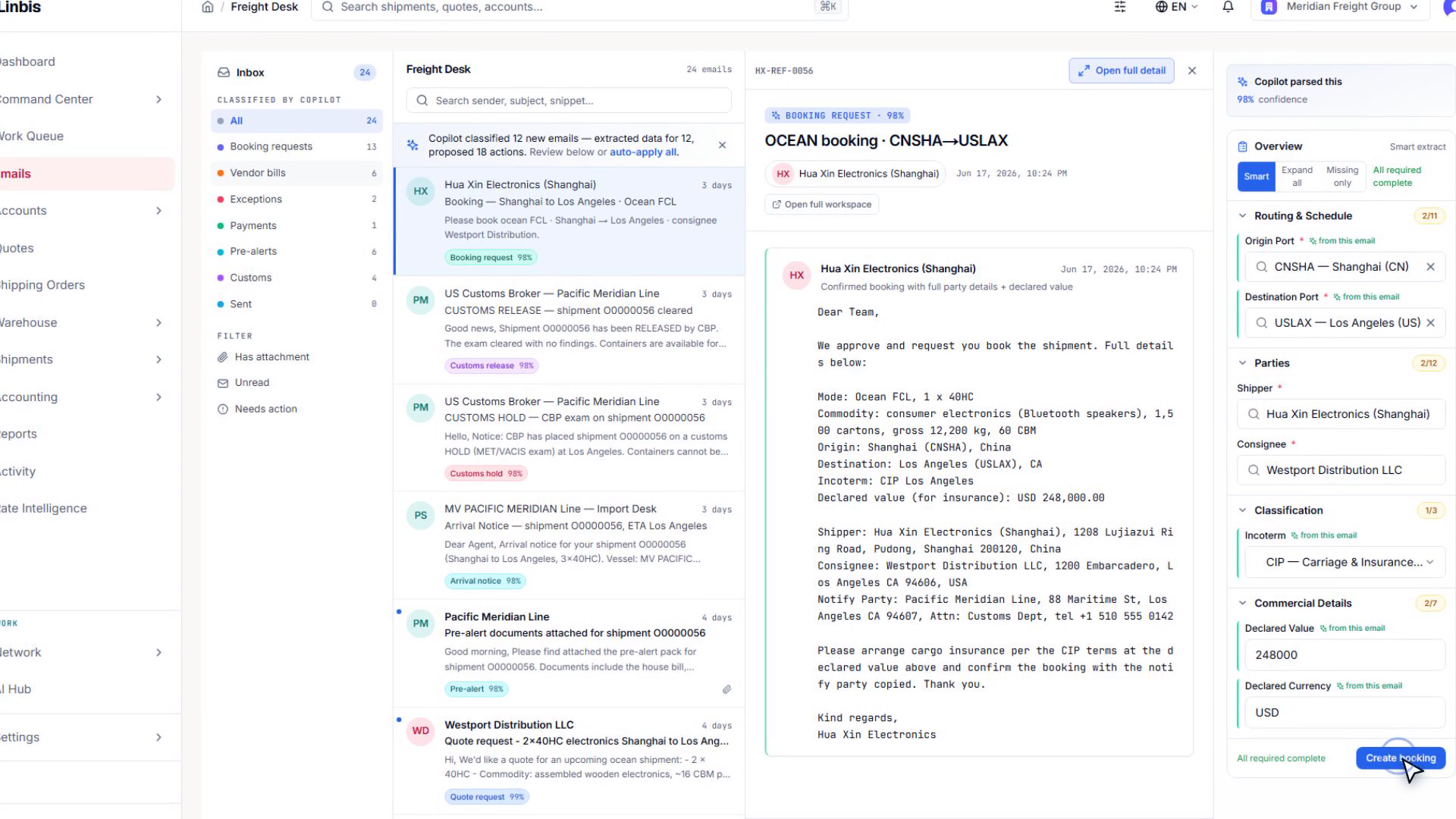
The short answer: Linbis AI reads every inbound email into freight-specific categories, extracts structured data from the message and its PDF attachments, drafts the resulting records and replies, and watches the whole book with background checks that flag risk before it becomes cost. The governing rule: the AI proposes, a person disposes. By default nothing the AI drafts is sent and nothing it proposes writes itself into operating data without an operator’s approval.
It reads everything — email and the attachments
Every inbound message is classified into one of 24 categories — 23 freight types (arrival notice, pre-alert, customs hold, booking confirmation, vendor bill, quote request and the rest) plus unknown — and every result carries a confidence score you can see: email that is unknown or below 60% confidence starts no workflow and is left for a person to handle.
Watch: the inbox reads itself
Bookings, arrival notices, customs holds — classified on arrival, with the described shipment already structured.
Video transcript
Every email is read and sorted the moment it lands — bookings, arrival notices, customs holds. Open one, and the shipment it describes is already structured — one approval turns it into the booking.
Watch: the attachment becomes data
A commercial invoice PDF read into structured, confidence-scored data — one click from applying.
Video transcript
The attachment gets read too: the commercial invoice becomes structured data — checked, scored for confidence, and ready to apply with one click.
It drafts; you decide
What the AI reads, it turns into staged work: a booking email becomes a proposed shipment; a quote request becomes a draft quotation; a carrier invoice becomes a draft payable with variances flagged; a risky container becomes a drafted customer notice. The work queue triages it all by confidence — approve the confident items in bulk, review the rest.
Watch: the work queue
Everything the AI processed, triaged — bulk approval where confidence is high, human review where it is not.
Video transcript
The work queue triages everything the AI processed — high-confidence items approve in bulk, the rest wait for a human.
It watches the book while you sleep
Named background checks sweep the whole book and raise deduplicated, priority-routed alerts: containers drifting toward demurrage with the exposure priced, files missing regulatory fields, vessels that stopped or went dark. The overnight demurrage watchdog drafts the customer notice before the last free day — the loop the demurrage page shows in action.
Autonomy you configure, accountability you keep
How much the AI may do is a setting, not a slogan: autonomy levels per action category, capped tenant-wide. High-risk categories require human approval at every level. Every AI action lands in an append-only decision log, approvals run through your role permissions, and executed actions carry a real undo. The AI cannot inflate its own trust score: machine-executed outcomes are excluded from the accuracy numbers that unlock more autonomy.
Frequently asked questions
Does the AI send emails to my customers?
No. It drafts them — replies, notices, follow-ups — and a person sends. By default every email it drafts waits for an operator’s approval; a customer status notification goes out on its own only if you raise its autonomy level or set a stage email to send automatically.
What can the AI read?
Inbound email in 24 categories (23 freight types plus unknown), plus PDF and image attachments: commercial invoices, arrival notices, packing lists, carrier documents — extracted into structured fields with confidence scores.
How is accuracy controlled?
Every result carries a confidence score you can see; unknown or low-confidence email routes to a human instead of a workflow. The reading pipeline is measured continuously against test corpora with hard accuracy floors.
Can I limit what the AI does?
Yes — autonomy levels per action category under a company-wide cap, with high-risk actions always requiring approval and an audit log of every decision.
Is this a chatbot?
There is a copilot you can ask questions — answers computed from live records with the rows cited. But the core is the working layer: reading, extracting, drafting, and watching, woven into the operation itself.
AI that earns trust the honest way
It reads, drafts, and watches. You approve. That’s the deal — and it’s written into the software.
Start Free TrialThe screens and clips on this page are the real Linbis product recorded on a demonstration company; workflows shown are production features.