
Enterprise logistics software: governance without the enterprise pain
Bigger operations don’t need more features — they need control: who may do what, proof of who did what, screens shaped to each team, and a way in from the legacy system that doesn’t lose history.
The short answer: Enterprise readiness in Linbis is four things: permissions built from a 79-permission grid into your own roles (down to reps who see only their own accounts, enforced in every list and search); a tamper-evident audit trail of who changed what; screens your admins reshape per team — fields renamed or hidden, cards and tabs rearranged, saved as named views with version history; and a way in for your history — a phased, resumable migration run by the Linbis team if you are moving off the old Linbis Logistics platform, and import wizards your team runs themselves for data from any other system.
Access that means it
Roles are built, not picked: a 79-permission grid composes into exactly the roles your org chart needs. Scope is enforced where it counts — put a salesperson on "only my accounts" and every list, dashboard count, and global search narrows to the book they own, with no way to switch it off from their side. Tenant isolation runs deeper still: the database itself refuses cross-company reads.
Proof of who did what
A tamper-evident record tracks who changed what — including which colleague acted on whose behalf, and with AI actions attributed to the AI service identity so a machine’s work can never impersonate a person’s. When the dispute or the audit comes, the answer is a query, not a memory.
Screens shaped to each team
Admins redesign the screens themselves: rename any field, hide what a team never uses, drag cards and tabs into a new order, add custom ones, choose layouts — and save the result as named views, personal or published company-wide, with version history and one-click restore. The operation’s language becomes the software’s language.
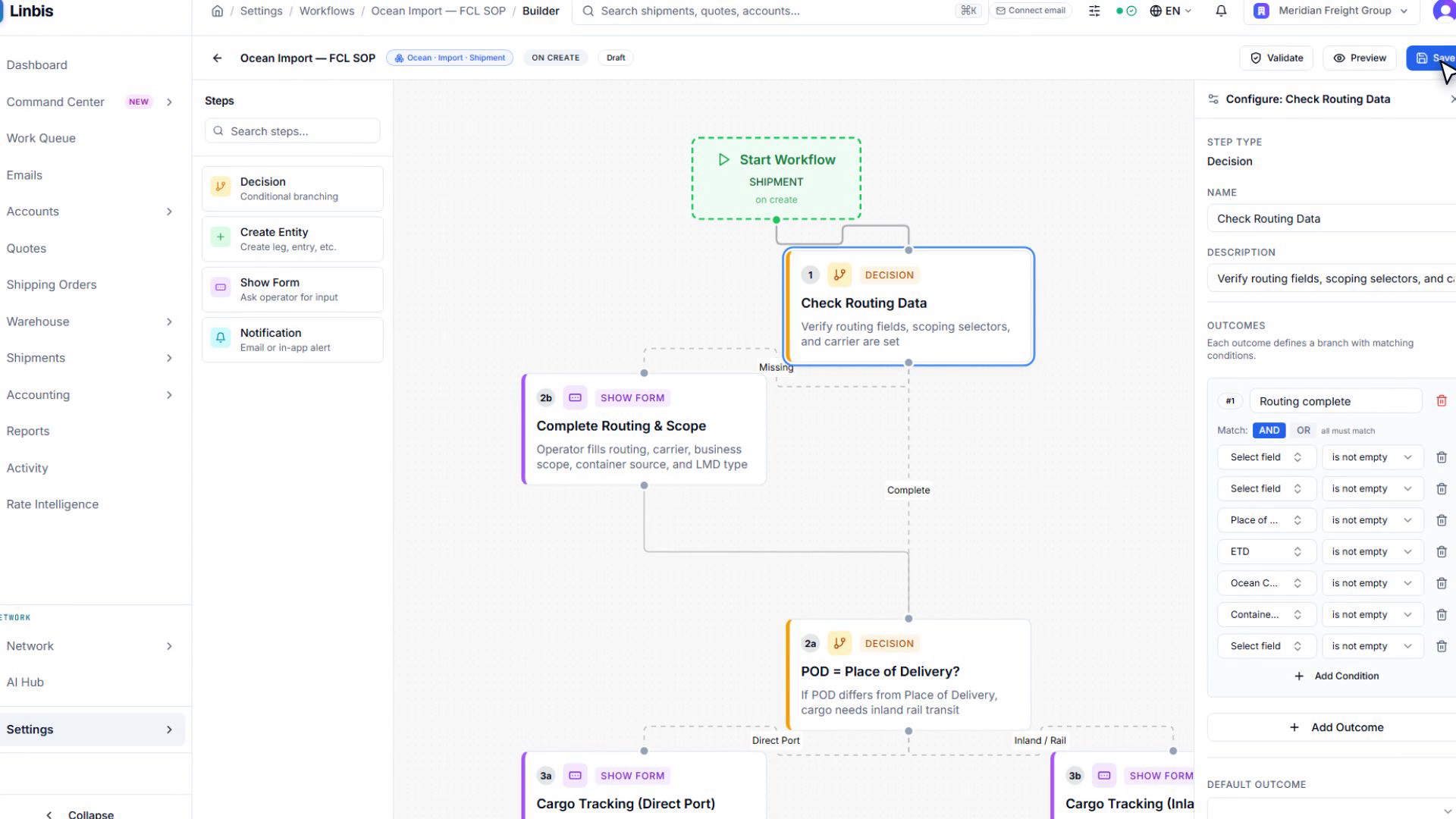
Watch: the SOP as a flowchart
Operating procedure drawn visually — decisions, branches, automations — the standardization layer big teams run on.
Video transcript
Your operating procedure, drawn as a flowchart — decisions, branches, and automations the whole team can see and follow.
The way in from your legacy system
History is the enterprise blocker, so migration is a discipline here. If you are moving off the old Linbis Logistics (.NET) platform, the Linbis team runs a phased, resumable migration that lifts your SQL Server database into Linbis and then proves it landed. Data from any other system comes in through the import wizards — shipments, accounts, shipping orders, and warehouse receipts, from CSV files (shipping orders and receipts also from Excel) — and they do the day-to-day loads too: column mapping suggested from your headers, duplicates flagged, a dry-run preview that writes nothing until you confirm, and, for shipping orders and receipts, the mapping saved for next time.
Frequently asked questions
Can I build custom roles?
Yes — from a 79-permission grid into exactly the roles you need, including record-scoped roles like "only my accounts" that narrow every list, count, and search.
Is there an audit trail?
Yes — tamper-evident, covering who changed what, delegation (who acted on whose behalf), and AI actions attributed to the AI identity so machine work cannot impersonate people.
Can different teams see different screens?
Yes — fields renamed or hidden, cards and tabs rearranged or added, layouts changed, all saved as named views (personal or company-published) with version history.
How does migration from a legacy system work?
If you are moving off the old Linbis Logistics (.NET) platform, the Linbis team runs a phased, resumable migration that lifts your SQL Server database into Linbis and verifies it landed. Data from any other system comes in through the import wizards, each with a dry-run preview that writes nothing until you confirm; the same wizards handle ongoing loads.
Scale the control, not the chaos
Roles that mean it, an audit trail that remembers, screens that fit each team — and your history migrated, not abandoned.
Start Free TrialThe screens and clips on this page are the real Linbis product recorded on a demonstration company; workflows shown are production features.