
What is demurrage? How freight forwarders avoid the charges
Demurrage is the fee that starts the moment your container overstays its welcome at the port. Here is what it is, how the charges actually accrue, and the system working forwarders use to stop them — including what that looks like in practice.
The short answer: Demurrage is a daily charge a carrier or terminal bills when an import container stays at the port beyond its allotted free time (commonly a few working days after discharge). It exists to keep containers and terminal space moving. The charge accrues per container per day, typically escalating the longer the box sits — and it stops only when the container is picked up. Avoiding it is a discipline of documents, deadlines, and visibility, not luck.
Demurrage vs. detention — the two fees people mix up
| Demurrage | Detention | |
|---|---|---|
| Where the container is | Inside the terminal/port | Outside the port, with you |
| What you're paying for | Occupying terminal space past free time | Keeping the carrier's container past free time |
| The clock stops when | The container leaves the terminal | The empty container is returned |
Both run on free-time clocks, both escalate, and both land on the importer's invoice — but they are triggered by different delays and fixed by different actions. This page covers demurrage; the same operating discipline applies to both.
How the charges actually accrue
Every import container gets free time — a number of days, set by the carrier and terminal, to be picked up after discharge. When free time ends, the meter starts: a per-day rate that typically rises in tiers the longer the container remains. Weekends and holidays may or may not count, ports differ, and every carrier's tariff is its own document. The operational truth is simple: the cost of a demurrage day is almost always far higher than the cost of the trucking, paperwork, or phone call that would have prevented it.
Free time and tier structures vary by carrier and terminal — the shape is universal: a short green window, a cliff, and an escalating meter. The winning move happens in the blue window, not after the cliff.
Wondering what the numbers look like per day? That's its own question — see our companion guide: how much demurrage costs per day, with rate examples.
Why containers end up stuck
- Documents not ready — a missing bill of lading endorsement, an incomplete customs entry, an unpaid freight invoice blocking release.
- Customs holds and exams — the clock usually keeps running while the box waits.
- No trucker booked — free time evaporates while dispatch is arranged.
- Port congestion — appointments scarce exactly when free time is shortest.
- Nobody was watching — the most common one: the deadline lived in someone's memory instead of a system.
How demurrage management works in Linbis
Explaining demurrage is easy — any page can do it. What matters is what managing it looks like on a real shipment, so here is exactly that, from a live Linbis workspace:
- Every container is tracked against its free time. The shipment carries its schedule, cut-offs, and containers — so "when does free time end?" is a fact on the record, not a memory.
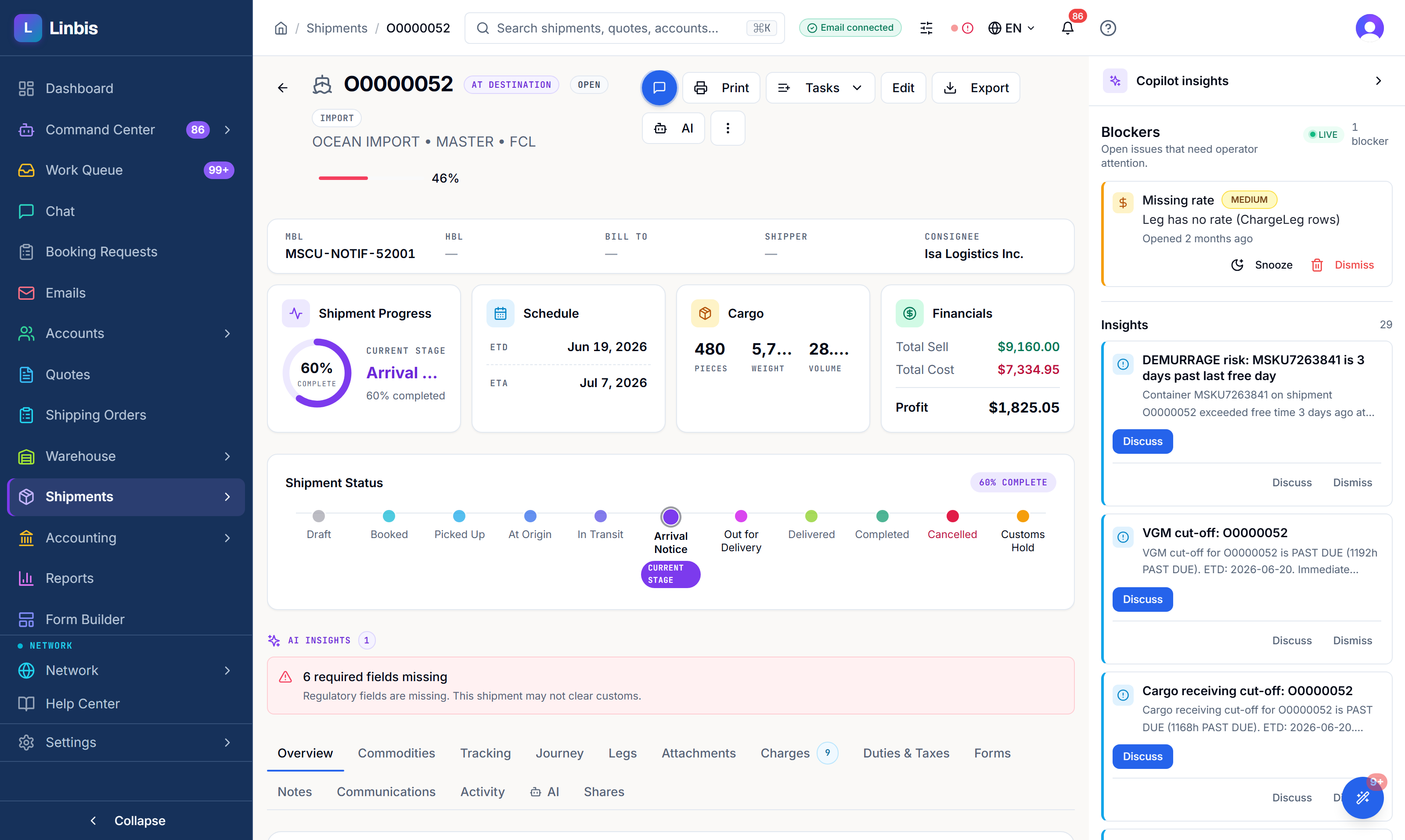
- The platform watches the clock, not a person. When a container approaches or passes its last free day, a demurrage-risk insight surfaces on the shipment itself — in the screenshot below: "container MSKU7263841 is 3 days past last free day."
- Risk arrives next to everything needed to act. The same screen holds the blockers (a missing rate), the past-due VGM and cargo-receiving cut-offs, the charges, and the documents — the operator resolves, books trucking, or escalates without leaving the shipment.
- The team discusses it where it lives. Each insight has a Discuss action, so the conversation about the flagged container happens attached to the container, not lost in a group chat.
Watch it happen — 40 seconds
The same workspace in motion: the flagged container, the shipment context around it, and where the operator acts.
Screen recording from a live Linbis workspace: a demurrage-risk insight on ocean import O0000052 — container MSKU7263841 flagged three days past its last free day, alongside the shipment's cut-off warnings and status flow.
Video transcript
Every forwarder knows the demurrage panic — the container nobody watched, the invoice nobody expected. This is Linbis. Your whole operation, one screen — every shipment, every deadline, every dollar. Open an ocean import: schedule, cargo, financials — and the profit you’re protecting. And here’s the difference: Linbis watches every container’s free time for you. The moment a box drifts toward demurrage — it’s flagged, the exposure is priced, and the customer notice is already drafted. Your team acts. The charge never lands. Stop paying for surprises. Start your Linbis free trial today.
Next question, its own answer: How much is demurrage per day? Rates, tiers, and a worked example →
Frequently asked questions
What is demurrage in shipping?
A per-container, per-day charge billed when an import container remains at the port terminal beyond its free time. It compensates the carrier and terminal for tied-up equipment and space, and it escalates the longer the container stays.
What is the difference between demurrage and detention?
Demurrage is charged while the container is inside the terminal past free time; detention is charged while you keep the container outside the port past its return date. Different clocks, different fixes — both expensive.
Who pays demurrage charges?
Contractually it follows the shipping terms, but in practice the importer of record usually receives the bill — and a forwarder who let the deadline slip usually receives the phone call.
How does Linbis help avoid demurrage?
Linbis tracks each container against its free time on the shipment record and surfaces a demurrage-risk insight when a container approaches or passes its last free day — next to the shipment's cut-offs, blockers, documents, and charges, with a Discuss action so the team resolves it in place. The goal: day one of risk is seen the morning it happens, not on the carrier's invoice.
How do freight forwarders avoid demurrage?
By running free time as a managed deadline: recording it per shipment, clearing documents before vessel arrival, dispatching trucks against the last free day, and using software that flags at-risk containers automatically instead of relying on memory.
See your containers' clocks in one place
Run one real import through Linbis — free-time visibility, cut-off warnings, and demurrage-risk flags included.
Start free — see pricingFree time, rates, and tariff rules vary by carrier, terminal, and contract; verify your own tariffs for specific shipments. This page describes Linbis platform capabilities as shipped and shows real product footage; nothing here is legal or financial advice.