
AI Agents vs Traditional Automation: What Changes in Logistics
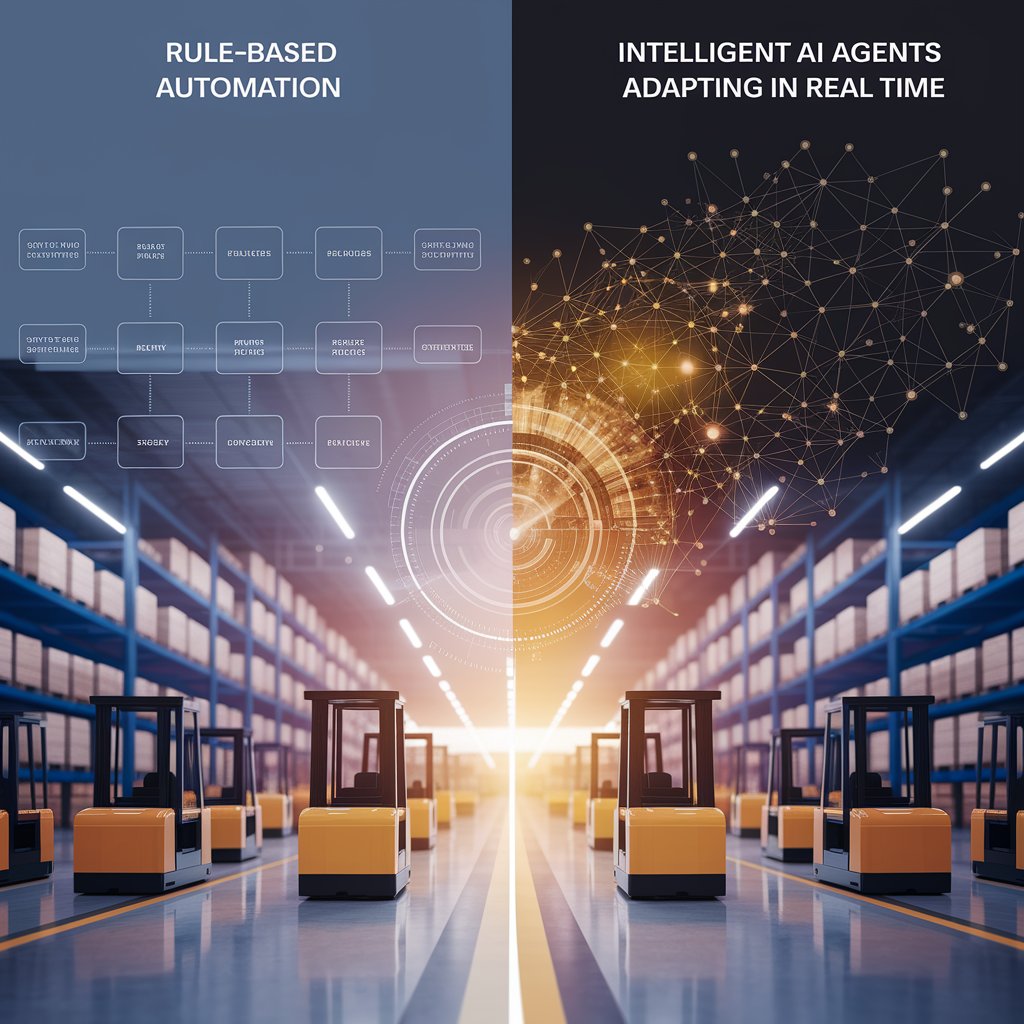
AI agents represent a new step forward. Unlike traditional automation, they can adapt, learn, and make decisions in real time. Understanding the difference between both approaches is essential for modern logistics teams.

What Is Traditional Automation in Logistics?
Traditional automation is based on fixed rules and predefined workflows.
Tasks are executed only when specific conditions are met.
If something unexpected happens, the system stops or requires human intervention.
Traditional automation works well for stable and repetitive processes.
However, it struggles in environments with frequent changes and uncertainty.

What Are AI Agents in Logistics?
AI agents are intelligent systems that observe, decide, and act autonomously.
They analyze real-time data from shipments, inventory, and operations.
They adapt their behavior when conditions change.
They learn from outcomes and improve over time.
This makes them suitable for complex and dynamic logistics environments.
Key Differences Between Both Approaches
- Decision-Making
Traditional automation follows rules.
AI agents make contextual decisions. - Adaptability
Traditional automation is static.
AI agents adjust in real time. - Learning Ability
Traditional automation does not learn.
AI agents improve continuously. - Human Dependency
Traditional automation needs frequent intervention.
AI agents operate with minimal supervision.

Where Traditional Automation Still Works Best
Traditional automation is still useful in many logistics areas.
Simple data transfers and system integrations.
Standard document generation.
Basic warehouse workflows with low variability.
Highly regulated processes with fixed rules.
In these cases, rule-based automation remains effective.
Where AI Agents Add More Value
AI agents excel in complex and unpredictable scenarios.
Shipment monitoring and delay management.
Dynamic routing and capacity planning.
Inventory optimization under fluctuating demand.
Customer communication with real-time updates.
Exception handling across global operations.
Choosing the Right Approach
Most logistics organizations will not choose one over the other.
Traditional automation handles stable processes.
AI agents manage dynamic decision-making.
Together, they create hybrid logistics operations that balance control and flexibility.
Conclusion
AI agents vs traditional automation highlights a critical shift in logistics technology. While traditional automation remains valuable for fixed tasks, AI agents bring adaptability, intelligence, and real-time decision-making to complex operations.
For logistics teams navigating constant change, AI agents are not replacing automation—they are enhancing it, enabling smarter, more resilient supply chains.