
Linbis › Compare › Logitude World vs Linbis
Compare · Logitude World vs Linbis
Logitude World vs Linbis for Freight Forwarders (2026)
Two cloud platforms a small or growing forwarding desk shortlists together. Compared on the thing that decides it first — per-user plans against flat plans with seats included — and then on what each one does with a shipment: consolidation, warehouse, customs filing, the books, the customer, the AI.
Short answer. Logitude World is cloud freight forwarding software sold per user: on the date above its Spanish pricing page lists three plans — Economy at $39, Business at $65 and Premier at $79 per user per month billed annually ($45, $70 and $90 monthly) — with API and customer-tracking-app features marked “minimum 10 users”; its English pricing URL returns a 404. Linbis is sold as flat monthly plans with seats included — $150 a month including one user, $299 including three, enterprise by quote — and puts the warehouse, US customs filing under your own bond, a double-entry ledger with a QuickBooks sync that runs both ways for payments, and a consolidation engine that turns up to five hundred imported orders into houses in one action, on the same record, in seven interface languages.
For one or two users who need quotes, shipments, documents and invoices, Logitude’s list price is lower and this page says so. For a desk that consolidates, runs a warehouse, files ISF and AMS, keeps a ledger, or is about to grow past the seats where per-user pricing stops being cheap, read the rows below and test both on one live shipment.
The comparison table
Alphabetical. Logitude rows are its public positioning — what logitudeworld.com says on the date above — because we have not operated the product, and we say so. The Linbis column describes the shipped product, with counts taken from its configuration.
| Row | Linbis | Logitude World (public positioning) |
|---|---|---|
| Built for | Forwarders, NVOCCs, customs brokers and 3PLs — one office or many — that want enterprise configuration without a consulting project, and the price up front | “An all-in-one freight forwarding software that scales with your operation”; “hundreds of freight forwarders” (its words) |
| Published price | Published. $150 / month incl. 1 user · $299 / month incl. 3 users · Enterprise by quote — linbis.com/pricing | Published on its Spanish pricing page: Economy $39 · Business $65 · Premier $79 per user / month billed annually ($45 / $70 / $90 monthly); English pricing URL returns 404 |
| Price shape | Flat monthly plans with seats included; not per-user, not per-transaction | Per user per month; some features (API, customer tracking app) listed as minimum 10 users |
| Modules | Quote, shipping orders, shipments (air, ocean, ground), consolidation, warehouse, documents, customs filing, invoicing, AP, general ledger, agents, CRM, portal, email copilot | Shipments management, quote management, cross-dock warehousing, cost/profit-loss analysis, INTTRA and e-AWB connectivity, CRM on the upper plan, customer tracking app (public positioning) |
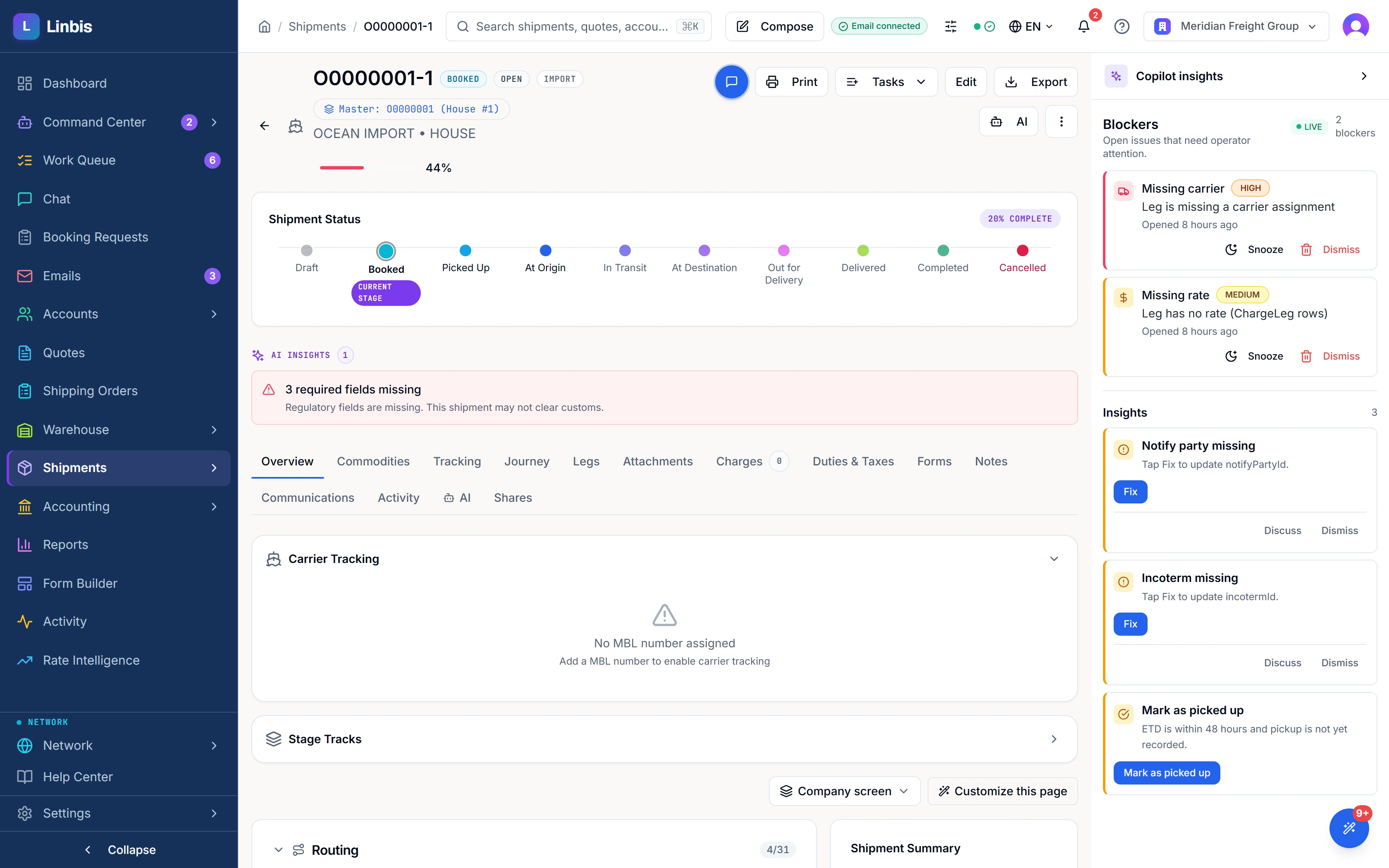
| Consolidation | Up to 500 imported shipping orders → houses under one master in one action (batches of 50); 19 fields cascade master → house; an edit to the master’s carrier, vessel, voyage, flight, ETD or ETA writes to every house | Master/house shipments (public positioning) |
| Warehouse | On Premium: receipts and releases with proof of delivery, zones and bins, piece/pallet/container nesting, an installable scan app that works offline, manifest import with per-line reconciliation, snapshot storage billing | “Cross-docs warehousing” (public positioning) |
| Customs filing | ISF 10+2 and AMS assembled from the shipment and transmitted to CBP under your own SCAC and bond; CBP-approved software provider; EEI validation; denied-party screening; duty and landed cost per line | Not a stated focus on its public pages |
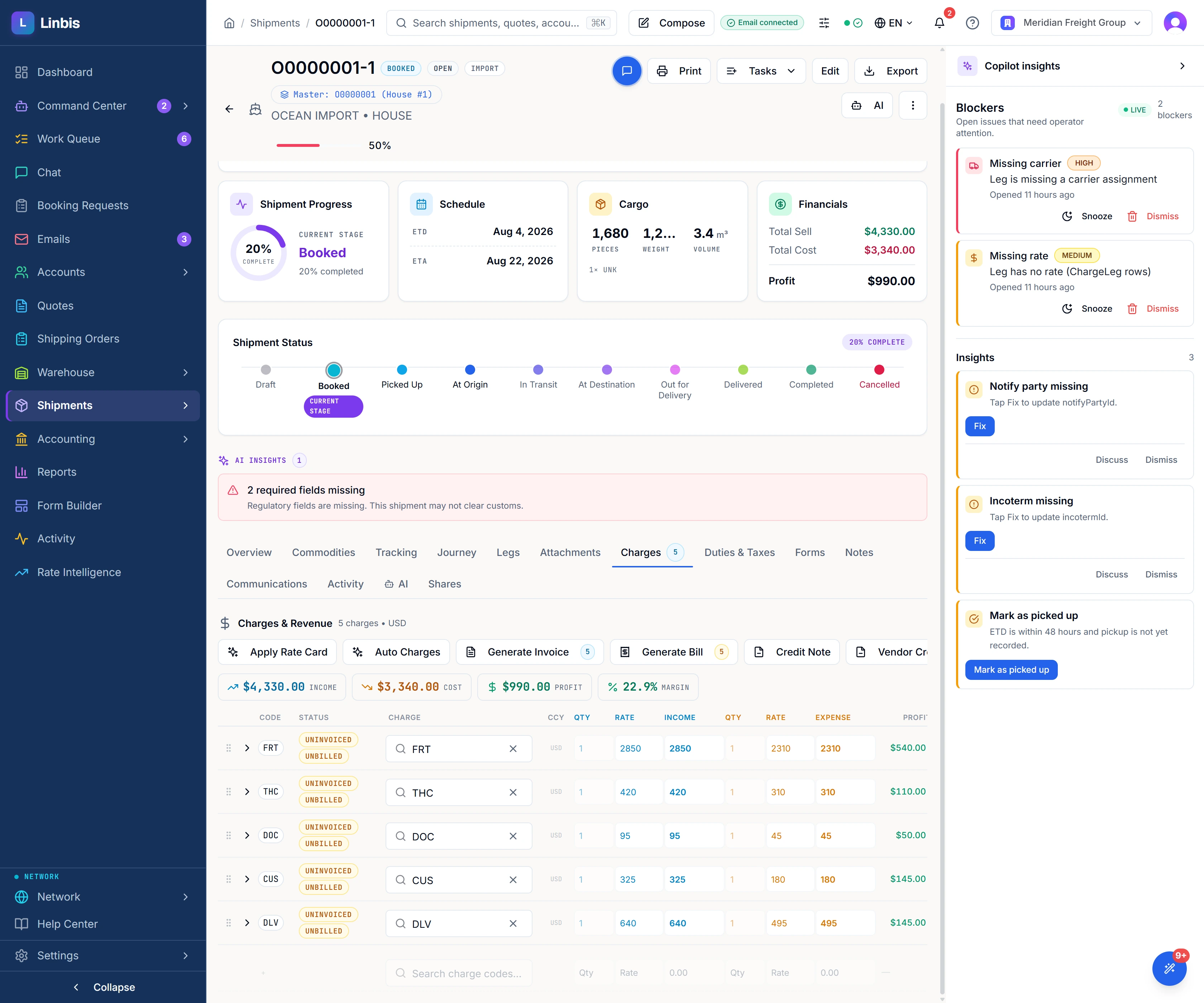
| Accounting | Income and expense on one charge line in two currencies with profit per line; 91-account freight chart of accounts; periods that close; AR/AP subledgers; agent statements; books in Linbis, in QuickBooks Online, or both via a sync across 13 entity types (payments both ways) | Cost / profit-and-loss analysis and shipping statements (public positioning) |
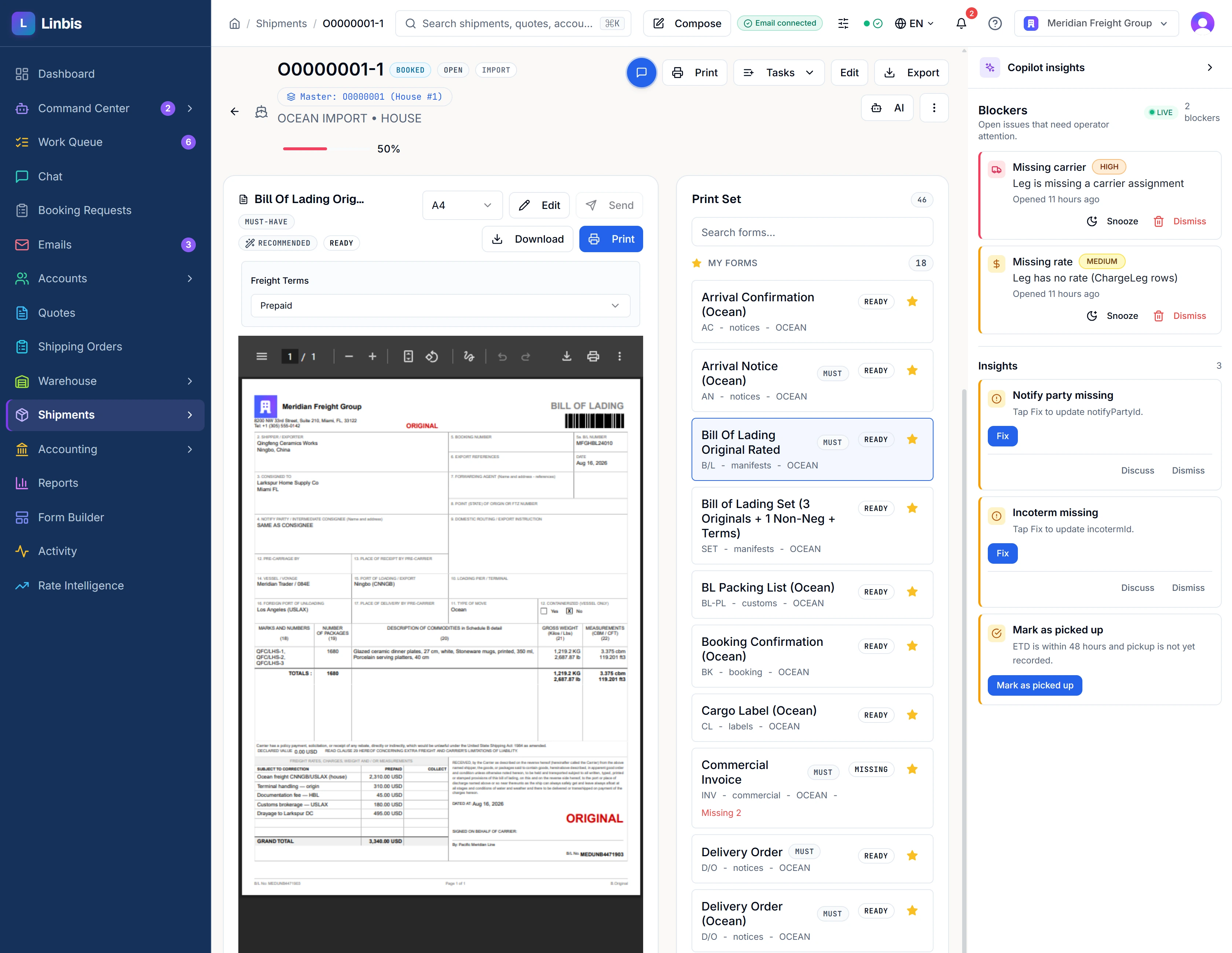
| Documents | More than 90 templates, over 75 of them rendered live from the record; browser designer binding up to 288 fields on a shipment document | Shipping documents from the shipment (public positioning) |
| Tracking | Container milestones from Maersk and CMA CGM over DCSA, pulled on request with your own carrier credentials; flights on 50 major cargo and passenger airlines followed by live aircraft position every five minutes once OpenSky Tracking is switched on, with departure and arrival recorded on the file; four container clocks | Customer tracking app on the upper plans (public positioning) |
| AI | 24 email classifications (23 freight types plus unknown), with confidence shown on each; extraction from attachments with evidence; one Approve creates the record and fires its workflow; four autonomy levels across 35 action categories | Automation features (public positioning) |
| Customer portal | 18 routes in 8 languages; no-login tracking links | Customer tracking app (public positioning) |
| Languages | 7 interface languages; portal in 8 | Site in English, Spanish and French |
| Getting live | Free trial, no card; a working chart of accounts, more than 90 templates and a permissive workflow from the first login; import wizards (shipments, accounts, shipping orders, warehouse receipts) with dry-run preview; on Premium and Enterprise, a phased migration run by the Linbis team for customers moving off the old Linbis Logistics platform | Self-serve trial sign-up (public positioning) |
| Honest weakness | Smaller company; small, old public review base; electronic customs filing is US CBP only; divisions are a reporting tag; a one-user desk pays more than Logitude’s list price | Per-user pricing grows with every login; API and tracking app gated at ten users; pricing published only on the Spanish site |
Logitude rows are its public positioning as read on logitudeworld.com on the date above; we have not operated the product. Its figures are quoted from its Spanish pricing page and may change; check the page. We do not reprint third-party star ratings.
Per-user versus flat: the arithmetic
Put both offers into the same unit — dollars per year for your team — and the comparison stops being a matter of opinion.
| Team | Logitude Business $65 / user / mo, annual |
Logitude Premier $79 / user / mo, annual |
Linbis flat plans, seats included |
|---|---|---|---|
| 1 user | $780 a year | $948 a year | Startup plan: $1,800 a year ($150 / month incl. 1 user) |
| 3 users | $2,340 a year | $2,844 a year | $3,588 a year |
| Larger teams | Multiply by every login — operations, accounting, warehouse, sales — and note the ten-user minimum on API and the tracking app | Same, at the higher rate | Seats beyond the included ones and larger teams are on the pricing page or quoted; the plan does not move with shipment volume |
Read honestly: at one to three seats on list price, Logitude is cheaper, and if the desk needs quotes, shipments, documents and invoices and nothing on this page’s operations rows, that is the right answer. What the Linbis plan buys for the difference is scope — the warehouse on Premium, ISF and AMS filed under your own bond, a ledger you can file from, a consolidation engine, a portal in eight languages — and a bill that does not grow with headcount or volume. Both vendors’ figures are on the page in the open, which is rarer in this category than it should be.
What Logitude publishes about itself
Read Logitude’s own site before anyone’s comparison, ours included. Its homepage title is “Freight Forwarding Software – Logistics Software”; the headline calls it “an all-in-one freight forwarding software that scales with your operation” and says it helps “hundreds of freight forwarders.” Its product page lists advanced shipment management, quote management and cross-dock warehousing, with security and automation sections. The pricing page exists on the Spanish site (three plans per user per month, annual and monthly rates, features stacked by plan, INTTRA and e-AWB connectivity on the mid plan, CRM on the top plan, API and the customer tracking app marked minimum ten users) and on the English site the equivalent URL returns a 404 while a “Solutions & Pricing” page carries no figures. That is a real product, published in three languages, with a self-serve trial — a forwarder shortlisting it is not wrong to.
Consolidation, warehouse, customs, the books
Consolidation. On Linbis, up to five hundred shipping orders imported from a spreadsheet become house shipments under one master in one action, in batches of fifty, each house with its own file number, leg plan and copied charges; nineteen fields propagate from master to house; an edit to the master’s carrier, vessel, voyage, flight, ETD or ETA is written onto every house; bulk edits do not send bulk emails. Ask Logitude how many houses it builds in one action and what cascades from the master.
Warehouse. Logitude lists cross-dock warehousing. Linbis includes a warehouse module on Premium: receipts and releases with proof of delivery, zones and bins, piece / pallet / container nesting, an installable barcode scanning app that keeps working when the Wi-Fi drops, manifest import with per-line reconciliation, storage billing frozen as a per-piece snapshot per run, releases that cannot be self-approved. If cargo sits in your warehouse for more than a cross-dock, receive one real consignment on each platform during the trial.
Customs filing. Customs filing is not a stated focus of Logitude’s public pages; ask. On Linbis the ISF 10+2 is assembled from the shipment, completeness-scored, converted to the X12 message CBP expects, and transmitted — standalone or as an ISF-5 on the AMS manifest bill — under your own SCAC and bond; Linbis is a CBP-approved software provider. Entry filing is the broker’s path. Details on the AMS and ISF page.
The books. Logitude lists cost and profit-and-loss analysis and shipping statements. Linbis keeps the customer’s price and the carrier’s cost on one charge line in independent currencies, with the profit per line and the P&L per file computed from them, issues the invoice and the vendor bill from those rows, and closes the period in a double-entry ledger with a 91-account freight chart of accounts — or syncs with QuickBooks Online across thirteen entity types (payments and bill payments both ways), or both. Agents who are both customer and vendor get a netted statement.
AI and automation
Logitude lists automation features. On Linbis, out of the box, every inbound email is sorted into one of twenty-four classifications (twenty-three freight types plus unknown), with a confidence score on every result, and unknown or low-confidence email goes to a person; fields are lifted from PDF and image attachments with the evidence beside each one; one Approve creates the shipping order, shipment, quote, vendor bill or pickup order and fires its workflow — and nothing is written to operating data until that approval. Then, when you are ready, you decide per action category — thirty-five of them, across four autonomy levels — how much it may do alone, inside an envelope you define, with high-risk actions requiring a human at every level and a replay of any policy change against your own history before you switch it on. Every tenant designs its own workflow — twenty-four shipment flows plus five other record types — and the automations fire the same way from a click, an import, an AI write or an API call.
Where Logitude wins
- List price for one to three users. $39–$79 per user per month billed annually is less than Linbis’s $150 or $299 flat plans at those seat counts.
- Published figures in three languages. The Spanish pricing page is complete, plan by plan; Linbis publishes in English and Spanish.
- Carrier connectivity named on the pricing page. INTTRA and e-AWB connectivity are listed by plan (public positioning); test them in the trial if you book that way.
- A larger public footprint. Some 1,050 URLs in its sitemap, a glossary and release notes going back years; a forwarder who wants a vendor with a long visible history may prefer that.
Where Linbis wins
Mechanisms, not adjectives — each one is testable in the trial.
- A bill that does not grow with headcount. Seats included; the warehouse, accounting and sales logins are not a per-user meter; API and portal are not gated at ten users.
- The warehouse on the same file, included on Premium, with offline scanning and snapshot storage billing.
- Customs filed from the shipment under your own bond by a CBP-approved software provider.
- One charge line carries both sides of the money, in two currencies, with the margin on it.
- A ledger you can file from — or QuickBooks, or both — through a sync across thirteen QuickBooks entity types, with payments both ways.
- Consolidation engineered for volume. Up to five hundred imported orders to houses in one action; nineteen fields cascade; bulk edits do not send bulk emails.
- Documents that fix themselves. More than 90 templates, over 75 of which render live from the record at print time.
- Rate sheets in, priced quotes out, with unknown bases refused rather than guessed and customer contracts fail-closed.
- An AI you can govern and audit — four levels, thirty-five categories, an envelope, replay before enabling.
- Seven interface languages, eight in the portal, on one login.
Switching from Logitude
- Export customers, vendors, agents, open shipments, and the document templates you customised — as files.
- Start the Linbis trial (no card), run the import wizards (shipments, accounts, shipping orders, warehouse receipts) in dry-run and read the preview before committing. Map charge codes to the 91-account chart.
- Run one live shipment beside Logitude: a real consolidation, the house bill from the record, the invoice from the charge lines, one ISF if you file.
- Configure the desk: workflow flows, the role grid, document templates, contract cards; connect QuickBooks if the finance team keeps the books there.
- Cut over at a month-end. Your Logitude data comes in through the import wizards; Premium and Enterprise include a phased migration with a specialist, but only for customers moving off the old Linbis Logistics platform.
How to test both in one week, on one live shipment
- Convert three real orders into houses under one master in one action, then change the vessel on the master and count how many houses updated.
- Correct one weight and reprint the house bill, the arrival notice and the invoice. Count the documents you had to reopen.
- Put the customer’s price and the carrier’s cost on the same charge line in two currencies and read the margin; issue the invoice and the vendor bill from it.
- Assemble one ISF from the shipment and see what the platform says is missing before transmission — and whose SCAC and bond it files under.
- Forward one real booking email with a PDF attached and see what the AI proposes, what evidence it shows, and what it wrote without asking.
Questions forwarders ask
Does Logitude World publish its pricing?
Yes, on its Spanish pricing page as of the date above: $39, $65 and $79 per user per month billed annually ($45, $70, $90 monthly). Its English pricing URL returns a 404. Linbis publishes $150 a month including one user and $299 including three at linbis.com/pricing.
Which is cheaper?
For one to three users on list price, Logitude. For a desk where the warehouse, accounting and sales all log in, or that needs the API and the tracking app (minimum ten users on Logitude), do the arithmetic in the table above with your real headcount, and add what the Linbis plan includes that Logitude’s does not.
Does either file customs?
Linbis transmits ISF 10+2 and AMS to CBP from the shipment under your own SCAC and bond as a CBP-approved software provider. Customs filing is not a stated focus of Logitude’s public pages; ask.
How does Logitude compare to CargoWise and Magaya?
Logitude has its own row and section in the six-vendor CargoWise alternatives table; the multi-branch view is on Magaya vs CargoWise vs Linbis.
Can I move from Logitude to Linbis without re-keying?
Yes — import wizards bring customers and other accounts, shipments, shipping orders and warehouse receipts across from CSV files (shipping orders and receipts also from Excel), each with a dry-run preview that writes nothing until you confirm; Premium and Enterprise include a phased migration with a specialist, but only for customers moving off the old Linbis Logistics platform.
See the price before the demo.
Plans are published. The trial is free and does not ask for a card. Start with one live shipment beside your current system.