
Ground shipping software for forwarders and 3PLs running LTL and FTL
Ground freight for a forwarder is not parcel shipping — it is consolidated linehauls, master and house BOLs, freight class math, and drayage that reconciles to the container. Here is that work in Linbis.
The short answer: Ground shipping software for a forwarder or 3PL runs LTL and FTL files with house shipments consolidated onto linehauls, generates master and house BOLs from the file, gets freight class and density math right, and reconciles drayage and trucking charges down to the container. Shipper rate-shopping tools and parcel platforms serve a different buyer.
The consolidated linehaul — many customers, one truck
The forwarder’s ground move is a consolidation: several customers’ house shipments riding one linehaul under a master BOL. Linbis models the structure natively — houses under the master, documents for both levels, and cost allocated back so each house shows its own profit.
- Build it — orders become house shipments in one action; the master carries the linehaul.
- Paper it — master BOL and house BOLs print from the file among 96 finished layouts.
- Move it — multi-leg movements compute their own leg chain from the shipment’s pattern — pickup, linehaul, delivery — without typing each leg.
- Settle it — costs allocate back per house and per leg; profit is a number on the file, not a spreadsheet.
Freight class and density — the ground version of chargeable weight
LTL pricing runs on density: cubic feet against weight decides the class, and the class moves the rate. The discipline is the same as air’s chargeable weight — compute it per shipment, price what the math says, and never let a guessed class eat the margin. Linbis captures dims and weights on the file, keeps the math visible, and prices charges against your own rate cards — including drayage and trucking rates that reconcile quoted versus charged per container.
Drayage that reconciles to the box
Port work lives or dies on container-level truth. Linbis carries drayage and trucking rates with container-level reconciliation — see quoted versus charged per container, apply a suggested rate card, and keep the correction for next time. The same file connects to the ocean side, where the container’s free-time clocks are already counting.
The paperwork reads itself
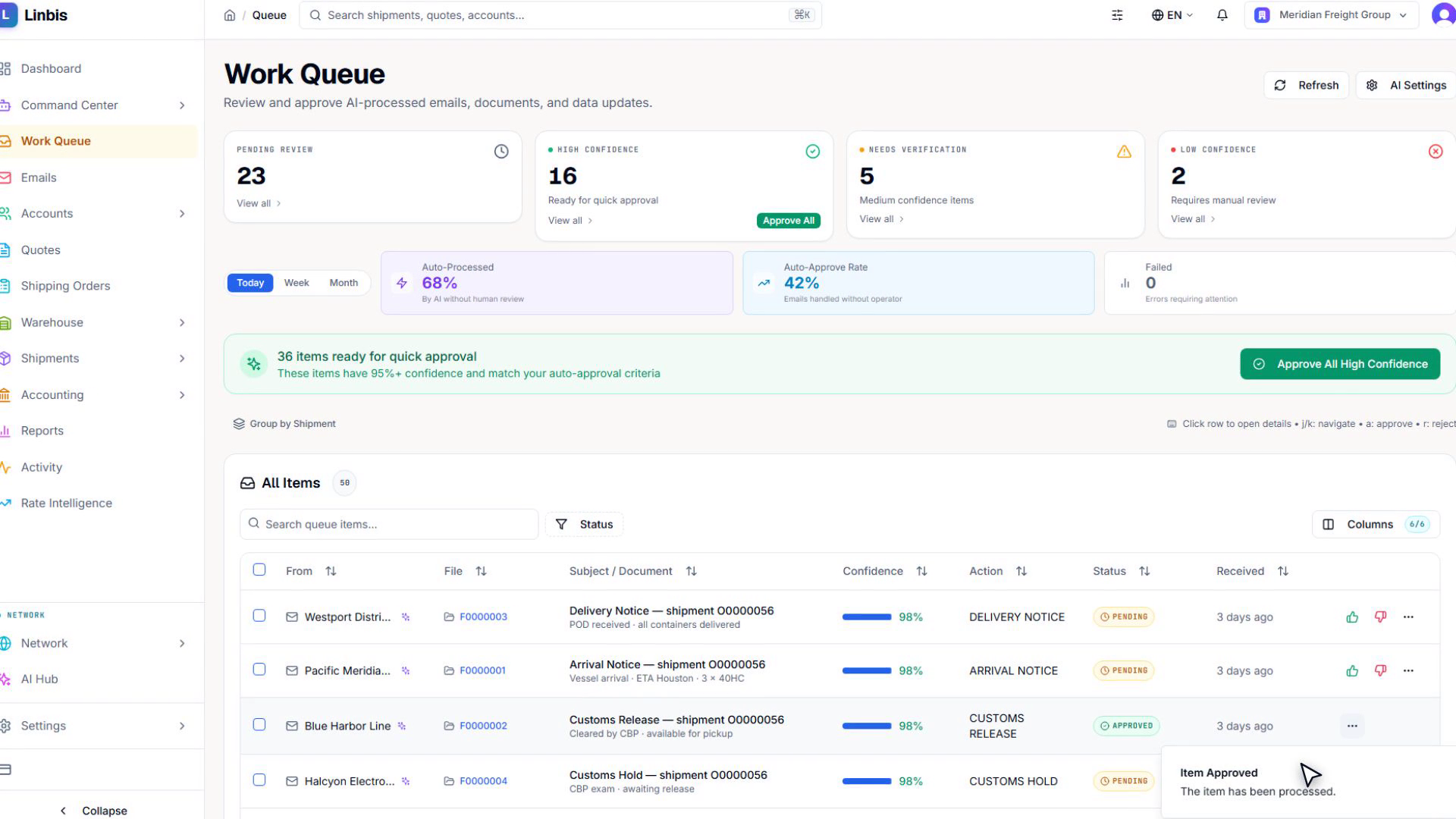
Delivery notices, arrival notices, PODs, and carrier paperwork arrive by email — Linbis reads them, extracts the data, and stages updates for approval in the work queue. High-confidence items approve in bulk; exceptions wait for a person.
Frequently asked questions
What is ground shipping software for a forwarder?
Software that runs LTL and FTL files the forwarder’s way: house shipments consolidated onto linehauls under a master BOL, freight-class math, multi-leg moves, drayage reconciliation per container, and per-house profitability.
What is the difference between LTL and FTL?
FTL (full truckload) dedicates the truck to one shipment. LTL (less than truckload) shares the truck among shipments — which is where consolidation, freight class, and per-house cost allocation decide whether the move makes money.
What is a master BOL?
The bill of lading for the consolidated linehaul itself, with house BOLs underneath for each customer’s cargo — the ground equivalent of ocean’s MBL/HBL structure. Linbis generates both levels from the file.
What is freight class?
The NMFC-based category LTL carriers use to rate freight, driven largely by density (weight against cubic feet). Getting the class right per shipment is the difference between the quoted rate and a reclassification surprise on the invoice.
Does Linbis handle drayage?
Yes — drayage and trucking rates with container-level reconciliation: quoted versus charged per box, suggested rate cards, and corrections that persist.
Ground freight with the math done
Consolidated linehauls, both BOL levels, class and density visible, drayage reconciled to the box.
Start Free TrialThe screens and clips on this page are the real Linbis product recorded on a demonstration company; workflows shown are production features.